EFJ workshop discusses EU policy for journalists
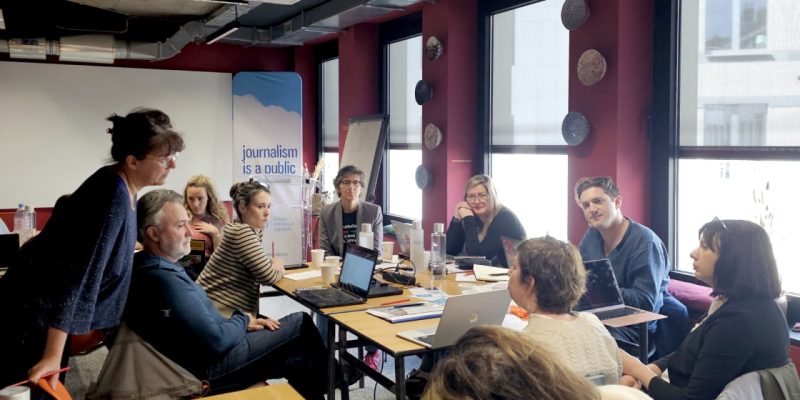
From 4-5 June 2026, the European Federation of Journalists (EFJ) hosted a two-day workshop focusing on EU legislation impacting media freedom and the digital environment. Around 40 journalists, journalists’ representatives, experts and policymakers gathered in Brussels to discuss the application in practice of key European legislation for journalists and the media sector as a whole.
“Today we’re here to exchange experiences, strengthen our advocacy and ensure that media freedom does not remain a beautiful phrase in European legislation, but become something that journalists actually feel in their everyday work,” said Maja Sever, President of EFJ, in her opening remarks.
Key legislation such as the European Media Freedom Act (EMFA), the Anti-SLAPP Directive, the AI Act, and the Digital Services Act (DSA) were thoroughly discussed with leading experts.
Putting EMFA to work
How can we make the most of the European Media Freedom Act (EMFA) despite the lack of political will? Strategic litigation offers a way forward: anyone can challenge government inaction in court, as Member States have a duty to act. Pierre Dagard, Head of Advocacy at Reporters without Borders (RSF), presented the NGO’s joint action with the French journalists’ unions (SNJ and SNJ-CGT) before the French Council of State to denounce the non-application of the EMFA, particularly in the case of LVMH’s acquisition of Challenges magazine, several months after the EMFA’s entry into force. The role of the new Media Board, an independent advisory body bringing together national media regulators, was also presented as a key lever in convincing Member States to take action. In Belgium, the IPM-Rossel merger is currently being reviewed by the Media Board.
Sabine Verheyen (EPP, Germany), European Parliament’s First Vice President, who had been rapporteur of the EMFA as former chair of the Culture Committee and now chair of the EMFA implementation working group, assured that the European Parliament would also scrutinise all Member States and remind the European Commission, as the guardian of the treaties, of its duty to insist its being done right and if not, use the Commission’s power to initiate infringement procedures. Commission’s representative Anna Herold, Head of Unit for Audiovisual and Media Policy at the European Commission, confirmed that 17 EU countries had already received administrative letters, the first step of the infringement process, while Hungary has received a formal notice and Slovakia is currently subject to a pre-infringement dialogue for failing to apply certain provisions of the EMFA.
Risks and opportunities of AI
Artificial intelligence continues to gain prominence, bringing both opportunities and challenges for journalists. Iva Nenadić and Roberta Carlini highlighted how AI companies have been relying on journalistic content to train their models, raising issues about copyright and transparency. MEP Tiemo Wölken (S&D, Germany) presented the European Parliament’s recent work on AI and Copyright, which resulted in the adoption of a report urging the European Commission to propose new mechanisms that ensure the fair remuneration of publishers and journalists, as well as an opt-in system that gives journalists full control over their content. Wolken emphasised the Parliament’s commitment to protecting independent creators from the unauthorised use of their content by AI companies.
Ena Bavčić and Elodie Vialle also explored how lessons learned from the implementation of the DSA can be used to shape the future AI policy and protect journalists in the face of Big Tech companies.
At the same time, newsrooms are increasingly using AI to boost productivity, improve access to content archives and promote more diverse reporting. Some have already developed tools that can rapidly scan documents, identify overlooked perspectives and sources in their reporting, and suggest potential follow-up stories. However, this raises the risk of increasing inequalities in the media sector, as smaller publishers lack the resources needed to access advanced AI tools.
Curbing SLAPPs
Active members of the Coalition against SLAPPs in Europe (CASE) Sielke Kelner and Charlie Holt explained what’s in the Anti-SLAPP Directive – still not transposed in many Member States – and Council of Europe (CoE) Recommendations, and discussed how to use these two important pieces of legislation together to advocate for robust national laws. Trial monitoring, legal support and legal analysis of cases by third-party (such as CASE) in light of the CoE indicators were presented as effective strategies to concretely support journalists and media outlets. SLAPPs are usually part of broader harassment campaigns, including verbal attacks, smears, and threats, and any advocacy efforts must integrate this comprehensive approach.
Participants shared key takeaways from the workshop including the need to build wide coalitions to counter the many threats the journalism sector is facing throughout Europe. Drawing on their experiences, speakers Charlie Holt, Laura Becana Ball and Giacomo Bonetti shared lessons on building collective power and how journalists’ unions can use EU legislation to their advantage. They emphasised that while building and managing coalitions requires sustained effort and coordination, they remain some of the most effective ways to advocate for journalists’ rights. Diverse coalitions are effective vehicles for campaigns because they bring together different perspectives and expertise. Key strategies for successful coalition-building included starting with what is needed, not what we think policymakers want to hear, and being both constructive and confrontational when necessary.
“Amid growing uncertainty in journalism, our imperfect yet cherished democracies, and the future of the European Union, we all valued the chance to unite, exchange expertise, and strategize on collaboration, ensuring we stand resilient against the encroachment of Big Tech and AI. The shared exercises on breathing and movement were a welcome addition, helping us to focus and avoid being overwhelmed by the many challenges ahead,” said Renate Schroeder, Director of the EFJ, expressing gratitude for the EU’s support.
The workshop was organised under the framework of the IMPACT project, which promotes advocacy, training and support to our members to strengthen the rights of journalists and journalists’ associations in Europe. It provided participants with an opportunity to exchange views and share lessons, empowering them to better advocate for journalists’ rights both at the European and national level.
The Independent Media Promoting Accountability, Community, and Trust in European Democracy (IMPACT) project will run from 1 January to 31 December 2026 and is funded by the European Union. Views and opinions expressed are however those of the EFJ only and do not necessarily reflect those of the European Union or EACEA. Neither the European Union nor the granting authority can be held responsible for them.