European Federation of Journalists

Stand Up for Journalism

The media industry in Europe has been experiencing and adapting itself to a sea of changes in the past decades due to the digital transformation. While the media industry has adapted to these challenges, the situation took a drastic turn following the Covid-19 pandemic in 2020 and the industry has been severely hit. While the pandemic has accelerated these changes rapidly, journalists, the media, and journalists’ unions are yet to catch up with and adapt to the changes.

Against this background, this project has its general objectives to improve the capacity of national journalists’ unions and associations in addressing challenges brought by the digital transformation in the media; and the compounding impacts of Covid-19 pandemic as well as the recent economic, social and political crisis brought by the Russian-Ukraine war.

Fair and decent working conditions are far from the reality without stronger journalists’ unions and associations to defend the rights of journalists. Therefore, the focus of the project is on the capacity of journalists’ unions in collective bargaining, workers’ representation (especially freelance / atypical workers), and engaging in social dialogues. The target groups are journalists’ unions and associations in the EU and candidate countries.

These objectives will be achieved through four main activities :

1) A series of 5 thematic, capacity-building workshops. The themes of the workshops will focus on:

  • Collective bargaining in times of crisis (Istanbul, Turkey) – 23 – 24 September 2024
  • Equal rights for freelances (Vichy, France) – 23 – 24 January 2025
  • Online harassment and better protection of journalists (Belgrade, Serbia) – 31 March – 1 April 2025 
  • Well-being and burnout in journalism (Namur, Belgium) – 16 – 17 June 2025
  • Organising in the age of AI (Copenhagen, Denmark) – 6 – 7 November 2025
  • Final conference (Montenegro) – 26 – 27 March 2026

2) National capacity building-programmes with national partners who are chosen for their regional representativeness: NUNS (Serbia), TUMM (Montenegro), DJ (Denmark), TGS (Turkey), SNJ-CGT (France), AJP (Belgium). It aims to improve the capacity building of the partners with tailor-made programme to their needs. The national partners will produce and implement a national capacity-building plan focusing on key strategic issues (i.e. collective bargaining, organising/recruitment or social dialogue).

3) Two research studies. The objective is to identify relevant cases of European journalists who have experienced online harassment on online social platform and developing good practices and recommendations on the topics of mental health and burnout in journalism and online harassment to open social dialogues with online social platforms, policymakers, media managers and trade unions.

4) A final conference for a wider European exchange and dissemination.

Logo


This project is funded by the European Union. Views and opinions expressed are however those of the author(s) only and do not necessarily reflect those of the European Union. Neither the European Union nor the granting authority can be held responsible for them.

Actions

Stand Up for Journalism: New report urges recognition of online harassment as a systemic professional risk

On the occasion of the International Day for the Elimination of Violence against Women, the European Federation of Journalists (EFJ) is releasing a new report “Ending the Silence on Online Harassment of Journalists”. Authored by journalist and tech policy advisor Elodie Vialle, the report provides an overview of the widespread phenomenon that is online harassment targeting journalists, whose normalisation makes it harder to address. It documents trends, identifies key challenges, highlights good practices, and offers actionable recommendations for all actors – journalists’ unions and associations, newsrooms, social partners, policy makers, as well as online platforms – to take action to…

SUJ: EFJ workshop discusses future of journalism and workers’ rights in the age of AI

The European Federation of Journalists (EFJ) on 6-7 November 2025, the fifth Stand Up for Journalism workshop aimed to discuss the impact of Artificial Intelligence (AI) in journalism, addressing youth and unions’ strength in shaping the future of the profession.  The event took place in Copenhagen, Denmark, currently holding the presidency of the Council of the European Union. Torsten Asbjørn Andersen, Deputy Permanent Secretary at the Ministry of Culture, opened the workshop with his keynote speech on the Copenhagen Declaration that was signed on 4 November on the importance of independent media and culture in Europe (1).  It is expected…

Stand Up for Journalism: New report calls for stronger mental health frameworks in media organisations

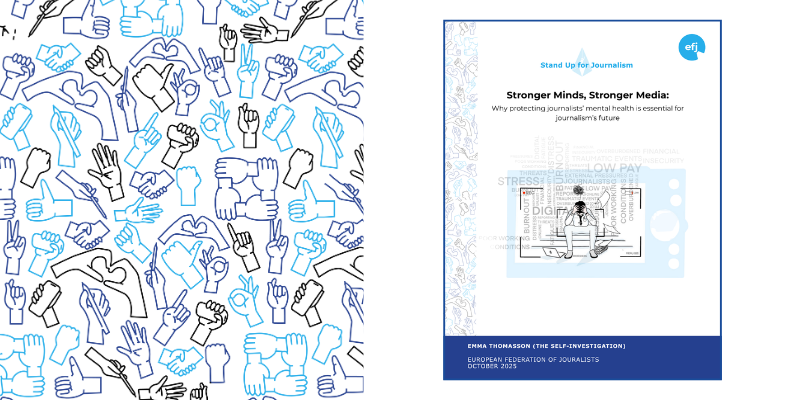
Today the European Federation of Journalists (EFJ) and The Self-Investigation release a new report entitled “Stronger Minds, Stronger Media: Why protecting journalists’ mental health is essential for journalism’s future”. This research collects good practice examples, provides recommendations to journalists’ representatives, media organisations and helpful resources. The issue of mental health has largely been ignored until recent years in the journalism sector, but more and more studies and evidence show that stress related to a highly competitive work environment, with 24h-news cycle, as well as low pay and job insecurity contribute to mental health problems. It leads to burnout, some leaving…

SUJ: EFJ workshop discusses urgent need to improve journalists’ wellbeing at work

Organised in Namur (Belgium) on 16-17 June 2025, the fourth ‘Stand Up for Journalism’ workshop was dedicated to the mental wellbeing of journalists. The European Federation of Journalists (EFJ), in partnership with its Belgian affiliate the Association des journalistes professionnels (AJP), gathered 35 union representatives and experts from 13 countries to discuss how to support journalists’ organisations in tackling psychosocial risks that are increasingly affecting journalists, such as burnout. Solutions identified include stronger legislative frameworks, development of in-house programs such as peer support, and trainings, especially for managers. Many studies throughout Europe show that journalists are workers at high risk…

EFJ to host workshop on journalists’ wellbeing and mental health in Namur, Belgium

On 16-17 June 2025, the European Federation of Journalists (EFJ) will be hosting a workshop entitled “Mental wellbeing: an invisible crisis in journalism” in Namur, Belgium, as part of the Stand up for Journalism (SUJ) project in partnership with the Association of professional journalists (AJP, Belgium). The workshop will focus on  It will feature insightful speakers from across Europe, including journalists, media professionals, and experts. This workshop is the fourth in a series of five thematic capacity-building workshops. The first workshop was held in Istanbul in September 2024, addressing collective bargaining strategies for freelancers. The second took place in Vichy,…

SUJ: EFJ members trained to address online harassment of journalists

The third ‘Stand Up for Journalism’ workshop was dedicated to the online safety of journalists and took place in Belgrade, Serbia, on 31 March – 1 April 2025. The European Federation of Journalists (EFJ) and the Independent Journalists’ Association of Serbia (NUNS) organised this event to support journalists’ organisations in addressing the rising threats journalists face, particularly online harassment and legal protections in the digital age. It was attended by 30 union representatives from 16 countries. One of the key topics was the increasing danger journalists face on social media platforms in Europe, exacerbated by the evolving digital media landscape.…