Steadfast support for Massimo Moratti, MFRR researcher, as he is facing an expulsion order from Serbian authorities
The European Federation of Journalists (EFJ) joins its Media Freedom Rapid Response (MFRR) partners and the undersigned press freedom and free expression organisations in expressing our firm support for our colleague Massimo Moratti, the Senior Research Affiliate for the Osservatorio Balcani Caucaso Transeuropa (OBCT), as he faces expulsion from Serbia in apparent connection with his human rights work. We urge Serbian authorities to immediately withdraw the expulsion order and allow our colleague to remain in the country with his family and continue his work.
On 4 September, Serbian authorities denied Moratti’s request for temporary residence on grounds of “unacceptable security risks for the country”, ordering him to leave the country within 15 days and imposing an entry ban of one year. Serbian authorities did not provide any additional information regarding the grounds for the decision.
An Italian citizen, Moratti is an experienced human rights advocate who has spent more than 20 years in the region and has been living in Serbia continuously since 2022, when he moved to Belgrade following his partner’s assignment in the country.
Moratti has served as a correspondent for the OBCT media outlet in Sarajevo and later in Belgrade since 2005. From 2011 to 2018, he worked in Serbia on multiple EU projects assisting displaced persons and refugees, as well as potential asylum seekers, while later moving to London to serve as Deputy Director of Amnesty International’s European Regional Office. After relocating back to Belgrade with his family, he joined the MFRR team, playing a crucial role in shaping the consortium’s media freedom advocacy efforts in the Western Balkans.
In late January, Moratti and his family submitted a request for temporary residence to Serbian authorities. In May his partner was granted temporary residence. In June, a formal meeting was scheduled with the Serbian State Security and Information Agency, which questioned him about his current and past professional activities in the country. On 3 September, his partner received a call from the police that notified that the following day Moratti was expected at the premises of the foreign citizens’ department, where he was eventually handed the expulsion order.
With the assistance of his lawyer, Moratti filed an appeal against the Office’s decision on 10 September, and subsequently requested an interim measure from the Administrative Court to suspend the enforcement proceedings, asking the Court to take into account the forced family separation that his expulsion would entail.
While there has been no specific explanation given for the justification of this decision by Serbian authorities, there are grounds to suspect that the removal order is connected to his different roles as a human rights and media freedom advocate, for his reporting for OBCT on the social and political tensions that have been rising in Serbia over the past few years, or for his work within the MFRR consortium.
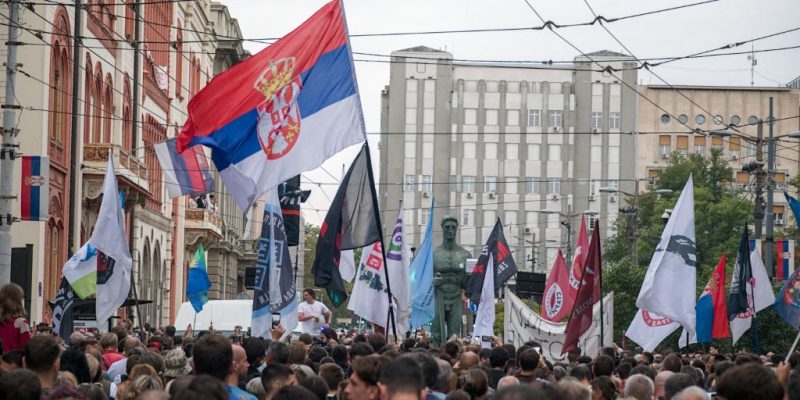
In the last few years, the MFRR and OBCT have documented the deepening slide into what we and others have called a media freedom crisis in Serbia, including escalating physical violence against journalists and the attempt by Serbian authorities to censor or silence independent journalism and critical voices. In this context, the MFRR together with the Council of Europe’s Safety of Journalists Platform conducted its last visit in the country in March 2026, an advocacy mission which was joined by Moratti on behalf of OBCT, and published the mission’s final report in July 2026. This timeline overlaps with the administrative backlash of which Moratti has been the target.
Our organisations consider his permit of stay denial and the expulsion order that was subsequently issued to be a form of administrative harassment intended to intimidate him in retaliation for his work, and for supporting journalists in the country and the broader region.
This permit rejection measure follows a worrying trend. Over the past two years, there have been multiple documented cases in which foreign civil society activists, journalists and human rights advocates in Serbia have had their residence permits refused, revoked, or were expelled and banned from re‑entry, or denied entry in the first instance, often on similarly vague “security risk” grounds. This trend has been documented in the European Commission’s 2025 Rule of Law Country chapter.
The undersigned organisations stand firm in solidarity with our colleague and urge the Serbian authorities to immediately revoke the expulsion order targeting him and to refrain from further forms of administrative harassment, allowing Moratti to live with his family and continue his work in support of media freedom.
As this is a crucial case involving a human rights advocate standing up for media freedom in the country amid a dramatic deterioration in press freedom, the undersigned MFRR partners and free expression organisations will closely monitor the proceedings.
Signed by
- Osservatorio Balcani Caucaso Transeuropa (OBCT)
- European Federation of Journalists (EFJ)
- European Centre for Press and Media Freedom (ECPMF)
- Free Press Unlimited (FPU)
- ARTICLE 19 Europe
- International Press Institute (IPI)
- Index on Censorship
- Reporters Without Borders (RSF)
- Balkan Free Media Initiative (BFMI)
- International Federation of Journalists (IFJ)
This statement was produced by EFJ as part of the Media Freedom Rapid Response (MFRR), a Europe-wide mechanism which tracks, monitors and responds to violations of press and media freedom in EU Member States and Candidate Countries.