The EFJ supports the Dutch class action lawsuit against Meta
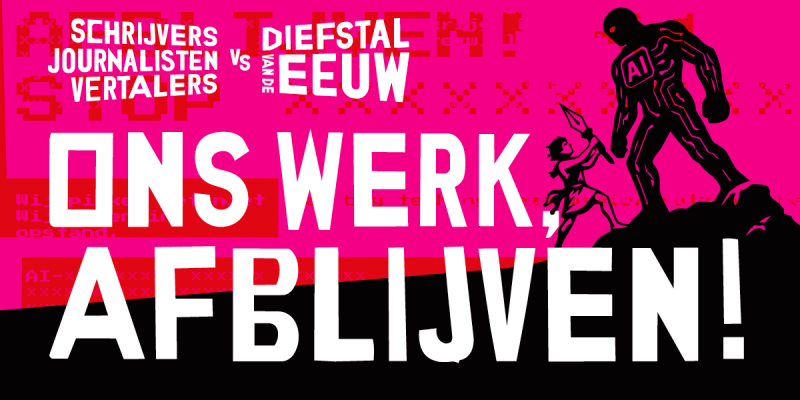
Today, Tuesday 29 September at 10:00, our Dutch affiliate NVJ, the collective management organisation Lira Foundation and the Dutch authors’ union Auteursbond are calling on freelancers to demonstrate in front of Meta’s Dutch headquarters in Amsterdam. The leadership of the European Federation of Journalists (EFJ) will be holding a similar event this lunchtime in Brussels.
Meta is using the work of freelance journalists, writers and translators to train its AI models, without consent and without pay. The Dutch organisations are preparing a collective lawsuit against Meta. Their aim is a collective agreement with AI companies that ensures fair pay, gives creators control over their texts and makes tech companies transparent about how they use people’s creative work.
The EFJ stands firmly with NVJ. Journalism is not free raw material for Big Tech. “Without proper regulations regarding usage, our role as journalists and writers is being marginalised. This leads to a society with less independent journalism and fewer real stories. We cannot let that happen,” said Thomas Bruning, NVJ general secretary.
“Meta does not merely steal content that does not belong to it in order to profit from it,” added EFJ President Maja Sever. “Through its actions, the American company that owns Facebook, Instagram, WhatsApp and Threads is undermining journalism and citizens’ right to access free, independent and pluralistic information.”
We are reprinting here, with his permission, the opinion piece published on Monday by the NVJ’s president, Folkert Jensma, in the daily newspaper NRC:
————————
We must stop Big Tech before it fully colonizes public space
Journalist Folkert Jensma doesn’t actually like demonstrating. But now that technology giants are throwing the fruits of journalism into the blender of their AI models with impunity, and thus contributing to the downfall of democracy, he has no choice.
On Tuesday, I will be standing in front of the Amsterdam office of tech giant Meta with fellow journalists and writers. With a banner featuring slogans like ‘Theft of the century’ and ‘Our work, keep your hands off!’.
I’m already dreading it.
I’m not really into angry protest clichés; as a journalist, I’m used to standing on the sidelines. Just observing a bit, noting down impressions, and then interpreting them, preferably at home. But then I shouldn’t have become a board member of the journalists’ union NVJ. Now I’m the one paying the price, even after decades of fairly well-paid journalism. Thanks for that, reader and advertiser. But Meta and her ilk are busy destroying our role in democracy. It’s not too late to prevent that yet, but the pace at which things are going wrong is breathtaking.
Everything I have typed over the past forty-plus years has been sucked up by Big Tech behind my back and shredded across all sorts of large language models. And now it comes out again on demand as AI mush. I can now easily, and above all for free, ask Copilot or Gemini to rewrite this piece ‘smoother’, ‘shorter’, ‘simpler’, or ‘more in the style of Folkert Jensma’. Which subsequently happens.
It is just like running into a digital replica of yourself in a psychiatric institution, in the hallway or inside your head. One that first completely copied your work and is now correcting it, in your own writing style. Am I hearing voices, seeing ghosts, or is it me after all? What comes out of such a question to AI is, of course, soulless trash. But the only one who might still recognize himself in the shredder pulp is presumably myself.
Bunch of crooks
On that square in front of the Meta office, I argue, partly on behalf of the professional body, that this is a brazen theft, a colossal copyright infringement. Everyone can get that. Money back, you bunch of crooks! After that, we go to court to obtain recognition in an expensive and endlessly slow substantive trial. In a subsequent, equally cumbersome ‘damages assessment procedure,’ the extent of the damages suffered is then determined. And so on, et cetera. Or Meta backs down and settles for 100 million or so; that is of course also possible. But that doesn’t solve the problem. And I am rich enough not to even need that money.
Sorry for stating the obvious, but in a democratic constitutional state, you need a free press and a free domain for writers, artists, translators, and scientists. Who decide for themselves about their own work – who may ‘possess’, exploit, publish, and distribute it. The (European) judiciary guards the boundaries in this process, once beautifully summarized as the right ‘ to shock, offend, and disturb .’ Shocking, offending, and disturbing. So, that is allowed. I’ll repeat it, because this phrase has been evaporating for a while now.
At Meta, things are certainly not in good hands. A cheerfully ironic video by satirist Roel Maalderink and civil rights group Bits of Freedom about Meta’s AI glasses (‘very privacy-friendly!’), filmed with unsuspecting Meta employees, was promptly removed from Instagram – owned by Meta. Reason: contrary to the guideline against ‘bullying and harassment’. That is, inadvertently, humorous. But Meta is clearly not a company that will ever guarantee freedom of expression, while it continues to grow ever more powerful.
Paying for journalism is becoming the same as donating to Natuurmonumenten: socially conscious charity
What is really going on here: the large-scale corruption of public space by Big Tech. A takeover of the most important domain of the democratic rule of law. The space in which the citizen can freely inform themselves, safely disagree with others, find reliable, falsifiable information, have diverse, recognizable sources at their disposal, expose themselves within self-determined boundaries, and also make mistakes or errors without facing lifelong consequences.
So all of that is being lost. The digital world is rapidly becoming a dark subculture from which minors must be urgently kept away, and in which adults run the risk of being deceived, or at least misled.
And that therefore has serious consequences for the functioning of democracy. Look at parliament, where polarization, extreme views, and an inability to listen to one another are rewarded. With a society in which young people have come to support predominantly anti-democratic parties, reject homosexuality more often , and a phenomenon like the manosphere is on the rise.
We journalists also notice that our publishers have become empty shells. Once they were the custodians of the revenue model, guardians of the ‘Chinese Wall’ between commerce and journalism, and skilled managers of distribution. ‘Newspaper publishers’ were just as much beacons of free journalism as their editors-in-chief.
That is now disappearing. By now, journalistic media have hardly any say left over their distribution, the prioritization of news, or even its presentation or description. The new back office is Big Tech, which supplies the hardware, software, and digital platforms on which media and democracy now depend. TikTok has become a journalistic format that can no longer be ignored. Social media now spread the news – the ‘newspaper’ has fallen apart into a thousand pieces and struggles with the task of explaining the added value of journalism. And subsequently, leading the citizen to the paywall. Paying for journalism is becoming the same as donating to Natuurmonumenten: socially conscious charity.
Anonymous miners
The classic revenue model of journalism is therefore in decline. Advertising revenue goes mainly to California, and proprietary news websites are rapidly becoming obsolete. Today, the average media user says aloud to their smartphone: “What is the latest news?” and is done. AI reads out a summary, cobbled together in half a second from countless sources, which then no longer need to be visited. Journalists have been devalued to anonymous miners. Their publishers have been bypassed. What remains now is a rear-guard battle—for the Meta office, that is.
But do not despair. Surely citizens – media consumers – and politicians will realize that one cannot accept the removal of serious journalism from democracy with impunity? Especially if it is replaced by the fueling of hateful, emotional, and inflammatory messages via anonymous algorithms? If that means that anger and distrust are stoked and the polder model, including the social contract, is crushed? The Netherlands will then turn into a low-trust desert, in which trust in one another, in governments, political parties, and institutions such as the judiciary, the police, and the free press plummets.
Surely something like that won’t happen? Right?
Folkert Jensma is a columnist and former editor-in-chief of NRC. He is chairman of the Dutch journalists’ union NVJ.