EFJ advocacy meeting in Hungary: the challenges of rebuilding independent media after years of capture
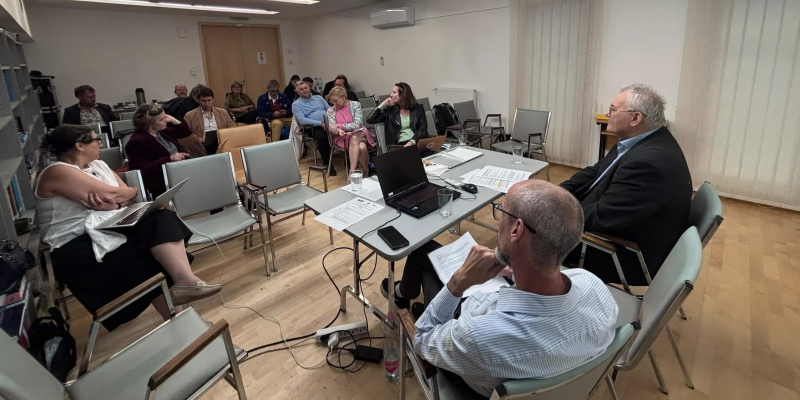
On 6-7 of October 2026, the European Federation of Journalists (EFJ) conducted an advocacy meeting as part of the IMPACT project funded by the European Commission. Together with our Hungarian affiliates, the Hungarian Press Union (HPU) and the Hungarian Association of Journalists (MUOSZ), a series of conversations with major stakeholders dealing with the transformation in media were held to evaluate the state of the country’s media landscape after 16 years under Viktor Orbán’s government, and look ahead of what needs to be done to create a truly independent media landscape in Hungary.
“Independent media survived Orbán’s government through the support of citizens, donors and international organisations, and played a crucial role in presenting unbiased information in the context of a repressive regime. Today, a new paradox emerges: with the recent political changes, there is a sense that the support previously given to Hungarian journalism is no longer necessary. We believe that this is precisely the moment when we must ensure that the basis for a lasting pluralistic media environment is set by building financially viable, pluralistic and editorially independent newsrooms”, said EFJ President Maja Sever, who joined the event together with Vice President Pablo Aiquel from Spain, several journalists’ organisations from the neighbouring countries and Finland, as well as the IPI, RSF and Liberties.
The discussion led to concrete conclusions on what strategy must be followed to heal the damage caused to Public Service Media during the Orbán regime, and how to train information professionals on media integrity in a shifting environment.
Rebuilding Public Service Media
One of the main themes of the conference was the transformation process of Hungary’s public media after more than a decade of political capture. Participants debated the challenges that come with creating an independent governance structure, rebuilding professional standards and, most importantly, regaining public trust and creating a lasting structure that is resilient to future potential illiberal actors.
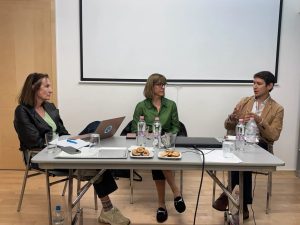
Judit Bayer, the chairperson of the newly established Independent Public Media Board outlined plans to create a modern, digital-first public service media system with stronger safeguards against political interference. Judith Grosz, Ministerial Commissioner for Public Media presented the ongoing institutional and financial audits of Orban’s propaganda machine, the former PSM in Hungary. The meeting agreed that rebuilding trust will be the hardest challenge, with plans to reform the public service media demanding additional measures to guarantee editorial independence and sustainable funding models.
It is vital to implement the European Media Freedom Act (EMFA) in order to address current shortcomings and establish effective safeguards against media capture, with journalists’ organisations being actively involved. And the meeting was impressed by the quick way of addressing the major challenges of decapturing the media regulatory authority and the PSM, though with a lack of public consultation.
Sustainability for independent media
Now that political repression from the previous government is not the main point of discussion, media outlets in Hungary are forced to reckon with the complicated challenges for the economic viability of the information sector.
It is undeniable that the environment for editorial independence has noticeably improved, but there are clear obstacles to protect the financial sustainability for media companies. Market concentration, limited advertising revenue and financial uncertainty threaten the livelihood of journalists. Local journalism is especially vulnerable in Central and Eastern Europe, with news deserts growing across the region and preventing many communities from having access to quality information.
Strengthened representative organisations for journalists
Representatives of HPU and MUOSZ spoke on ongoing efforts to rebuild membership, improve working conditions and address the growing fragmentation of the journalistic landscape.
Freelancers, self-employed journalists and creators outside of traditional working structures often lack bargaining power and adequate protections. There is a necessity for improved professional training and legal support, as well as a need for journalists’ organisations to evolve into service-oriented institutions that provide representation, professional development and community. Strengthened cooperation among journalists’ organisations in Central and Eastern Europe is an urgent goal, as problems are similar, and capacity building a must.
Solidarity across different sectors
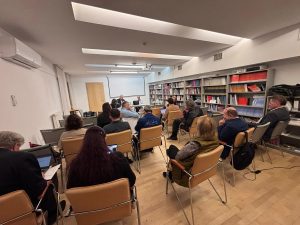
Hungary’s experience demonstrates both how quickly media freedom can be weakened and how complex its reconstruction can be. Rebuilding independent journalism, strengthening Public Service Media and setting the appropriate conditions for a pluralistic information landscape will require long-term commitment from journalists, policymakers, civil society, academics and European institutions.
The event was organised under the framework of the IMPACT project (Independent Media Promoting Accountability, Community and Trust in European Democracy), which supports advocacy, training and capacity-building initiatives to strengthen journalists’ rights, media freedom and democratic resilience across Europe.