
AgoraEU: Why Europe Must Stand Up for Funding Civil Society
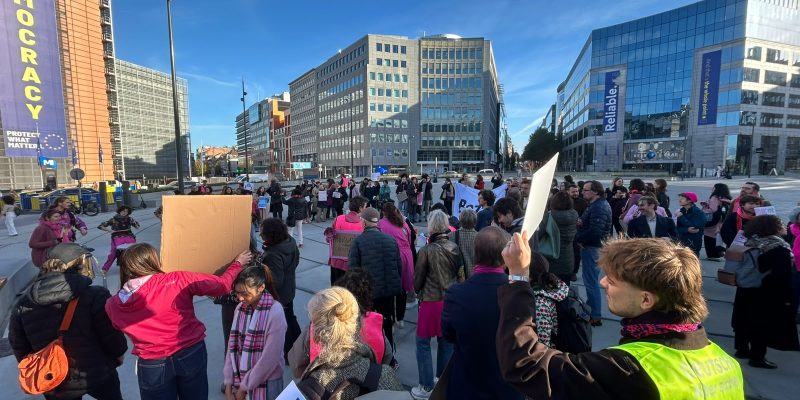
“Strong culture, free press! Democracy deserves no less!”: These words from EFJ Director Renate Schroeder’s closing remarks were echoed by the many attendants who gathered together earlier today, including over 150 journalists, artists, cultural workers, and civil society representatives to peacefully protest a proposed 30% cut to AgoraEU, the EU’s core programme for culture, media, and fundamental values for the 2028-2034 budget period.
The demonstration, organised jointly by Culture Action Europe, Civil Society Europe, the European Civic Forum, and the European Federation of Journalists (EFJ) in partnership with the Future of Europe cohort, sent a resounding message to EU leaders negotiating the multi-year financial framework: Democracy deserves no less than a strong cultural sector and a free press.
A Disproportionate Cut to Critical Infrastructure
Under the Irish Presidency’s budget proposal, funding for AgoraEU would be slashed from €8.6 billion to €6 billion. While this 30% reduction represents a minuscule 0.2% saving for the overall EU budget, its impact on the ground would be devastating—resulting in a third fewer books in libraries, a third fewer independent films, and a third fewer independent media outlets across the continent. Protesters and organisers are demanding that EU institutions reverse this cut and secure at least €10 billion for culture, media, and civil society.
Speaking at the rally, EFJ Director Renate Schroeder highlighted the fundamental importance of funding independent journalism as a public good, referencing the European Commission’s own motto:
“If ‘Democracy. Protect what matters’ is not meant as marketing but a serious attempt to promote the EU’s values, the EU, including its 27 Member States, should financially support journalism as critical infrastructure and a public good.”
Schroeder pointed to recent democratic victories, such as the recent electoral victory in Serbia, to demonstrate the vital role played by independent reporting:
“The Student List, together with the independent media, which had been fiercely attacked in recent years, has won. That gives us some hope, but it is also a reminder that we need accountability, independent and innovative reporting not least to fight against disinformation and corruption at local, regional, national, and international level.”
In her address, she further warned against the danger of allowing local newsrooms to disappear:
“When local newsrooms close, nobody covers the town council, the hospital board or the local election. That gap gets filled by rumour, spin and disinformation. Journalism is how citizens hold power to account… Europe can’t defend its democracy and underfund it at the same time.”
Broad Alliance Across Civil Society and Parliament
The rally brought together a wide alliance of cultural and democratic defenders. Lars Ebert, Secretary General of Culture Action Europe, stressed that civil society will not accept the dismantling of European creative and journalistic infrastructure:
“What this cut means is one third less books in our libraries, one third less movies being produced, one third less independent media outlets… And we will not accept that.”
Support was also expressed from within the European Parliament. MEP Nela Riehl, Chair of the Parliament’s Committee on Culture and Education, pledged full backing for the sector, warning against using national security arguments to defund civic space:
“I will continue to stand with you… Tanks won’t stop disinformation. When local journalism and civil society loses, democracy also loses.”
Uniting to Protect European Democracy
Today’s action was a vital reminder that workers across Europe’s civil society, cultural, and media ecosystem must unite. As EU leaders prepare to finalise budget negotiations in the coming weeks, the EFJ and its partners will continue demanding that European institutions protect the foundational pillars on which democratic life is built.





