Voices Podcast: Ukraine-Palestine discussion on award-winning Solidarity Centres supporting journalists during war
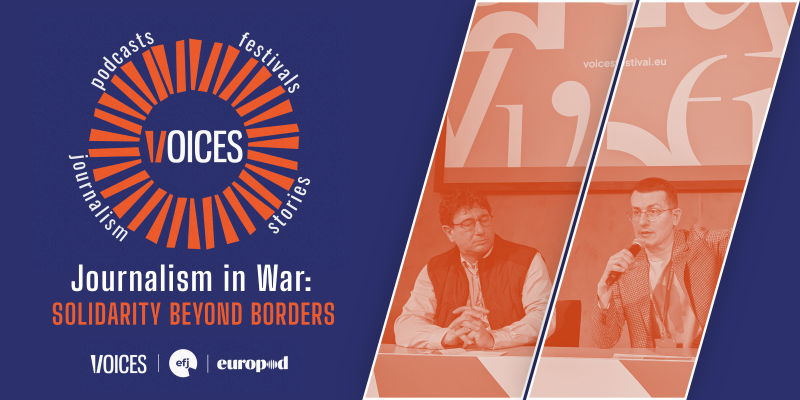
The European Federation of Journalists (EFJ) with Europod released their first episode of the Voices podcast “Journalism in War: Solidarity Beyond Borders”. Recorded in March during the third edition of Voices Festival, it explores the challenges journalists face when reporting from conflict zones and the structures that have been established to support them.
At this year’s festival, Voices presented the Media Freedom Award to the National Union of Journalists of Ukraine (NUJU) and the teams behind the network of Journalists’ Solidarity Centres. These hubs were developed as a response to Russia’s full-scale invasion of Ukraine in 2022, to provide journalists essential services such as electricity, internet connection, food, and safety equipment. They have become safe spaces where journalists can regroup, coordinate, and keep reporting despite extreme conditions.
“We were unprepared for the full-scale invasion. We had only one bullet-proof vest located in Kyiv, but it was not enough for hundreds of Ukrainian journalists,” said NUJU president Sergiy Tomilenko. “We don’t know what challenges tomorrow will bring. But we know journalists must not feel alone, this is why the Centres exist.”
This model has also been adopted in other conflict contexts, including Gaza. In the podcast, Yousef Habache from the European Branch of the Palestine Journalists Syndicate explains how three of these hubs have already been installed under highly constrained conditions. Operating in tents due to the severe destruction of infrastructure, they allow journalists to charge their equipment and continue working even under severe threat.
“Sometimes we are afraid that those centres can be attacked, directly targeted by the Israelis,” said Habache. “We have lost, in these 2 years, around 260 journalists. We call it mediacide.”
The situation in Ukraine and Gaza has shown that, during conflict, journalism does not depend only on individuals, but on the systems that support them. The Solidarity Centres require continuous funding to maintain their activities. They are currently supported by international networks of journalists, including the European and International Federations of Journalists (EFJ-IFJ).
“Journalists are brave, but it’s not enough,” said Tomilenko.