Czech Republic: Public media funding bill raises concerns over compatibility with EMFA
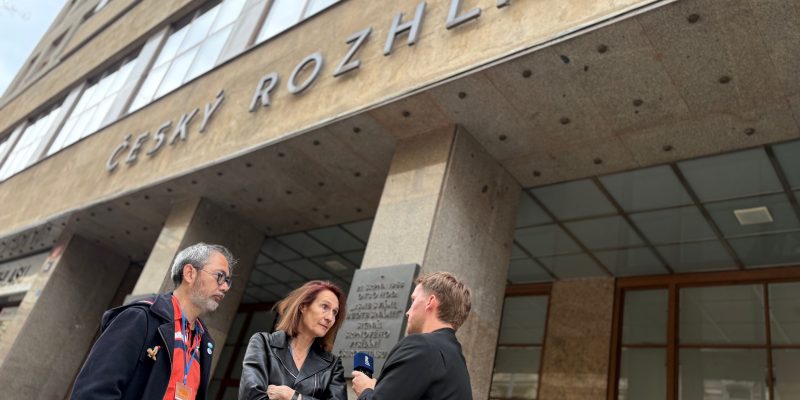
A new government bill which would overhaul the funding model for the Czech public media risks financially weakening the broadcasters, eroding safeguards for their financial independence and violating European Media Freedom Act (EMFA), the undersigned Media Freedom Rapid Response (MFRR) partners, the European Federation of Journalists (EFJ) and other media freedom, journalist and freedom of expression organisations warn today.
Our organisations call on the European Commission to closely assess this bill regarding its compatibility with Article 5 of EMFA and to ensure that no reforms are undertaken which threaten the financial, editorial or institutional independence of the Czech public media.
On April 14, Czech Minister of Culture Oto Klempíř presented the new bill, which fundamentally changes the funding model of Czech Television (ČT) and Czech Radio (ČRo). The proposed law would abolish the current system of licence fees, replace it with direct funding from the state budget, and significantly reduce the amount of funding for both broadcasters.
Under the proposal, funding would be set at a fixed amount and annually adjusted in line with inflation, up to a cap of five percent, while both institutions would fall under the oversight of the Supreme Audit Office. According to the bill, the two institutions would not be merged, contrary to earlier announcements, and their supervisory boards would remain unchanged.
ČT would receive CZK 5.7 billion (€233 million) annually from the state, down from roughly CZK 6.7 billion (€274 million) in licence-fee income, while ČRo’s funding would fall from CZK 2.5 billion (€102 million) to just over CZK 2 billion (€82 million), effectively reversing the fee increase introduced by the previous government.
While the government points to similar funding models for other public media across the EU, ČT and ČRo have strongly opposed the plan, warning that the bill would open doors for “legal uncertainty, external pressure, and the weakening of editorial autonomy”.
A separate parliamentary proposal announced on 21 April is expected to exempt the above-75 age group and companies with less than 50 employees from paying license fees as of late 2026, as a transitional step ahead of the abolition of licence fees. But details on this secondary bill remain unclear due to lack of agreement within the ruling coalition.
Our organisations are concerned that the parliamentary bill has been developed without proper consultation with ČT and ČRo, as well as media experts, civil society policy stakeholders, or international media freedom groups. Prime Minister Andrej Babiš and his coalition partners vowed before being reelected to merge ČT and ČRo and replace the licence fee with direct financing from the state budget. These proposals follow previous hostility towards public media by Babiš, and efforts under previous ANO-led administrations to weaken the safeguards protecting Czech public media’s independence.
ČT and ČRo are recognized within Central Europe as models of quality public-service broadcasting. For over three decades, both institutions have served as trusted broadcasters, reaching some of the largest audiences in the Czech Republic. The licence fee model, widely perceived as an effective and well-functioning system in the Czech Republic, has been a crucial guarantee of their financial sustainability and editorial independence.
Our organisations fear therefore that a motivation behind the announced changes is to weaken the broadcasters’ financial and editorial independence and compromise their ability to fulfill their public service remit.
Article 5 of the European Media Freedom Act (EMFA) requires all EU Member States, including the Czech Republic, to ensure the funding procedures of public broadcasters “are based on transparent and objective criteria laid down in advance” and broadcasters are provided with “adequate, sustainable and predictable financial resources corresponding to the fulfilment of and the capacity to develop within their public service remit”.
Our organisations call on the European Commission to closely monitor developments, examine the bill in light of the Article 5 of the EMFA, and urge the Czech authorities to refrain from making any changes to the funding system of the public media which weaken or erode financial, editorial or institutional independence.
These proposed changes represent a crucial test of the EMFA’s safeguards for the independence of public service media. The EU should use all tools at its disposal to prevent authorities in the Czech Republic from destabilising public media and increasing government leverage.
Signed:
- International Press Institute (IPI)
- IPI National Committee in the Czech Republic (CZ IPI)
- European Federation of Journalists (EFJ)
- Syndikat novinaru Ceske republiky
- Osservatorio Balcani Caucaso Transeuropa (OBCT)
- European Centre for Press and Media Freedom (ECPMF)
- Free Press Unlimited (FPU)
- ARTICLE 19
- Index on Censorship
- South East Europe Media Organisation (SEEMO)
- Association of European Journalists (AEJ)
- PEN International
- Public Media Alliance (PMA)
- European Broadcasting Union (EBU)
- Reporters Without Borders (RSF)
This statement was produced as part of the Media Freedom Rapid Response (MFRR), a Europe-wide mechanism which tracks, monitors and responds to violations of press and media freedom in EU Member States and candidate countries.