Georgia: An escalating media freedom crisis
Since the contested parliamentary elections in October 2024, Georgia has experienced one of the most rapid and serious deteriorations of press freedom ever seen in an EU member state or candidate country, Media Freedom Rapid Response (MFRR) partners warn today.
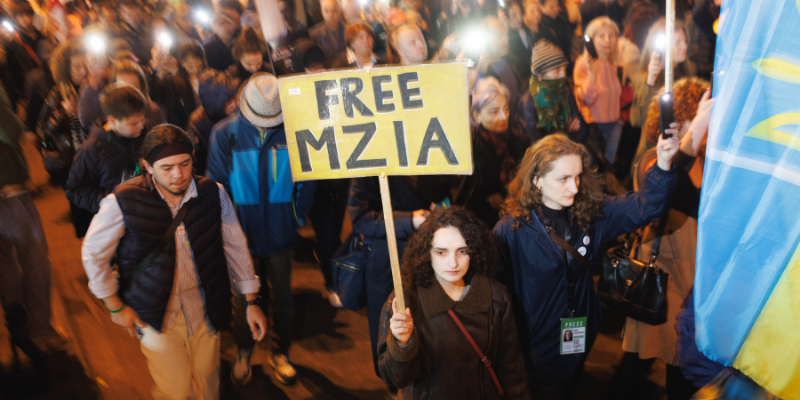
As we mark World Press Freedom Day 2026, the European Federation of Journalists (EFJ) and its partners once again draws attention to the plight of independent media and journalists in Georgia, where the Russia-friendly ruling party has continued its intensifying clampdown over the past year. Our thoughts today are particularly with jailed journalist Mzia Amaglobeli, who has now been behind bars for one year and three months on politically motivated charges.
The Georgian Dream’s erosion of media freedom has been a driving factor in the unprecedented period of democratic backsliding in the country, which on paper remains a candidate for EU accession. Today, our organisations again call for urgent action from the European Union and the international community to support independent media and hold those responsible for this autocratic assault to be held accountable.
Legal and economic harassment of journalists
Since Georgia received EU candidate status in early December 2023, the Mapping Media Freedom Platform, the largest database for media freedom attacks in Europe, has documented 319 media freedom violations, affecting 555 journalists and media organisations, making Georgia one of the countries with the most rapid decline in media freedom in Europe.
In recent months, pressure on independent journalists intensified further, especially for the journalists reporting from rallies. In April, the bank accounts of two journalists including Maka Chikhladze (TV Pirveli) and Liza Tsitsishvili (Formula TV), both from government-critical outlets, were frozen. The freezes were tied to fines the journalists say they were never notified about, issued while they were reporting from rallies in the course of their work.
In 2025 alone, the MFRR documented 36 cases of journalists facing arbitrary fines, including 25 linked to covering demonstrations. In all 25 cases, journalists reported being fined despite clearly identifying themselves as members of the press while carrying out their work.
Since the ruling Georgian Dream party adopted restrictive amendments undermining freedom of expression in October 2025, police have detained dozens of protesters in Tbilisi, including journalists. Under the new legislation, vaguely defined offences such as “artificially blocking a road” or “wearing a mask at a rally” are punishable by up to 15 days of administrative detention, with repeat offences carrying sentences of up to one year in prison.
Following these changes, several journalists from independent media have faced imprisonment of up to 15 days for their reporting on rallies, including Mariam Dzidzaria from Netgazeti, Mariam Kuprava of Tabula, and Ninia Kakabadze from Mediachecker.ge.
Although the complaints against Kuprava and Kakabadze were eventually dropped, proceedings against Dzidzaria remain ongoing, while Kakabadze was required to attend four hearings before the charges were dropped.
Repressive legislation
Since April 2024, the ruling Georgian Dream party has introduced and adopted laws aimed at restricting independent media. Among EU member states and candidate countries, Georgia represents the most far-reaching example of a government abusing repressive legislation, including foreign agent laws, to muzzle free media.
Despite international outcry, the ruling party has not withdrawn any of the repressive measures adopted in 2024 and 2025, including the initial draft of the foreign agent law, the Foreign Agents Registration Act (FARA), amendments to the laws on Grants and Broadcasting and amendments to the Law on Freedom of Speech and Expression.
Instead, in 2026 Parliament has adopted a sweeping new legislative package introducing criminal sanctions for cooperation with international entities or donors. Furthermore, it included an “extremism” provision, punishing acts that “systematically” question the government’s legitimacy with up to three years’ imprisonment for individuals. These legal changes further constrain independent media, as any public activity or campaign of social and political relevance can be assessed as conduct aimed at influencing the government’s domestic or foreign policy and may be treated as a criminal offence.
Safety of journalists and ongoing impunity
Since 2024, the country’s media landscape has grown increasingly hostile and perilous, with journalists exposed to attacks on their physical safety and legal or institutional harassment. With political institutions including the judiciary effectively captured and run by a so-called ‘clan’ connected with the ruling party, impunity for crimes against journalists remains widespread.
Journalists have been subjected to arbitrary detentions and physical assaults. Since 2024, Mapping Media Freedom has documented 63 cases of physical attacks involving 148 journalists. In 60% of these cases, police and state security forces were the perpetrators as the vast majority of cases remain uninvestigated.
In the recent months, journalists including independent media organisation Mtis Ambebi’s journalists and independent journalist David Tchabashvili have received death threats by private individuals.
Georgia must end the cycle of impunity by conducting thorough investigations into all cases of attacks against journalists by police, state security forces as well as private individuals.
Continued imprisonment of Mzia Amaglobeli
The continued imprisonment of Mzia Amaglobeli, co-founder of Batumelebi and Netgazeti, and the Sakharov Prize Laureate remains deeply alarming. Arrested in January 2025 after an altercation with a police officer during a protest, she was sentenced in August to two years in prison.
Amaglobeli’s parole request was denied on 2 April on the grounds that she “does not repent,” after on 3 March the Supreme Court refused to hear her appeal, exhausting all domestic remedies. Since her arrest, she and her outlets have faced sustained smear campaigns, defamation, degrading treatment, and economic pressure.
Amaglobeli has now spent over a year and three months in prison on politically motivated charges. Her case became a symbol of the fight of independent media against the backdrop of the broader assault on media freedom in Georgia.
Call for urgent action
Deliberate efforts by the ruling Georgian Dream party to erode the freedom of the media and weaken independent and watchdog journalism are central to wider efforts to limit checks and balances on power, stifle dissent and solidify the government’s position. Our organisations and partners have repeatedly called on the international community to respond, support independent media and civil society, and stem the country’s rapid descent into authoritarianism.
Despite repeated calls for sanctions from the European Parliament, the EU has not succeeded in taking steps to reverse Georgia’s growing authoritarianism, including imposing robust sanctions. With the change of government in Hungary, which repeatedly blocked EU sanctions against Georgia under the Fidesz rule, the EU now has an opportunity to move forward with targeted sanctions.
As we mark World Press Freedom Day, our organisations call on Europe not to lose sight of the crackdown on media freedom in Georgia. We also renew our call on the EU to take urgent, coordinated and effective action including sanctioning the leaders of institutions who are responsible for this open crackdown on the country’s free press.
Signed by:
- International Press Institute (IPI)
- European Federation of Journalists (EFJ)
- European Centre for Press and Media Freedom (ECPMF)
- Free Press Unlimited (FPU)
- Osservatorio Balcani Caucaso Transeuropa (OBCT)
- ARTICLE 19 Europe
This statement was produced as part of the Media Freedom Rapid Response (MFRR), a Europe-wide mechanism which tracks, monitors and responds to violations of press and media freedom in EU Member States and candidate countries.