Tackling online harassment of women journalists as a professional risk issue
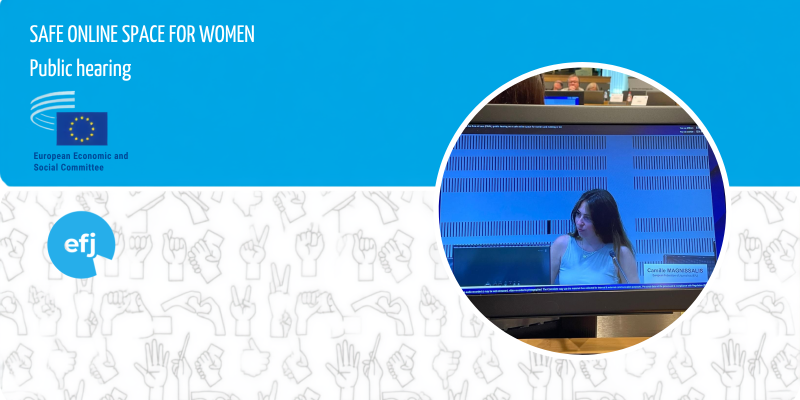
Today, the European Economic and Social Committee (EESC) held a Fundamental Rights and Rule of Law (FRRL) Group hearing dedicated to the topic of online harassment of women. This provided the European Federation of Journalists (EFJ) with an opportunity to reaffirm the importance of tackling online harassment of women journalists as a professional risk issue.
“Online attacks do not remain confined to the screen. We have been monitoring several incidents that have escalated offline, putting women journalists at serious risk and requiring a timely response and safety measures. Unfortunately, online harassment is difficult to tackle as threats are under-reported and all too often underestimated,” said EFJ Press Freedom Monitoring and Communications Officer Camille Magnissalis.
Gender-based violence under-reported
This underreporting was highlighted during an EFJ workshop last year, organised in Belgrade as part of the EU project ‘Stand up for journalism’. During the workshop, the EFJ conducted a survey on the attendees, which consisted of 30 journalists associations and unions across 44 countries. The survey found that 40% of online harassment, ranging from hate speech, insults to rape threats, goes under- reported, often seen as “part of journalist’s job”. Following the workshop, journalist and tech policy adviser Elodie Vialle authored the EFJ report ‘Ending the Silence on Online Harassment of Journalists’, which provided an overview of this widespread phenomenon. The normalisation of such behaviour and the proliferation of new tactics, such as malicious AI-generated content, make it challenging to tackle. The report also shared best practices already in place among EFJ members and set out recommendations.
Family members increasingly at risk
As of today, the EFJ has documented 33 cases of gender-based violence against 45 women media professionals on the Mapping Media Freedom platform since the beginning of the year. Of these cases, 72.7 % occurred online, primarily in the form of attempts to discredit media professionals and threats. Meanwhile, male journalists are mostly targeted through intimidation as highlighted in a survey conducted by Free Press Unlimited (FPU). During the panel discussion, Camille Magnissalis warned that in the Western Balkans, and especially Serbia, female family members of male journalists are increasingly being targeted with online sexual harassment.
Improved monitoring of gender-based violence on Mapping Media Freedom
Amidst a surge in gender-based violence, with journalists from minority backgrounds being specifically targeted, the EFJ, together with its partners from the Media Freedom Rapid Response (MFRR), has been working to improve the mapping of incidents on the Mapping Media Freedom platform. This has involved designing a specific category for gender-based incidents, including monitoring attacks targeting women journalists from the LGBTQI+ community. As emphasised by Elena Tarifa, Chair of the EFJ Gender and Diversity Expert Group (GENDEG), an intersectional approach is crucial when it comes to gender-based violence. Challenges can be detrimental to journalists’ professions, including self-censorship, abandoning a social media presence, or, in the worst-case scenario, leaving the profession entirely.
‘Doxxing’ requires scrutiny
While AI-generated content has contributed to widespread online harassment, including the creation of spoof accounts involving sexualised or fake content that misuses the identities of women journalists, another type of incident that requires scrutiny is ‘doxxing’, which involves sharing personal information ranging from phone numbers to home addresses. Since January, MapMF has recorded 14 cases of doxxing affecting personal data of 23 media professionals. One case of particular concern involved Serbian journalist Dejana Cvetković, who was sexually harassed online after her phone number and social media accounts were shared in a ‘Viber’ instant messagery group. In light of the growing attacks targeting journalists’ data, over the past few years, including instances unrelated to online harassment, such as data seizure, hacking, DDoS attacks, spyware and violation sources, the MFRR introduced another new category ‘Data attacks’ as an umbrella term to reflect these worrying developments. The category was inaugurated in the recent MFRR monitoring report for January-June 2026.
Some take aways
Only a collective response can address online harassment efficiently as a systemic professional risk.
- Online harassment intersects with other forms of violence and pressure ;
- Newsrooms are encouraged to forge close collaborations with journalists’ associations and trade unions to establish safety protocols and threat assessments as a first crucial step. International Press Institute (IPI), MFRR partners has developed its own safety protocol for newsrooms to swiftly support affected journalists ;
- Governments must strengthen funding for safety mechanisms.
- While safety mechanisms exist in most of the European countries, they remain poorly implemented by governments, public authorities, platforms and media outlets ;
- Regulatory instruments like the European Media Freedom Act (EMFA) and the Digital Services Act (DSA) must be leveraged to secure robust protections against digital harms, affecting journalists personally and professionally, in addition to the public right to be informed.
The EFJ urgently calls on all media professionals to report every instance of abuse, and will continue to monitor online harassment and any other type of abuse with its MFRR partners and advocate for thorough investigation into the threats to hold perpetrators accountable. Online violence is not virtual.
This statement was produced by EFJ as part of the Media Freedom Rapid Response (MFRR), a Europe-wide mechanism which tracks, monitors and responds to violations of press and media freedom in EU Member States and Candidate Countries.