A Promising Start, But Not Enough: The Case for Getting EU Journalism Funding Right Before 2028
In the negotiations on the EU Multi-Financial Framework (MFF) 2028 – 2032, journalism funding is the new kid on the block. The EFJ has analysed where EU funding on journalism is currently being spent. Local, independent journalism does not come out on top.
Journalism is facing an unprecedented crisis of viability. The European Media Industry Outlook report shows that the total revenue generated by the EU news media sector declined by 8% from 2023 to 2024. In response, the EU is, for the first time, developing a welcome and timely specific budget for the journalism and news sector. What started with scattered funding has become a system of developing programmes and grants for journalism, media freedom, and information integrity space.
In our analysis, we find that Euronews, a commercial broadcaster, received more EU journalism funding from 2021 – 2026 (€23M), as a sole beneficiary with no consortium partners on any of its grants. Only less than double went to funding projects that supported local and community media, and media NGOs, in consortiums with multiple partners (€45.4M). This single statistic captures the structural problem the EU must address before 2028.
The stakes are not simply editorial. The EU news media sector generates roughly €77 billion in annual revenue and employs more than 700,000 people and yet the sector lost 57,000 jobs between 2021 and 2023 alone. A 97-country study has found a 1-2% reduction in real GDP growth associated with declining press freedom. Funding journalism is an investment in economic and democratic resilience, as much as it is an important security issue.
For every €1 spent on local independent journalism, cross-border investigations, and freelancers, roughly €1.20 is spent on disinformation. Research consistently finds that the countries most resilient to disinformation are those with strong, trusted public and independent journalism and not those with the most monitoring infrastructure. The most cost-effective antidote to countering disinformation is public interest journalism, in whatever format and especially at the local level and the local journalist,” said EFJ Director Renate Schroeder.
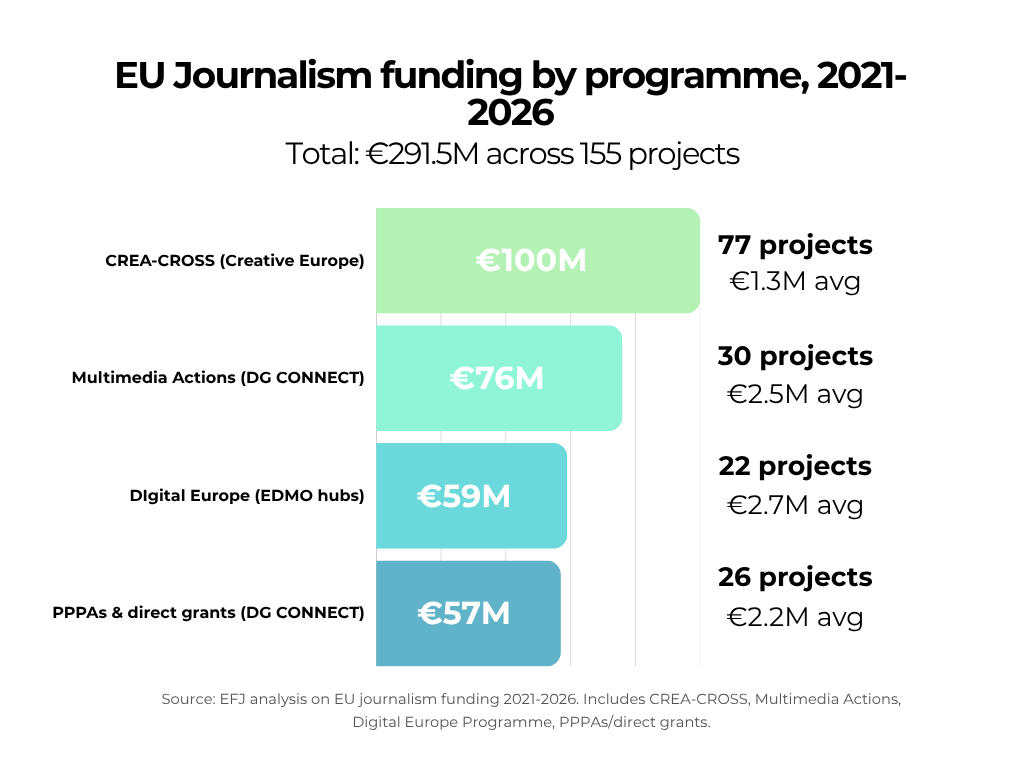
The EFJ analysis reviews EU funding on journalism, media freedom, and the information ecosystem from 2021 – 2026 (first 6 months of 2026). The programmes analysed include CREA-CROSS (€99.7M), Multimedia Actions (€68M), Digital Europe Programme (€59.4M), and PPPAs or direct grants (€53.5M). Research and social cohesion grants were not considered for this analysis.
A critical caveat is that the €288.1M mapped here is not a single journalism funding programme with a long-term plan. It is the sum of scattered actions across four different EU programmes and three agencies, none of which had journalism sustainability as their primary objective. The new EU funding programme for culture, civil society, and journalism, AgoraEU, proposed by the European Commission, which is currently being negotiated by the EU institutions, represents the first time the EU has proposed a dedicated funding strand for the journalism and press sector.
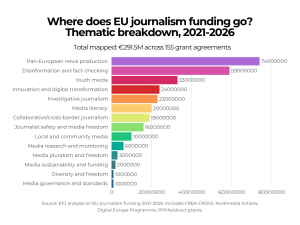
When grouping the different funded projects into thematic clusters, we found that the largest cluster was the Creative Europe journalism partnerships programme (€70.6M), which funds cross-border and local journalism production, within the CREA-CROSS fund, and closely followed by disinformation (€59.2M). The EU seems to spend nearly as much on studying and monitoring threats to journalism as it does supporting journalism production itself.
A comparative study of 18 countries found that high levels of media trust and strong independent journalism correlate directly with disinformation resilience. The 2026 Sopra Steria study estimated the global economic cost of disinformation at $417 billion in 2024, amplified by 15-20% by AI.
Our analysis finds that media outlets and media support NGOs are the most frequently involved organisation types across funded consortia, appearing in an estimated 239 and 226 project participations respectively (as coordinators and partners combined). Within Creative Europe journalism partnerships, several projects use cascade funding, meaning the lead organisation re-grants smaller amounts to individual local or regional newsrooms. An example of this is Local Media for Democracy (LM4D), led by the EFJ, which mapped news deserts across all 27 member states and provided direct support to startup, local and regional media.
Eastern and Central Europe is a major focus for EU funding, partly for geopolitical reasons, and partly because media markets in those countries are weaker and more vulnerable. Yet Western European organisations were most frequently coordinators of the journalism projects analysed, as Belgium, France, Germany, and the Netherlands together account for over 55% of coordinator budgets. The Center for Sustainable Media found that leading a project is worth 2.2x the average partner share.
“Every journalist who leaves the profession because they cannot pay their rent, every local newsroom that closes because it cannot survive the next 18 months, is a loss that no monitoring report can fully capture. As EFJ President, I see this across our journalists’ organisations. EU funding for journalism has grown, and that matters, but growing a system that is not reaching people is not progress. We need 20% of AgoraEU ring-fenced for independent media, we need grant cycles long enough to create lasting support for local journalism, and we need access mechanisms that a small newsroom with two journalists can actually use. The past five years of scattered funding should be the starting point we move away from, towards an EU that adequately funds journalists who can do their jobs without fear and without financial desperation,” said EFJ President Maja Sever.
Project-based funding in a structural crisis: the sustainability deficit
Nearly all EU journalism grants are short-term project grants (12 to 24 months), yet the sector faces structural crises requiring long-term institutional support: a near-absence of sustainable venture capital for news, weak philanthropic traditions outside Northern Europe, collapsing advertising revenue, and political and legal attacks on independent journalism. A single two-year grant cycle cannot build the institutional resilience needed.
The EU’s own funding behaviour reveals this contradiction: the European public sphere programme has renewed the same core projects (ENTR, SPHERA, Perspectives) for five consecutive rounds, implicitly acknowledging that the 12 to 24 month grant cycle is too short to achieve the stated objectives. Yet no mechanism exists to convert this de facto long-term support into formal institutional funding.
By contrast, Sweden’s press support system has operated continuously for over 50 years, providing structural subsidies that allow newsrooms to plan editorially across decades. France’s Fonds Stratégique pour le Développement de la Presse offers multi-year structural subsidies to news publishers based on circulation and public interest criteria
Local & community media: €10M for a pan-continental crisis
Local journalism has high social value but low commercial viability in small or declining markets. National governments in the countries with the worst news deserts, such as Hungary, Bulgaria, Slovakia, are often the cause of the problem, as state advertising is weaponised and public broadcasters are captured, making EU funding structurally the only actor positioned to intervene at scale without political capture. Local journalists and media outlets access EU money primarily through intermediaries and cascading grant structures.
The Council of Europe’s Safety of Journalists Platform recorded 344 alerts of serious threats to media freedom in 2025, a 29% jump from 2024, and the CMPF Media Pluralism Monitor‘s 2026 edition found journalists’ working conditions deteriorating in roughly one in three European countries. The outlets most exposed are local and regional newsrooms, which are the most reliant on precarious freelance labour and the least able to absorb the legal and financial costs of defending their journalists.
There needs to be a structural commitment to simplified access mechanisms that do not require a small local newsroom to navigate the same administrative apparatus as a pan-European consortium.
Media viability & business model support: almost absent
The Reuters Institute Digital News Report consistently shows that the majority of European news startups fail within three to five years of launch, almost always for commercial rather than editorial reasons.
Only two projects (totalling €3.4M) in the entire five-year mapping were explicitly focused on new revenue models or business sustainability for news media. The EU funds journalism production but not the structural conditions for journalism to survive commercially or non-commercially. Future EU funding should include dedicated business model support, modelled on instruments like Norway’s media innovation fund, with eligibility criteria that reward revenue diversification plans alongside editorial quality.
A 2024 study shows the most pressing issues in the media sector include collapsing revenues, biased state advertising, and a decline in local journalists due to poor working conditions. The EFJ welcomes the Commission proposal for journalism to have its own dedicated funding for the first time. As negotiations for the new EU budget 2028 – 2032 are under way, policymakers now have the first real chance to build a funding architecture that reaches the newsrooms that need it most.