
Everyone remembers where they were on 2 September 2026 and 16 October 2017
By Rebecca Bonello Ghio
European Federation of Journalists, writing in personal capacity
Previously worked at The Daphne Caruana Galizia Foundation (2021 – 2022)
On 11 October 2026, the media reported that four jurors expressed debasing comments online and in group chats about Daphne Caruana Galizia. The vilification of Daphne didn’t end with her death, and that is a Maltese problem as well as a media freedom issue.
Only days after hearing in court the screams and cries of her family who still don’t have the closure they are looking for, a juror mocked Daphne and her sons, police have found. During the proceedings, jurors heard details and saw images of her murder, watched her sons cry, and entered her family home. And yet one still felt confident enough to poke fun and consider her only as the derogatory caricature that those in power had promulgated when she was alive.
I was 17 when Daphne was killed. My family home is on a main road, and at the time of her death I vividly remember people car-cading to celebrate her death. Back then I wasn’t politically aware, but I remember feeling sick to my stomach and questioning where I had grown up. Malta to me was the safest country in Europe, we were lucky to be living in such a warm, close-knit community. But people were out there on the street celebrating a woman’s death, and online they were forwarding images of the explosion to WhatsApp groups. I couldn’t understand it.
Nine years on, I have that same sick feeling in my stomach.
Daphne was also a journalist. As a Policy Officer at the European Federation of Journalists (EFJ) in Brussels, I work daily on the issues that journalists face in Europe. The way that Daphne was isolated and mocked unfortunately isn’t an anomaly in Europe. But the sustained vilification of her reputation posthumously is.
Daphne was not the last journalist killed in Europe. Four months after her death, journalist Ján Kuciak and his fiancée Martina Kušnírová were shot dead in Slovakia. In 2021, Peter de Vries was shot in Amsterdam. Across Europe, journalists face threats, online abuse and lawsuits meant to drain their time and money, the same pressures Daphne described in her last interview, when she told of 19 libel cases filed by one person at once. The EU has since adopted the Anti-SLAPP Directive and the European Media Freedom Act (EMFA), but laws only matter if they are applied and if the public stands behind the people they protect.
I recently had a discussion with a Greek journalist and unionist about the legacy of Daphne compared to that of Giorgio’s Karaivaz, a journalist who was murdered in 2021 for reporting on organised crime in Greece. His murderers were acquitted twice, and there isn’t the uproar in Greece compared to in Malta. We settled on the idea that Daphne was reporting about Maltese politics and society more broadly. She was not a niche journalist, like Karaivaz, but she was the most-read blogger in Malta, receiving more views in a week than there are people in the country. What she wrote about affected us all, personally, because it was about Malta, collectively.
And that’s why she’s become such a target, especially for the online trolls.
The 2026 Media Pluralism Monitor (MPM) report found that Malta lacks a national strategy to tackle disinformation. There is a major disinformation problem and severe trolling online as a result of the highly polarised political environment. Additionally, Malta has weakly implemented its anti-SLAPP legislation, continuously denies Freedom of Information (FOI) requests, and there is a lack of repercussions for public servants who target journalists.
The European Commission has remained too silent, too long. President Von Der Leyen mentions Daphne in speeches, yet does not act as swiftly as the Council of Europe has in investigating the situation on the ground in Malta and coming up with real repercussions if Malta doesn’t uphold the recommendations of the public inquiry into Daphne’s assassination, which found that the State created the conditions that enabled her murder to take place.
The consequences of inaction by the Maltese government and EU institutions are not abstract. Matthew Caruana Galizia has said that Facebook groups spread “poison” about his mother and that those views reached members of the jury. That is his allegation, and the investigation into the jurors is still ongoing, but it describes the same kind of smear campaign his mother lived through. In September 2025, Malta hosted a Council of Europe conference on building democratic resilience to disinformation. Yet Malta has been short of action. The 2026 MPM report rated Malta 71% risk overall, second only to Hungary in the EU, and found that the fight against disinformation is left to news outlets, universities and NGOs.
In her last interview, Daphne described her situation as classic scapegoating on a national scale. She said people who have never read her work know they are supposed to hate her. News reports on the comments shared by the jurors before and after the trial, and the comments many of us read on social media by others in the days after the acquittal, show that disinformation thrives and hate still exists in some.
Daphne’s family should be able to feel safe in the country they live. Journalists in Malta should be able to report without facing threats, lawsuits or abuse. Neither is guaranteed today, and the divisions Daphne faced keep us from agreeing on something basic: killing a journalist and a woman is wrong, whatever you thought of her.
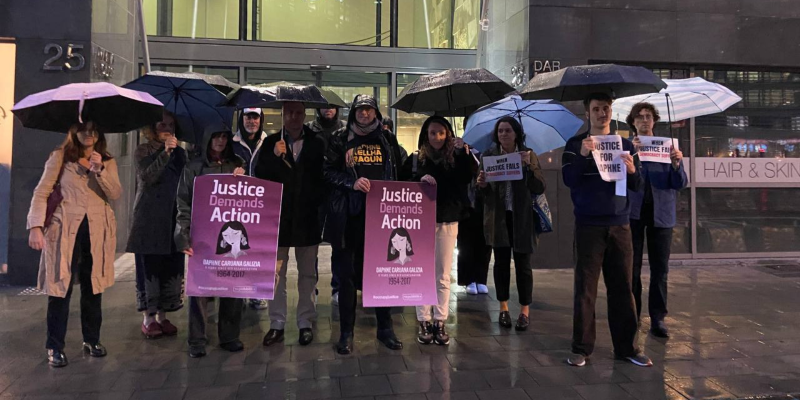
If you live in Malta, join the protest this Friday, 16 October, in Valletta. If you live abroad, attend or organise something near you. Nine years on, showing up is the least we can do.
This piece was first published in the Times of Malta.





