Albania: Authorities must take action to guarantee journalists’ safety without delay
The European Federation of Journalists (EFJ) joins its Media Freedom Rapid Response (MFRR) partners and the Safejournalists Network (SJN) remain deeply concerned by the frequency and severity of attacks on journalists covering ongoing student-led protests in Albania. Despite the authorities being informed and urged to take action in an open letter dated 14 October and signed by over 30 organisations, attacks have continued with high frequency, leaving journalists vulnerable on the ground.
The undersigned organisations strongly condemn all acts of physical violence, intimidation, and obstruction, and reiterate calls on the authorities to thoroughly investigate the cases and hold all perpetrators, including law enforcement officers, accountable without delay. The undersigned organisations also remind state officials and political figures of their responsibility to refrain from unsubstantiated accusations and inflammatory rhetoric that could delegitimise journalism and incite further attacks against media professionals.
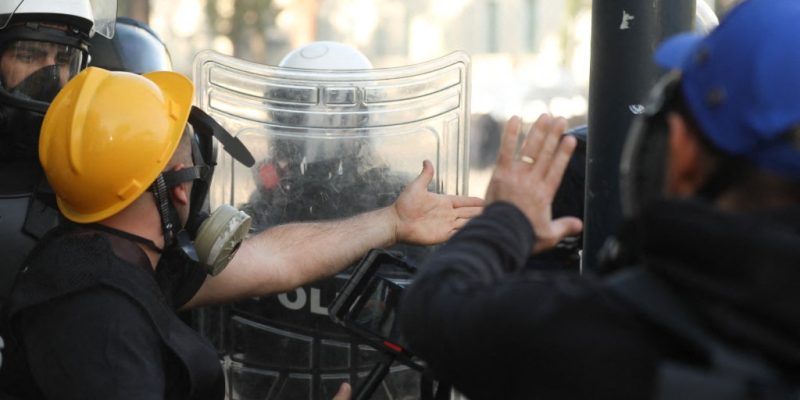
Since the latest wave of protests began in mid-October, our organisations have recorded alarming levels of police violence against journalists and media workers, including numerous reports of journalists being beaten, verbally abused, detained, or obstructed, and of media equipment being seized. Among the very first cases documented on Mapping Media Freedom (MapMF) was that of Izmir Akulli, editor-in-chief of the online news outlet Dosja.al, who required hospital treatment after being reportedly assaulted by officers of the Rapid Intervention Forces (FNSH) and despite identifying himself as a journalist. The attack on Top News journalist Xhoi Malësia, who was violently pushed back by officers with their shields before a member of the Rapid Intervention Forces pointed a tear gas launcher directly at him, also raised serious concerns about the excessive use of force by law enforcement officers.
From 13 to 31 October 2026, the SafeJournalists Network (SJN), recorded with the support of the Association of Journalists of Albania (AGSH) at least 55 incidents, the majority of which are attributed to State Police officers. Among the recent cases, five journalists and media workers confirmed having been struck by rubber bullets fired by the State Police while eight reported being targeted with pepper spray or other chemical irritants, in several cases at close range.
Several media professionals were also prevented from filming, including having their phones seized in violation of the State Police Guide for the Safety of Journalists, which guarantees journalists’ right to film state police officers (Section 6.2(c)). In September, two similar cases were documented, one of them involving Vjolanda Peca, a journalist for Citizens.al who faced repeated detention and obstruction in recent months.
Of particular concern was also the forcible obstruction of journalists asking questions to Skënder Hitaj, the Director-General of the State Police on 17 October. The media professionals were pushed by masked individuals standing next to Mr Hitaj who did not intervene. The State Police Director General, eventually announced the suspension of seven officers for exceeding their authority and failing to respect the principle of proportionality when dealing with protesters. However, it is not known whether any attacks on journalists resulted in disciplinary sanctions.
Most recent reports included the handcuffing and detention of a Dutch journalist and author by the Albanian state police on 7 November. His mobile phone was confiscated and returned the following day. Both the Dutch journalist and freelance journalist Alisa Braho, who was filming the police intervention, were reportedly targeted with pepper spray.
These series of incidents also highlight the blatant failure to implement the State Police’s Guidelines on the Safety of Journalists and the crucial need for constructive dialogue with journalists’ associations and media experts to ensure journalists can report freely and safely.
The Safejournalists Network (SJN) also collected a small portion of reports, attributing responsibility of attacks to protesters. Out of the six cases reported by AGSH, one involved vandalism of Report TV’s camera by masked individuals. The undersigned organisations stand in full solidarity with all journalists, and encourage them to protect themselves by wearing safety equipment, and to report any attacks that prevent them performing their professional duties.
Political leaders’ rhetoric targeting journalists and media outlets during the protests reflected a broader pattern of discrediting independent reporting, questioning journalistic integrity and portraying critical coverage as contributing to unrest. Such language risks legitimising hostility towards journalists, undermining public trust in the media and creating an increasingly intimidating environment for independent reporting.
Public officials must also strongly condemn any smear campaign aimed at discrediting those who defend independent voices. The undersigned organisations express deep concern about the persistent targeting of researchers and civil society representatives, including SafeJournalists researcher Blerjana Bino, her family, and the Center Science and Innovation for Development (SCiDEV), for which she works for. The smear campaign began amid Bino and SCiDEV’s research, public analysis and civil society advocacy concerning the mounting pressure faced by media workers reporting on civic mobilisations. Those behind the smear campaign must be held accountable to send a clear message that attacks attempting to undermine the credibility of, and support for, media professionals, as well as attacks on journalists, will never be tolerated.
Journalists, media professionals and their representatives must be able to work without fear of violence, intimidation or retaliation. As Albania’s progress towards EU accession, its authorities must uphold media freedom and their citizens’ right to access transparent, independent information.
Signed by
Partner organisations from the Media Freedom Rapid Response (MFRR)
European Federation of Journalists (EFJ)
Osservatorio Balcani Caucaso Transeuropa (OBCT)
Free Press Unlimited (FPU)
International Press Institute (IPI)
European Centre for Press and Media Freedom (ECPMF)
SafeJournalists Network
Association of Journalists of Albania
Association of Journalists of Kosovo
Association of Journalists of Macedonia
BH Journalists Association
Croatian Journalists’ Association
Independent Journalists’ Association of Serbia
Trade Union of Media of Montenegro
This statement was produced as part of the Media Freedom Rapid Response (MFRR), a Europe-wide mechanism which tracks, monitors and responds to violations of press and media freedom in EU Member States and candidate countries.