European Federation of Journalists

openMedia, investigating press freedom

Title of the project : openMedia, investigating press freedom
Lead Applicant
: openDemocracy

Partner organisations : EFJ, Index on censorship, King’s College London

The recently launched openMedia project aims to investigate and expose commercial interference in editorial decisions. The project is run by openDemocracy with the European Federation of Journalists (EFJ) as a partner alongside the Index on Censorship and King’s College London.

The project believes that there has not been enough of a concerted, ongoing spotlight on the extent and effects of commercial influence over the media, despite the dangerous consequences it poses for press freedom. For now, the project focuses on 47 countries across Europe but also has ambitions to expand.

Despite the recent launch, the project is adamant that it is not a response to the “fake news” hype of the past year or so. Rather, the project responds to scandals of commercial sponsors influencing media content; for example the Daily Telegraph’s suppression of investigations into its advertiser HSBC; and allegations that Buzzfeed deleted articles which advertisers found unfavourable.

According to the project, this power dynamic can suppress investigations of banks, pharmaceuticals, agriculture, fossil fuel giants, energy companies and other big businesses.

In addition, the project recognizes how for many readers, “sponsored content” is difficult to distinguish from genuine news content. The project therefore aims to clarify the commercial interests apparent in media to readers, and as part of the project, King’s College London will develop digital tools to help readers be better informed about news sources.

The findings of the project will be used to campaign for greater transparency and press freedom in news organisations and to empower journalists to advocate for transparency.

In order to do this, openMedia is currently conducting a confidential and anonymous survey of journalists across Europe, asking about their own working practices and experiences of commercial pressure inside newsrooms. The survey is available in English here and in many other languages here.

Actions

Austria: EFJ calls on MPs to reject bill ending print edition of Wiener Zeitung

A new draft law presented by Austrian Media Minister Susanne Raab (ÖVP), introduced in Parliament on 30 March 2023, would permanently stop the printing of the world’s oldest daily newspaper, the Wiener Zeitung. The government’s plans to stop funding the state-owned newspaper as a printed daily is seen as a blow to media pluralism and quality information in Austria. The European Federation of Journalists (EFJ) joined its affiliates the Austrian Press Union (GPA) in calling on Members of Parliament to reject the bill that is to be voted on next week. The draft law “on the promotion of quality journalism” provides for…

EFJ organises conference on journalists’ safety to mark World Press Freedom Day

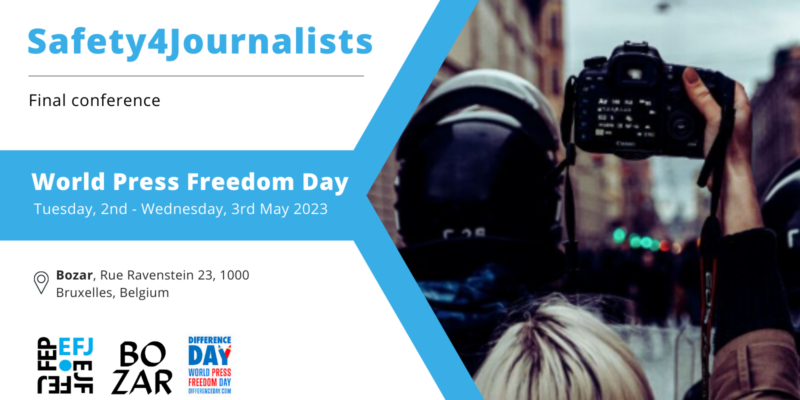
To mark World Press Freedom Day, the European Federation of Journalists (EFJ) organises a conference at Bozar on 2-3 May 2023, as part of its Safety4Journalists project. The 1.5 days final conference will highlight the good practices of safety in the media from unions, media employers, policy-makers and international experts. Experts will discuss the EFJ risk assessment tools to be launched on the day with a focus on what can be done by media managers, employers, journalist unions and associations, and national and international authorities to create a culture of health and safety at work in the media. Please find the…

Turkey: Broadcast regulator must stop punishing critical reporting ahead of elections

The European Federation of Journalists (EFJ) joined the partners of the Media Freedom Rapid Response and 20 press freedom, freedom of expression and human rights organisations in calling on Turkey’s broadcast regulator (RTÜK) to immediately stop fining broadcasters for their critical reporting. Journalists and broadcasters must be allowed to do their jobs of informing the public over critical issues and holding the government to account. Instead of upholding freedom of expression and media pluralism in the country, RTÜK is being weaponised by the governing parties to silence legitimate criticism and provide them with an unfair advantage in the May 2023…

Brutal attack on Valon Syla: Kosovo must take action to protect journalists

The European Federation of Journalists (EFJ) and its affiliate in Kosovo, AGK, strongly condemn the violent attack on journalist Valon Syla in Pristina on Tuesday evening. The EFJ calls on the Kosovo authorities to condemn publicly this act of violence and to do their utmost to identify the perpetrators and their sponsors and to prosecute them. Kosovar journalist Valon Syla was attacked last night by three unknown men in the Bregu i Diellit area of Pristina. Syla was attacked a few minutes after leaving the studio of a broadcast, where he was invited to discuss the trial of former UÇK leaders…

EFJ to hold its Annual Meeting in The Hague on 11-12 May 2023

The European Federation of Journalists (EFJ) will hold its annual meeting in The Hague, Netherlands. Around 100 journalists and trade union representatives from 45 countries in Europe are expected to meet on 11-12 May 2023. The Hague was chosen as the host city of the upcoming congress of the EFJ, representing 320,000 journalists in Europe. Co-organised by the Dutch journalists’ union Nederlandse Vereniging van Journalisten (NVJ), the assembly will be held in Beeld en Geluid, the Sound & Vision Museum. “With its reputation as the home of international law and arbitration, The Hague is an appropriate venue to convene in times of…

News Deserts Aren’t New: The cases of Croatia, Portugal and Turkey

The existence of vibrant and independent local media that serves the public interest of its local communities is a cornerstone of our democratic societies. They are the key to empowering citizens to grasp and exercise their rights in the communities where they live. However, the very existence of these media has become uncertain across different parts of the European Union. We spoke to people researching this phenomenon in Turkey, Portugal and Croatia. They spoke to us about the news deserts emerging in their countries, a term developed by US scholars and policymakers to explain the crisis of traditional news media…