
European Federation of Journalists

openMedia, investigating press freedom

Title of the project : openMedia, investigating press freedom
Lead Applicant
: openDemocracy

Partner organisations : EFJ, Index on censorship, King’s College London

The recently launched openMedia project aims to investigate and expose commercial interference in editorial decisions. The project is run by openDemocracy with the European Federation of Journalists (EFJ) as a partner alongside the Index on Censorship and King’s College London.

The project believes that there has not been enough of a concerted, ongoing spotlight on the extent and effects of commercial influence over the media, despite the dangerous consequences it poses for press freedom. For now, the project focuses on 47 countries across Europe but also has ambitions to expand.

Despite the recent launch, the project is adamant that it is not a response to the “fake news” hype of the past year or so. Rather, the project responds to scandals of commercial sponsors influencing media content; for example the Daily Telegraph’s suppression of investigations into its advertiser HSBC; and allegations that Buzzfeed deleted articles which advertisers found unfavourable.

According to the project, this power dynamic can suppress investigations of banks, pharmaceuticals, agriculture, fossil fuel giants, energy companies and other big businesses.

In addition, the project recognizes how for many readers, “sponsored content” is difficult to distinguish from genuine news content. The project therefore aims to clarify the commercial interests apparent in media to readers, and as part of the project, King’s College London will develop digital tools to help readers be better informed about news sources.

The findings of the project will be used to campaign for greater transparency and press freedom in news organisations and to empower journalists to advocate for transparency.

In order to do this, openMedia is currently conducting a confidential and anonymous survey of journalists across Europe, asking about their own working practices and experiences of commercial pressure inside newsrooms. The survey is available in English here and in many other languages here.
Actions

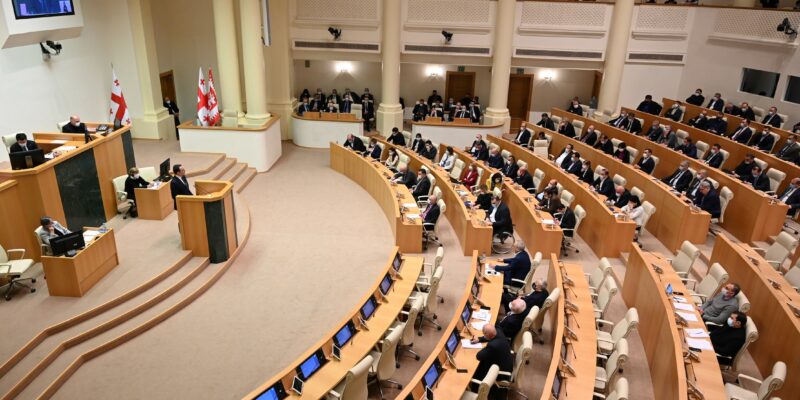
Georgia: New draft law requires internationally funded media outlets to register as “foreign agents”

A draft law to require entities receiving money from abroad to register as “agents of foreign influence” was introduced by the People’s Power party to the Georgian Parliament on 20 February 2023. The European Federation of Journalists (EFJ) joined its affiliate, the Independent Association of Georgian Journalists (IAGJ), in criticising the proposed law and calling for its withdrawal. In the name of “transparency”, the draft law would require organisations receiving over 20% of their income from a ‘foreign power’ to register on a ‘Foreign Influence Agents Registry’, or face fines of up to ₾25,000 (8,900€). It would affect any broadcaster,…

Maja Sever: “Slovak journalists do not allow Ján Kuciak or his work to be forgotten”

Five years after the murder of Slovak investigative journalist Ján Kuciak and his fiancee Martina Kušnírová, EFJ President Maja Sever traveled to Bratislava on 20-21 February 2023 with a delegation of international media freedom organisations. They took an active part in the commemorative events, met with Jan’s and Martina’s relatives, Slovak journalists and state authorities. In this testimony, Maja Sever looks back on these two days with a moving personal account. On the kitchen table, investigators found cups of tea, coffee and an open laptop on which Martina Kušnirova was looking at wedding dresses. Her body was found on the kitchen…

2023 Rule of Law Report: Recommendations to the European Commission

In July 2023, the European Commission will publish its annual rule of law report. The significant challenges to the rule of law within the Union in the past year are both old and new. While issues such as the non-implementation of court decisions, the shrinking of civic space in the EU and the restriction of freedom of expression across the EU have featured in previous joint civil society statements, the new coverage in country chapters and the rapidly changing geopolitical landscape have generated new horizontal concerns. Compliance with and respect for the rule of law in the EU are crucial…

Slovakia: Fifth anniversary of Kuciak and Kušnírová’s killing marked by fragile press freedom progress

Five years after the assassination of Já​​n Kuciak and Martina Kušnírová, Slovak judges are nearing their judgment in the retrial of the alleged mastermind of the murder of Aktuality.sk’s journalist and his fiancée. While the hitmen and an intermediary of the February 2018 killing have already been convicted to long prison sentences, suspect Marián Kočner, charged with ordering the crime, was acquitted. With the retrial verdict expected in April 2023, our organisations renew our call for full justice for the double murder. The undersigned organisations conducted a fact-finding and advocacy mission in the country to express their support to the…

Ukraine: two Italian journalists unable to work after accreditations revoked

Two Italian journalists, Andrea Sceresini and Alfredo Bosco, had their press accreditation withdrawn on 6 February 2023 while reporting for the public broadcaster Rai3 in Ukraine. Since then, they have been unable to work, awaiting interrogation by the Ukrainian security service (SBU). The European Federation of Journalists (EFJ) joined its Italian affiliate, the FNSI, in calling on the Ukrainian authorities to let the journalists continue their reporting by granting them new accreditation as soon as possible. In a letter published in Il Fatto Quotidiano,the two freelance reporters wrote that the Ukrainian Ministry of Defence had notified them of the suspension of…

Turkey: “Journalists reporting from earthquake- affected areas face safety, hygiene and health problems”

Two weeks after the terrible earthquake that shook Northern Syria and Eastern Turkey, Kenan Şener, Secretary General of the Ankara Journalists Association (GCD), describes the dire humanitarian situation for the inhabitants and the local journalists who are trying to tell their stories despite everything. Şener recounts the daily grind of journalists reporting on the ground, as well as how the Association is responding to their urgent needs, and preparing for a long crisis. What are the main issues journalists are facing in the field? The protection of journalists’ rights and freedoms has become more difficult due to the declaration of a…



