Malta: EFJ condemns government inaction on media reforms

The European Federation of Journalists (EFJ) and international press freedom and journalist organisations are today calling on the Maltese authorities to make long-overdue media reforms an immediate priority, and to commit to meaningful and transparent collaboration with national and international civil society.  The assassination of investigative journalist Daphne Caruana Galizia in 2017 generated significant pressure to improve working conditions for all journalists in Malta. A 2021 public inquiry, established independently to assess the circumstances of her murder found the state had to “shoulder responsibility” because it had created an “atmosphere of impunity” and failed to take reasonable steps to protect…

ReMeD: Meeting the Challenges of a Changing Journalism Landscape through Funding, EU Regulation and Dialogue (Report)

The European Federation of Journalists (EFJ) has published the report on the policy workshop “Meeting the Challenges of a Changing Journalism Landscape through Funding, EU Regulation and Dialogue”, authored by media expert Oliver Money-Kyrle. The workshop took place on 12 February 2026, within the framework of the Resilient Media for Democracy in the Digital Age project (ReMeD), a consortium of eight European universities and EFJ. It brought together journalists, journalists’ unions, NGOs, policymakers, and academics for a full day dedicated to discussing journalism funding, the rise of new media actors, and the challenges that journalism faces today. Panelists discussed the…

Netherlands: Writers and journalists demand that Meta ends illegal use of their texts

Authors’ texts are indispensable for AI Large Language Models, but they receive no compensation. The Dutch Writers’ Guild (Auteursbond), the Dutch Association of Journalists (NVJ) and the Lira Foundation have sent a formal demand letter to Meta, the parent company of Facebook and developer of the AI model Llama. In the letter, they request that Meta immediately cease the unlawful use of copyrighted work of Dutch writers, translators and journalists in the training of its AI models. According to Liesbet van Zoonen, president of the Auteursbond: “We are not opposed to Large Language Models, but the AI industry is a…

Why defamation should be fully decriminalised in Albania

By Isa Myzyraj, Journalist and Chairperson of the Association of Journalists of Albania (AJA) For more than a decade, dozens of journalists and media outlets in Albania have been dragged through the country’s criminal courts, accused mainly of defamation and insult. At first glance, these are provisions that protect individual reputation. In practice, they have been transformed into instruments of pressure and intimidation against the media. In the overwhelming majority of cases, criminal lawsuits have not been initiated by ordinary citizens seeking protection from defamation, but by politicians, high public officials, and companies with economic power. The purpose has not…

Ukraine: Journalists’ Solidarity Centers need support to keep protecting reporters under fire

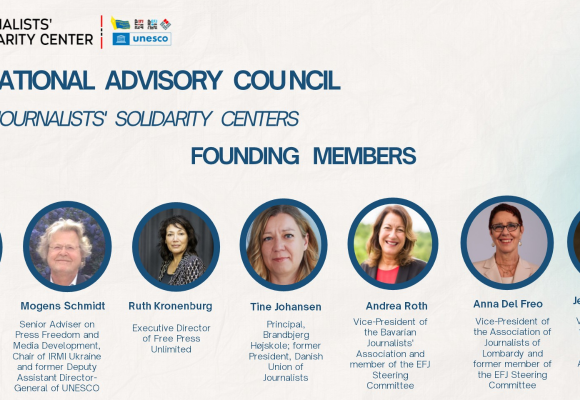
As Ukraine marks four full years since Russia’s full-scale invasion, the National Union of Journalists of Ukraine (NUJU) has launched a renewed fundraising campaign to sustain its network of six Journalists’ Solidarity Centers — safety hubs that enable Ukrainian and foreign journalists to continue reporting under wartime conditions. The European and International Federations of Journalists (EFJ/IFJ) support the NUJU campaign and invite journalists’ organisations and citizens who are able to do so to make a donation. Established in 2022 with the support of the IFJ/EFJ Safety Fund, the Centers have become a model of “safety spaces” for journalists operating in…

Ukraine: Four years into full-scale invasion, journalism remains a deadly profession

On the fourth anniversary of Russia’s full-scale invasion of Ukraine, the European Federation of Journalists (EFJ) joins Media Freedom Rapid Response (MFRR) partners in hailing the continued courage of journalists in the country who continue to report on the war despite serious risks – and waning international attention. As we mark the anniversary, our organisations honour and remember the journalists who have been killed while reporting on the war and in the line of duty. We pay our respects to these reporters, who made the ultimate sacrifice in bringing news on the war to Ukrainian and international audiences. As documented in…

Turkey: EFJ demands immediate release of journalist Alican Uludağ

Deutsche Welle correspondent Alican Uludağ, who was detained Thursday evening in Turkey, was brought before a detention judge on Friday. The prosecutor in charge requested that he be placed in pre-trial detention, and the court subsequently issued an arrest warrant. The European Federation of Journalists (EFJ) joins its Turkish affiliates, TGS, TGC, DISK Basin-Is and GCD, in demanding the immediate release of the journalist. Alican Uludağ is a well-known investigative journalist with 18 years of experience and no prior convictions. He has worked for Germany’s international broadcaster DW in Turkey for several years. On Thursday evening, he was detained by…

Slovakia: EFJ and MFRR partners continue to demand full justice for Kuciak assassination

Ahead of the eighth anniversary of the murder of Slovak investigative journalist Ján Kuciak and his fiancée, Martina Kušnírová, the European Federation of Journalists (EFJ) joins the undersigned partner organisations of the Media Freedom Rapid Response (MFRR) in renewing the call for full justice for their brutal killing. With the new retrial of the twice-acquitted but alleged mastermind Marian Kočner now again underway in Bratislava as of January 2026, hope remains that all those responsible for ordering and carrying out this assassination will eventually face justice for their crimes. On 21 February 2018, Kuciak and Kušnírová were fatally shot at…

Germany: drastic cost-cutting plan impacts international public broadcaster DW

The European Federation of Journalists (EFJ) joins its German affiliates, dju in ver.di and DJV, in condemning the drastic reduction in programmes and staff at the international public broadcaster Deutsche Welle (DW). These cost-cutting measures jeopardise access to free and pluralistic information for millions of citizens around the world. The reduction in DW’s broadcasting comes at a time when the United States has itself withdrawn its international broadcasting. Following the German federal government’s decision to cut DW’s funding by 10 million euros in 2026, the management of the international public broadcaster adopted on Wednesday a drastic cost-cutting plan of 21…

Italy: MFRR to conduct follow-up media freedom mission to Rome

The Media Freedom Rapid Response (MFRR) partners, including the European Federation of Journalists (EFJ), will conduct an advocacy mission to Rome, Italy, on 9–10 March 2026 to assess key developments affecting press and media freedom in the country and push for implementation of crucial reforms.  The mission will focus on four main themes: the reform of the public broadcaster RAI and its compliance with the European Media Freedom Act (EMFA); the transposition of the EU Anti-SLAPP Directive and broader defamation reform; digital threats and the use of surveillance against journalists; and media market concentration and its compatibility with the EMFA. …

Kosovo: EFJ joins urgent call for adequate budget allocation for public broadcaster RTK

The European Federation of Journalists (EFJ) today joins international media freedom organisations in expressing strong concerns about the underfunding of Kosovo’s public broadcaster, Radio Television of Kosovo (RTK), and calling for legal budget requirements to be met. The Assembly of Kosovo is currently discussing the RTK budget, which is anticipated to be passed in two readings on 19 and 20 February 2026. According to the draft Law on the Budget for 2026, the parliament, based on the government’s proposal, will allocate only 8.9 million euros, which is sufficient only to cover basic operational needs such as staff salaries. The Law…

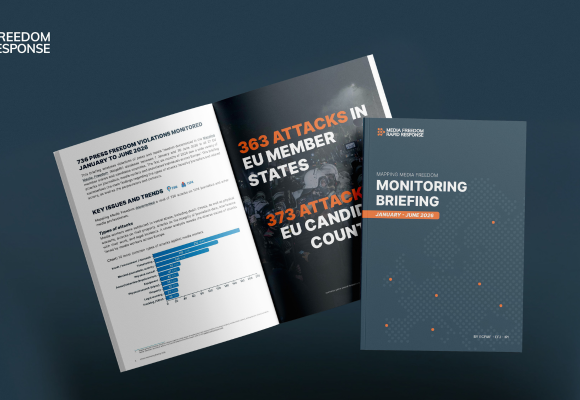
MFRR Monitoring Report 2025: 1,481 press freedom violations across 36 European countries

The Media Freedom Rapid Response (MFRR) partners today publish the Annual Monitoring Report for 2025, which documents 1,481 press freedom violations affecting 2,377 journalists or media-related entities in 36 European countries between January and December 2025. The report was compiled by the European Centre for Press and Media Freedom (ECPMF), the European Federation of Journalists (EFJ), and the International Press Institute (IPI). Journalists and media outlets across Europe faced sustained threats throughout 2025, according to the latest Monitoring Report. Based on verified cases recorded in the Mapping Media Freedom database, the report provides a comprehensive overview of the main threats facing journalists across the 27 EU Member States and nine candidate countries.…

Switzerland: US analytics firm takes Republik magazine to court

The American company Palantir Technologies has filed a lawsuit against Republik, an independent Swiss media outlet that published an in-depth investigation into its activities. The case is currently being heard by the Zurich Commercial Court. The European Federation of Journalists (EFJ) considers this legal action to be a potential case of a SLAPP suit (strategic lawsuit against public participation). Palantir develops intelligence and law enforcement software. The US Immigration and Customs Enforcement (ICE) uses Palantir products to track migrants in the United States. The Israeli army also uses Palantir software in its war in Gaza. In collaboration with the investigative…

Belgium: Unions win annulment of law criminalising leaks of state secrets to journalists

Journalists in Belgium can no longer be prosecuted for possessing a state secret. On 29 January 2026, the Belgian Constitutional Court annulled a provision allowing prison sentences for journalists receiving confidential information such as state secrets. The European Federation of Journalists (EFJ) joined its Belgian affiliates, the Association des Journalistes Professionnels (AJP) and the Vlaamse Vereeniging van Journalisten (VVJ) in welcoming the ruling. The provisions were part of the Penal Code reform adopted in February 2023, which expanded the definition of “state secret” and criminalised their unauthorised receipt, including by journalists who might obtain – or merely become aware of…

Italy: EFJ in solidarity with RAI journalists on strike today

Today, journalists at Italian public broadcaster RAI have called a one-day byline strike. The European Federation of Journalists (EFJ) joins them in denouncing the disastrous image given by Paolo Petrecca, the RAI sports director, throughout his commentary on the opening ceremony of the Milano Cortina Winter Olympics. The Winter Olympic Games started with a slick ceremony last Friday at Milan’s San Siro stadium, but the event was marred for Italian TV viewers by a stream of on-air mistakes from the head of RAI’s sports division, Paolo Petrecca, who was appointed to the role in 2025. Today, RAI journalists omitted their…

Serbia: Coordinated bot attacks on Instagram accounts of independent media emerge as new weapon of censorship

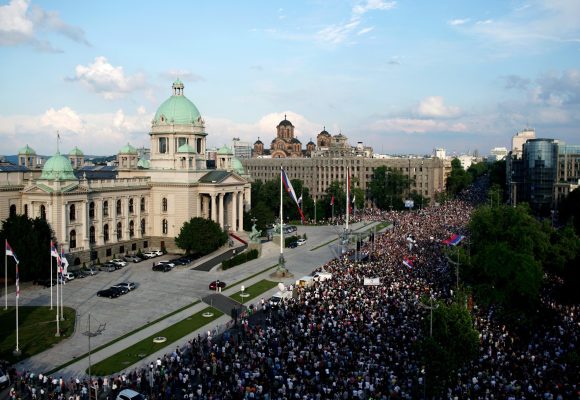
The European Federation of Journalists (EFJ) joins its Media Freedom Rapid Response (MFRR) partners today in raising alarm over a recent wave of bot-driven cyber attacks targeting the social media accounts of Serbian media outlets. Our organisations warn that the dozen recorded incidents are not isolated cases but part of a broader pattern of coordinated attacks on the free flow of news and independent information in Serbia, which remains in a period of media freedom crisis. Between 8 and 30 January, the Independent Journalists’ Association of Serbia (NUNS) recorded at least 12 coordinated bot attacks against Instagram accounts of independent…

Journalists’ organisations increasingly engaging with news creators, though ethical concerns remain high, EFJ survey finds

A new survey by the European Federation of Journalists (EFJ) reveals a mixed approach among its members toward so-called ‘news creators’, with journalists’ organisations split on whether to recognise these emerging actors as part of the information landscape. The findings show that concerns over journalistic ethics and conflicts with organisational statutes remain the main barriers to their inclusion.  In its latest Digital News Report, the Reuters Institute highlights how news creators (see definition below) are successfully reaching large audiences, often at the expense of traditional media, including within the news sector. As the boundaries of the information landscape shift rapidly,…