Policy
EMFA
Actions
EMFA: First article enforced into national legislation
On 8 November 2024, Article 3 of the European Media Freedom Act (EMFA) on the right to access to a plurality of editorially independent media content came into force in the European Union. For the first time in EU law, Member States have a positive obligation to protect this right “for the benefit of free and democratic discourse“. In practical terms, all Member States must ensure that framework conditions are in place to guarantee European citizens access to editorially independent information. As the EMFA is a regulation, its first Article to be implemented is now “enforceable”, even in the absence…

European Media Freedom Act (EMFA): What does it mean for journalists ?
The European Media Freedom Act (EMFA) entered into force on 7 May 2024. The new rules will fully apply at national level in each EU member state as of 8 August 2025. It has been said this is a historic act as the European Media Freedom Act, called “EMFA” is the first European regulation dealing with all media. The European Federation of Journalists (EFJ), together with other media freedom groups, the European Broadcasting Union (EBU) and civil society organisations, has worked hard for over two years to get an ambitious act. A future-proof act against the growing attacks against journalism,…
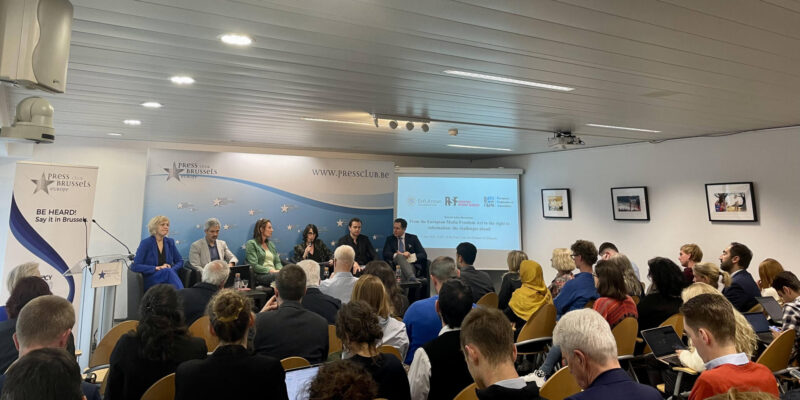
From the European Media Freedom Act to the right to information: the challenges ahead
On 5 June, the Kofi Annan Foundation (KAF), the European Federation of Journalists (EFJ) and Reporters without Borders (RSF) organised a roundtable discussion at the Brussels Press Club on the European Media Freedom Act (EMFA), which came into force on 7 May. Opening remarks were provided by Corinne Momal-Vanian, Executive Director of KAF, Renate Schroeder, Director of EFJ, and Antoine Bernard, Director of Advocacy at RSF, followed by a keynote speech from Vice-President of the European Commission, Vera Jourova. Sébastien Brack, KAF’s representative in Brussels, moderated a panel discussion with Renate Nikolay, Deputy Director-General of DG Connect, Frederic Bokobza, Deputy…

EFJ calls for immediate and ambitious implementation of the European Media Freedom Act
As the final text of the European Media Freedom Act (EMFA) was formally adopted today by the European Union, the European Federation of Journalists (EFJ) calls once again on the Member States to be efficient and ambitious in implementing this crucial legislation. The final green light given to the EMFA by European governments – except Hungary – could not be more timely as the situation is worsening in several EU countries, where public service media are being used politically and weakened financially, instead of guaranteeing citizens independent, plural and quality information as their mission requires. First tests in Slovakia and…

Coalition calls for effective implementation as the Parliament adopts the European Media Freedom Act
The European Parliament today adopted with an overwhelming majority (464 in favour, 92 against, 65 abstentions) the European Media Freedom Act (EMFA). Media freedom and pluralism along with the rule of law have been in decline in the EU (and beyond) for many years. Where the rule of law is undermined, independent journalism is often the first to suffer. Against this background, our coalition of organisations representing journalists, media freedom and civil society groups, and public service media, congratulate the EU institutions and welcome the EMFA as an important step towards protecting and promoting media freedom and pluralism in the EU.…

EFJ welcomes agreement on European Media Freedom Act
The European Federation of Journalists (EFJ) welcomes the adoption on Friday of the European Media Freedom Act (EMFA), the final version of which no longer refers to the possibility of spying on journalists on the basis of vague “national security” imperatives. This is a victory for all defenders of press freedom and democracy. Pending an in-depth analysis of the text of the agreement and the precise guarantees it puts forward to protect journalistic sources, the EFJ would like to thank the key players in the trilogue negotiations, European Commission Vice-President Vera Jourova, Spanish Culture Minister Ernest Urtasun, and MEPs Sabine…