European Federation of Journalists

IFJ-EFJ Regional Development Fund

Czech Republic


The European Federation of Journalists (EFJ) signed an agreement on 18 December 2014 with the Union of Journalists and Media Workers of Czech Republic (OSNPM) in order to investigate the working conditions of Czech journalists and media workers. The project is implemented with the cooperation of Judith Reitstatter, from the Austrian union GPA-djp.

The online survey was launched on 19 May 2015. Around 2,500 journalists and media workers were invited to participate to the survey. The EFJ, OSNPM and GPA-djp analysed together the main outcomes of the survey during a round table conference, on 19 August 2015, in Prague.

The questionnaire focus mainly on labour rights. “This area is underestimated by the Czech media, journalists themselves and their employers as well,” explains Zdeněk Kučera, chairman of OSNPM.

“Over the past 25 years, journalists’ attention was focused primarily toward freedom of speech, access to information, relations with media ownership and the development of media houses. These are very serious topics. However, journalists’ status remained grossly underrated. A specific problem is the status of freelance journalists, which are increasingly numerous, particularly in regional media.”

The main findings of the survey are available on the EFJ website, here.
FOCUS EFJ

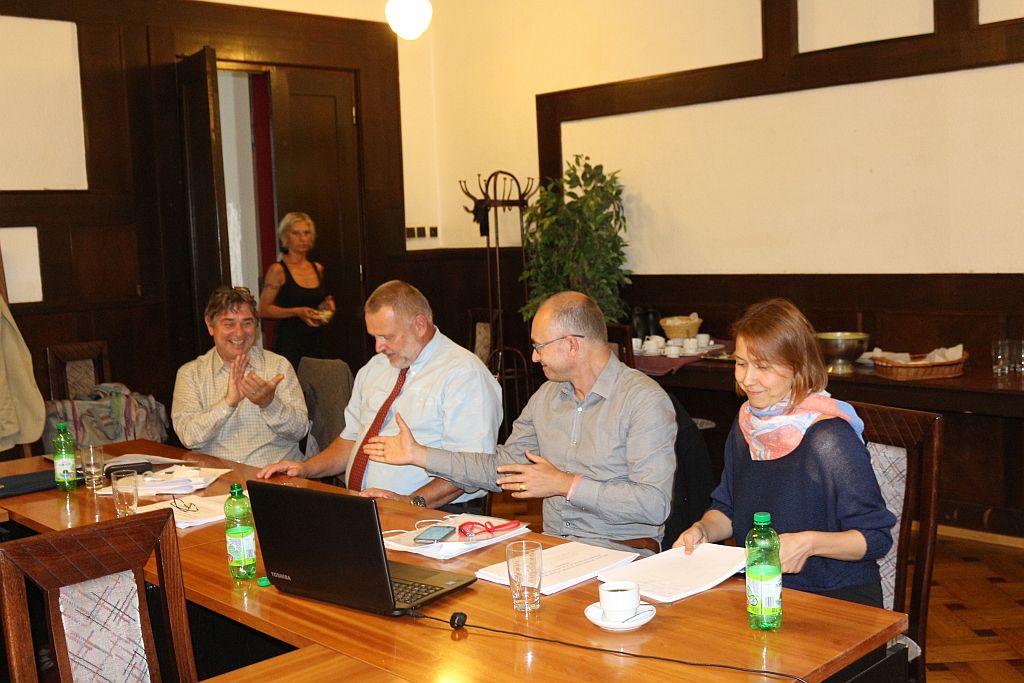
Side event of our project: a high school magazines national competition (Nejinspirativnější středoškolský časopis 2015). Here are the winners (picture credit: F. Cakl):

Czech

Contact details: OSNPM, e-mail: odborovy-svaz-novinaru@seznam.cz, website: http://www.odborovysvaznovinaru.cz


Slovakia

The European Federation of Journalists (EFJ), its Austrian union GPA-djp and the Slovak Union of Journalists (Slovenský syndikát novinárov) organized a meeting in Vienna, on 30 October 2014. Trade unionists and media students from both countries met in GPA-djp offices, in Vienna. The discussion on media convergence was launched by Dr. Roman Hummel, from the university of Salzburg.

Contact details: Judith Reitstaetter, judith.reitstaetter (at) gpa-djp.at


Estonia

The European Federation of Journalists (EFJ), the Estonian Union of Journalists (Eesti Ajakirjanike Liit, EAL) and the Union of Journalists in Finland (Suomen Journalistiliitto, UJF) agreed on 6 February 2015 to jointly implement the project “Workshops to Strengthen Journalists’ organisation in Estonia”.

The main objective of the project is to strengthen journalists’ organisation in Estonia, through three activities:

  • a freelance workshop in Helsinki,
  • a radio & TV negotiators workshop in Helsinki,
  • an authors’ rights seminar in Tallinn.

An action plan will be proposed for the next period.

Contact details: Juha Rekola, Juha.Rekola (at) journalistiliitto.fi, and Helle Tiikmaa, helle (at) eal.ee
 

Actions

Ukraine: Two Russian journalists killed within three days in occupied Donetsk region

Two Russian journalists have been killed in separate incidents in Russia’s occupied Donetsk region in eastern Ukraine. Journalist of News.ru, Nikita Tsitsagi, died on 16 June, in a drone attack amidst ongoing battles. Earlier, Valery Kozhin, a cameraman of Russian state-controlled media NTV, also died after a shelling attack near Horlivka, on 13 June. The International and European Federation of Journalists (IFJ-EFJ) strongly condemn these killings and urge the authorities to conduct a swift investigation into the deaths of the journalists. According to a report from News.ru, Tsitsagi lost his life while reporting in the town of Vugledar, which was…

Portugal: “Community media is especially needed in these times of great polarisation”

Mensagem de Lisboa is a community-focused media outlet based in the Chiado district in Lisbon, Portugal. Their mission is to disclose the small and human-interest stories in a big metropolis like Lisbon, an objective in line with the opportunity offered by the Local Media for Democracy (LM4D) funding scheme. “There are only a few projects that allow you to do what this project does: to work at the purely local level,” said Catarina Cavalho, editor and co-founder of Mensagem de Lisboa. “Community media is especially needed in these times of greater polarisation and distancing between communities.” They partnered with trusted…

Serbia: KRIK journalists facing SLAPPs after publishing the profile of Judge Dušanka Đorđević in database

The undersigned journalists and media freedom organisations condemn the legal actions filed by Judge Dušanka Đorđević and her husband against Crime and Corruption Reporting Network (KRIK), its editor-in-chief Stevan Dojčinović, and journalist Bojana Pavlović. The Media Freedom Rapid Response (MFRR) coalition considers those legal actions as Strategic Lawsuits Against Public Participation (SLAPPs), aiming at silencing KRIK for its investigative work. The SLAPPs are vexatious legal actions that are pursued as a means of harassing or intimidating journalists, media outlets, and other public watchdogs.  The lawsuits followed KRIK’s publication of Judge Dušanka Đorđević and her husband’s profile on the “Judge Who Judges”…

European Media Freedom Act (EMFA): What does it mean for journalists ?

The European Media Freedom Act (EMFA) entered into force on 7 May 2024. The new rules will fully apply at national level in each EU member state as of 8 August 2025. It has been said this is a historic act as the European Media Freedom Act, called “EMFA”  is the first European regulation dealing with all media. The European Federation of Journalists (EFJ), together with other media freedom groups, the European Broadcasting Union (EBU) and civil society organisations, has worked hard for over two years to get an ambitious act. A future-proof act against the growing attacks against journalism,…

European Commission study on journalist safety lacks solutions while security deteriorates

The European Federation of Journalists (EFJ) joins the undersigned organisations in welcoming the recent study on the actions taken by Member States to implement the European Commission’s Recommendation on the protection and safety of journalists. However, our coalition finds that the report lacks a critical assessment of on-the-ground realities that reduce the effectiveness of initiatives that otherwise look good on paper. We stress therefore the need for more effective measures, and a deeper engagement with journalists and media freedom organizations, to build structures that can genuinely safeguard journalist safety in Europe. The Media Freedom Rapid Response (MFRR) coalition reviewed the recently published…

Georgia: MFRR partners call for lifting ban on journalists’ access to Parliament

The European Federation of Journalists (EFJ) joined the Media Freedom Rapid Response (MFRR) partners in condemning the barring of journalists from reporting within the Parliament of Georgia. We urge the Parliament to reinstate the accreditation of all journalists including online media. Since the start of the debate on the foreign agent bill titled “Law on Transparency of Foreign Influence in Georgia,” journalists from online outlets have been barred from the Parliament. On 27 May 2024, Speaker of the Parliament Shalva Papuashvili signed a decree on “enhancing security levels,” indefinitely barring online media journalists and visitors from attending parliamentary sessions. Since…