European Federation of Journalists

IFJ-EFJ Regional Development Fund

Czech Republic


The European Federation of Journalists (EFJ) signed an agreement on 18 December 2014 with the Union of Journalists and Media Workers of Czech Republic (OSNPM) in order to investigate the working conditions of Czech journalists and media workers. The project is implemented with the cooperation of Judith Reitstatter, from the Austrian union GPA-djp.

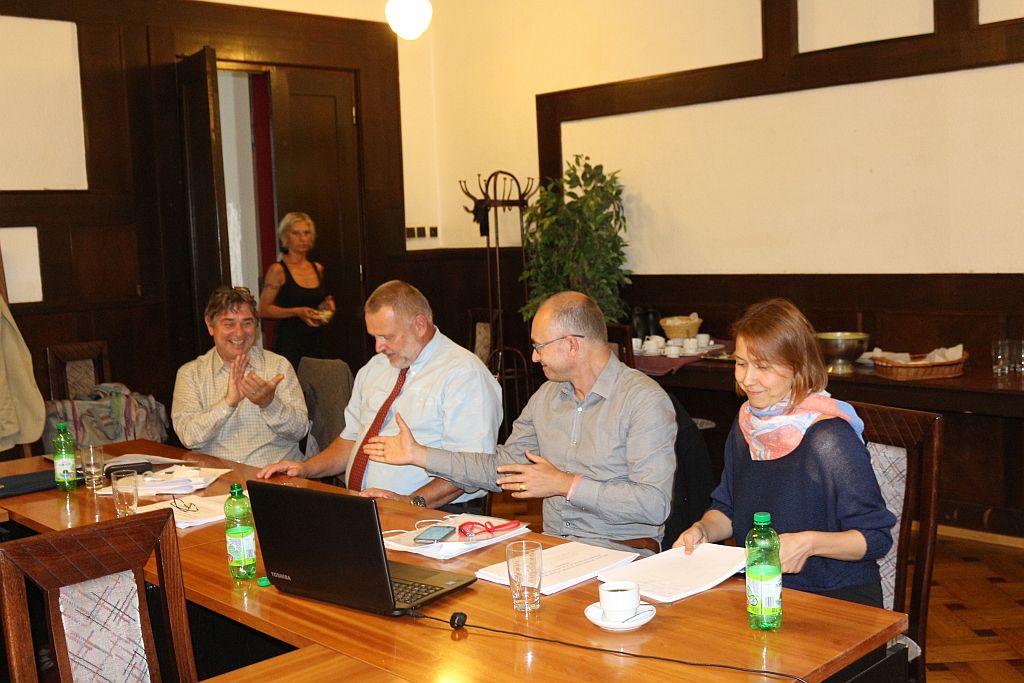
The online survey was launched on 19 May 2015. Around 2,500 journalists and media workers were invited to participate to the survey. The EFJ, OSNPM and GPA-djp analysed together the main outcomes of the survey during a round table conference, on 19 August 2015, in Prague.

The questionnaire focus mainly on labour rights. “This area is underestimated by the Czech media, journalists themselves and their employers as well,” explains Zdeněk Kučera, chairman of OSNPM.

“Over the past 25 years, journalists’ attention was focused primarily toward freedom of speech, access to information, relations with media ownership and the development of media houses. These are very serious topics. However, journalists’ status remained grossly underrated. A specific problem is the status of freelance journalists, which are increasingly numerous, particularly in regional media.”

The main findings of the survey are available on the EFJ website, here.
FOCUS EFJ

Side event of our project: a high school magazines national competition (Nejinspirativnější středoškolský časopis 2015). Here are the winners (picture credit: F. Cakl):

Czech

Contact details: OSNPM, e-mail: odborovy-svaz-novinaru@seznam.cz, website: http://www.odborovysvaznovinaru.cz


Slovakia

The European Federation of Journalists (EFJ), its Austrian union GPA-djp and the Slovak Union of Journalists (Slovenský syndikát novinárov) organized a meeting in Vienna, on 30 October 2014. Trade unionists and media students from both countries met in GPA-djp offices, in Vienna. The discussion on media convergence was launched by Dr. Roman Hummel, from the university of Salzburg.

Contact details: Judith Reitstaetter, judith.reitstaetter (at) gpa-djp.at


Estonia

The European Federation of Journalists (EFJ), the Estonian Union of Journalists (Eesti Ajakirjanike Liit, EAL) and the Union of Journalists in Finland (Suomen Journalistiliitto, UJF) agreed on 6 February 2015 to jointly implement the project “Workshops to Strengthen Journalists’ organisation in Estonia”.

The main objective of the project is to strengthen journalists’ organisation in Estonia, through three activities:

  • a freelance workshop in Helsinki,
  • a radio & TV negotiators workshop in Helsinki,
  • an authors’ rights seminar in Tallinn.

An action plan will be proposed for the next period.

Contact details: Juha Rekola, Juha.Rekola (at) journalistiliitto.fi, and Helle Tiikmaa, helle (at) eal.ee


Actions

Serbia: EFJ condemns acquittals in Slavko Ćuruvija murder case

The European Federation of Journalists (EFJ) supports the demonstration organised today at 2pm in front of the Belgrade Court of Appeal to denounce the outrageous acquittal of the alleged killers of Serbian journalist Slavko Ćuruvija. We call on the Serbian authorities to put an end to impunity in this case. “The murder of journalist Slavko Curuvija, which was ordered and organised by the state, remains an unpunished crime, 25 years after it was committed and nine years after the start of the trial,” the Slavko Curuvija Foundation said, noting that the Court of Appeal acquitted four members of the State…

Bosnia and Herzegovina must not become the only European country without a public service media

Bosnia and Herzegovina Radio and Television (BHRT) is facing catastrophic financial difficulties and risks being shut down, leaving 800 employees with no job, if a funding agreement is not reached. The European and International Federations of Journalists (EFJ-IFJ) appeals to the BHRT management and politicians to find a solution as a matter of urgency. The national public broadcaster was deprived of its only source of income, when the state-owned electric utility company Elektroprivreda BiH did not collect the TV licence fees from the citizens along with their January electricity bills. The contract with Elektroprivreda BiH was not renewed last December…

EFJ calls on EU Member States to reach agreement on the AI Act

As the Council of the EU is expected to vote on the AI Act on 2 February 2024, the European Federation of Journalists (EFJ) urges the EU Member States to reach a long-awaited political agreement on this important text for journalism. The media reported that Germany and France were still blocking several provisions just a few days before the vote, suggesting that negotiations are not yet completely concluded. They fear that this regulation will subject their startups to increased scrutiny related to foundation models. In Germany, the coalition government could withhold its backing for the law. With an internal consultation…

Webinar: Assessing the state of press freedom in Greece

30 January 2024 11:00 CET Register here   On 30 January, international media freedom groups will hold a webinar and press conference to mark the publication of a major report assessing the landscape for press freedom and independent journalism in Greece, following a mission to Athens in September 2023. The report examines the clear period of deterioration in media freedom in the EU Member State over the last few years, identifies the reasons behind this deterioration, and sets out recommendations for steps to be taken to address these many challenges. It also provides a detailed analysis of the measures taken…

EFJ calls on future Secretary General of the Council of Europe to commit to press freedom

The European Federation of Journalists (EFJ) welcomes the call by the Parliamentary Assembly of the Council of Europe (PACE) to enforce Council of Europe standards on media freedom. This must be the top priority for the next Secretary General of the Council of Europe, who will be elected in June. Meeting in Strasbourg on 25 January, PACE emphasised the pressing need “to enforce the high standards on media freedom which the Council of Europe has established, to ensure effective protection of journalists and to uphold in all member States a friendly and safe environment for media independence and pluralism”. It…

Interview with CBLocal grantees: “Safety trainings should be compulsory for journalists, and editors too”

Journalists sometimes find themselves in high-risk environments for their physical safety, because of the nature of the assignment or because they are ill-equipped and poorly trained in safety issues. According to a 2022 EFJ survey about the risk perceptions and safety concerns of journalists in Europe, media professionals seriously lack training and awareness while threats and intimidation at work are increasing. Based on these findings, the ‘Local Cross-Border Investigative Journalism’ (CBLocal) project integrated an important element of journalists’ safety in its grant programme supporting cross-border investigations. Four journalists underwent an online safety course for two weeks with media safety expert…