European Federation of Journalists

IFJ-EFJ Regional Development Fund

Czech Republic


The European Federation of Journalists (EFJ) signed an agreement on 18 December 2014 with the Union of Journalists and Media Workers of Czech Republic (OSNPM) in order to investigate the working conditions of Czech journalists and media workers. The project is implemented with the cooperation of Judith Reitstatter, from the Austrian union GPA-djp.

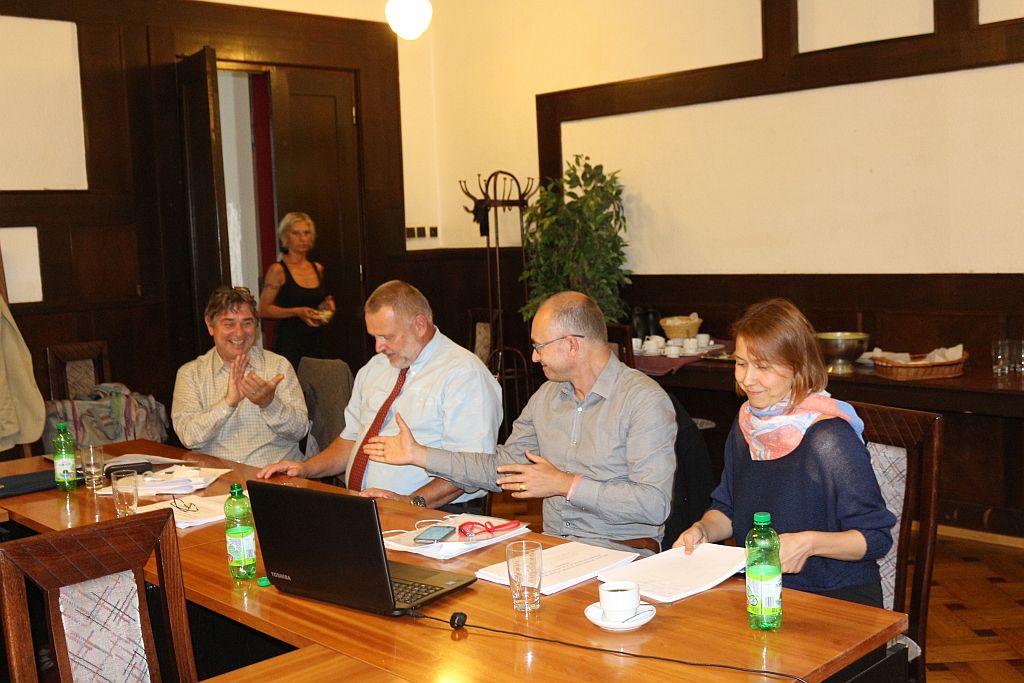
The online survey was launched on 19 May 2015. Around 2,500 journalists and media workers were invited to participate to the survey. The EFJ, OSNPM and GPA-djp analysed together the main outcomes of the survey during a round table conference, on 19 August 2015, in Prague.

The questionnaire focus mainly on labour rights. “This area is underestimated by the Czech media, journalists themselves and their employers as well,” explains Zdeněk Kučera, chairman of OSNPM.

“Over the past 25 years, journalists’ attention was focused primarily toward freedom of speech, access to information, relations with media ownership and the development of media houses. These are very serious topics. However, journalists’ status remained grossly underrated. A specific problem is the status of freelance journalists, which are increasingly numerous, particularly in regional media.”

The main findings of the survey are available on the EFJ website, here.
FOCUS EFJ

Side event of our project: a high school magazines national competition (Nejinspirativnější středoškolský časopis 2015). Here are the winners (picture credit: F. Cakl):

Czech

Contact details: OSNPM, e-mail: odborovy-svaz-novinaru@seznam.cz, website: http://www.odborovysvaznovinaru.cz


Slovakia

The European Federation of Journalists (EFJ), its Austrian union GPA-djp and the Slovak Union of Journalists (Slovenský syndikát novinárov) organized a meeting in Vienna, on 30 October 2014. Trade unionists and media students from both countries met in GPA-djp offices, in Vienna. The discussion on media convergence was launched by Dr. Roman Hummel, from the university of Salzburg.

Contact details: Judith Reitstaetter, judith.reitstaetter (at) gpa-djp.at


Estonia

The European Federation of Journalists (EFJ), the Estonian Union of Journalists (Eesti Ajakirjanike Liit, EAL) and the Union of Journalists in Finland (Suomen Journalistiliitto, UJF) agreed on 6 February 2015 to jointly implement the project “Workshops to Strengthen Journalists’ organisation in Estonia”.

The main objective of the project is to strengthen journalists’ organisation in Estonia, through three activities:

  • a freelance workshop in Helsinki,
  • a radio & TV negotiators workshop in Helsinki,
  • an authors’ rights seminar in Tallinn.

An action plan will be proposed for the next period.

Contact details: Juha Rekola, Juha.Rekola (at) journalistiliitto.fi, and Helle Tiikmaa, helle (at) eal.ee


Actions

Denmark: Condemnation of legal threats against Danwatch by Ingosstrakh and ELWI

The European Federation of Journalists (EFJ) joins the undersigned media freedom and journalists’ organisations in condemning the legal threats issued by the Moscow-based law firm ELWI on behalf of the Russian insurance company Ingosstrakh against the Danish investigative media outlet Danwatch. These actions represent an attempt to intimidate and silence independent journalism, and we stand in full solidarity with Danwatch and its journalists in the face of these threats. Between December 2024 and January 2025, Danwatch received four strongly worded legal letters from ELWI, representing their client Ingosstrakh, a major Russian insurance company, which has previously been sanctioned by the…

No concessions to Big Tech: EFJ demands comprehensive transparency obligations for AI model providers

The European Commission has released a draft template for the summary of training data designed to support the implementation by AI model operators of the transparency obligations from the AI Act. The European Federation of Journalists (EFJ) calls on the EU Commission’s AI Office not to be influenced by the Big Tech industry when formulating these obligations and urges to protect the legitimate interests of authors. In order to implement the transparency requirements of the AI Act for providers of generative AI models, the AI Office is currently working on so-called templates. These templates will set the legally binding framework…

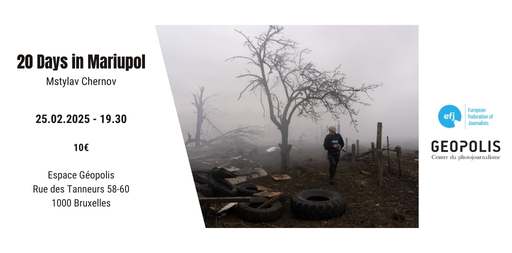
“20 Days in Mariupol” – Charity Screening in Brussels on 25 February

To mark the third anniversary of the unprovoked invasion of Ukraine, the European Federation of Journalists (EFJ), in collaboration with the Center of Photojournalism Géopolis, invites you to the screening of the Oscar-winning documentary “20 Days in Mariupol”. The screening will take place on 25 February 2025 at 19.30 in Brussels. Directed by Ukrainian filmmaker and Pulitzer Prize-winning journalist Mstyslav Chernov, the documentary offers a harrowing firsthand account of the early days of Russia’s full-scale invasion of Ukraine. Captured by Associated Press journalists trapped in the besieged city of Mariupol, the film provides undeniable evidence of Russian war crimes –…

Monitoring Report 2024: 1,548 media freedom alerts in the past year

The Media Freedom Rapid Response (MFRR) published its annual Monitoring Report analysing the press freedom situation in 35 European countries, including the 27 EU Member States and nine countries with EU candidate status. Between January and December 2024, Mapping Media Freedom documented 1,548 press freedom violations targeting 2,567 media-related persons or entities – an alarming increase compared to the 1,153 violations recorded in 2023. Smear campaigns, websites disguised as legitimate news outlets, and obstruction and attacks during reporting are just a few of the major issues media workers faced in 2024. Journalists also faced verbal attacks, physical assault, attacks against…

Explaining the EMFA with the European Audiovisual Observatory

The Council of Europe’s European Audiovisual Observatory (EAO) published a report analysing the European Media Freedom Act (EMFA) ahead of the entry into force of several articles in February 2025. The report highlights both the weaknesses and the strengths of the EMFA, whose application could vary depending on the will of national governments. Although the EMFA has many loopholes, it is the first legal document capable of protecting media freedom and the work of journalists in general. Published in December 2024, the report is divided into 3 main sections: “Legal basis and (ongoing) controversy”, “The EMFA in a nutshell”, and…

EAO report: Unpacking the EMFA

The Council of Europe’s European Audiovisual Observatory (EAO) published a report analysing the European Media Freedom Act (EMFA) ahead of the entry into force of several articles in February 2025. The report highlights both the weaknesses and the strengths of the EMFA, whose application could vary depending on the will of national governments. Although the EMFA has many loopholes, it is the first legal document capable of protecting media freedom and the work of journalists in general.In this article, we have summarised the main points raised by this report. The institutional framework Chapter IV of the EMFA introduces the institutional…