France mission report: Media freedom at critical juncture ahead of the 2027 presidential election
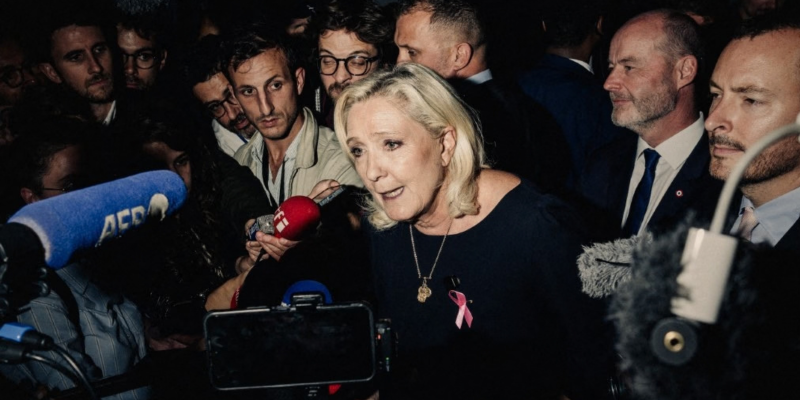
Although France enjoys a legal and regulatory framework which is generally supportive of media freedom, challenges are mounting ahead of the 2027 presidential election, the European Federation of Journalists (EFJ) concluded with its partners from the Media Freedom Rapid Response (MFRR) in a new report published today.
The report follows an international press freedom mission to Paris in June, which was led by the European Federation of Journalists (EFJ), and joined by partner organisations of the Media Freedom Rapid Response (MFRR). The mission was also joined by Reporters Without Borders (RSF), EFJ French affiliates (SNJ, SNJ-CGT, CFDT Journalistes and FASAP-FO), and MFRR official partner OFALP.
In recent years, the MFRR consortium and RSF have documented a persistent and growing number of attacks against media professionals. Pressures on media freedom and media pluralism are unfolding against the backdrop of the 2027 presidential elections and in a highly polarised political environment.
Political deadlock in the parliament and the approaching electoral cycle have stalled key media freedom reforms or fast-tracked them without due democratic consultation. At the same time, growing electoral support for far-right political parties, some of which have demonstrated particular hostility towards journalists, particularly those working for the public broadcaster, raises questions about the future direction of media policy and reform, as well as the protection of journalists’ rights.
The report provides an in-depth analysis of the state of media freedom in the country, following in person and online meetings with journalists, editors, legal experts, civil society organisations, the media regulator Arcom, and government officials including representatives of the Ministry of Culture, the Ministry of Interior, and the Ministry of Justice. It also examines the state of implementation of EU media laws and outlines key recommendations to reverse the worrying trend.
The growing concentration in the hands of industrial billionaires, and circumvention of rules regarding internal pluralism, urgent action from the authorities is required to implement the European Media Freedom Act (EMFA). Implementation of EMFA into national law has been stalled, leaving the question of the media regulatory authority Arcom’s regulatory mandate over print and online press unresolved, with no clear timeline for reforms in sight.
Months following the Parliamentary Commission Inquiry, France’s public service broadcasters have also faced intensified continued political pressure over their funding, governance and perceived impartiality, eroding public trust at a crucial time.
The safety of journalists covering demonstrations is also a particular concern. Journalists covering protests, unrest and politically sensitive events are at risk of violence, particularly at the hands of law enforcement officers, despite being identified as press in most cases. The report addresses the ongoing failure to implement the National Law Enforcement Scheme, the delay in imposing administrative sanctions for police misconduct and the downgrading of the National Plan on Urban Violence to an operational guide that does not recognise the special status of the press.
Vexatious litigation, including Strategic Lawsuits Against Public Participation (SLAPPs), remains one of the most common tools used to suppress the free press in the country. Although an Anti-SLAPP law was passed in 2026 and covers domestic cases, the law is widely considered to be lacking.
Another pressing issue affecting media freedom in France is the insufficient protection of journalists’ sources. The 2010 law governing source protection contains vague wording and a lack of meaningful standards, and has enabled repeated breaches of press freedom over the past 15 years, including major cases in recent years affecting investigative journalists.
Mission partners also met with journalists in exile from Tunisia, Afghanistan, Benin, Algeria, Guinea, Egypt, Yemen, Pakistan and Haiti, to understand their needs, which ranged from safety to the ability to continue working once they arrived in France.
Key recommendations to French authorities include:
- Give full effect to the European Media Freedom Act (EMFA), with a particular focus on source protection (Art. 4), public service media independence (Art. 5), and media concentration criteria (Art. 22);
- Adopt strong anti-monopoly and editorial independence laws for the media;
- Amend law no. 2010-1 on the Protection of Journalistic Sources with stricter and more clearly defined limitations to the conditions on the lifting of source confidentiality, including independent judicial review ;
- Amend anti-SLAPP legislation to align with Council of Europe Recommendation on countering the use of SLAPPs;
- Thoroughly investigate online and offline attacks on journalists to identify perpetrators and held them accountable;
- Enforce law enforcement officers accountability for attacks against media professionals, and implement the National Law Enforcement Scheme (SNMO) ;
- Strengthen support to exiled journalists through network building, funding, and language training
- Take measures to address transnational repression against journalists residing in France;
The mission report was produced by the European Federation of Journalists (EFJ), ARTICLE 19 Europe, the European Centre for Press and Media Freedom (ECPMF), Free Press Unlimited (FPU), International Press Institute (IPI), and the Osservatorio Balcani e Caucaso Transeuropa (OBCT) while RSF contributed to some sections of the report.
For press enquiry, please contact – secretariat@europeanjournalists.org ; Camille Magnissalis cmagnissalis@europeanjournalists.org
This statement was produced as part of the Media Freedom Rapid Response (MFRR), a Europe-wide mechanism which tracks, monitors and responds to violations of press and media freedom in EU Member States and candidate countries.