Slovenia must protect independent and sustainable funding for RTV Slovenija

The European Federation of Journalists (EFJ) stands with its Slovenian affiliates, the Trade Union of Slovenian Journalists (SNS) and the Slovenian Association of Journalists (DNS), in their defense of independent, sustainable and predictable funding for the public service media RTV Slovenija.
On 11 October 2026, Slovenian citizens will vote in a consultative referendum on the proposed abolition of the mandatory RTV contribution that finances RTV Slovenija. The referendum question reads: “Are you in favour of abolishing the mandatory payment of the contribution for Radiotelevizija Slovenija programmes?”
The referendum proposal was initiated by the parliamentary groups of SDS, NSi, SLS, Fokus, Anže Logar’s Democrats and Resni.ca.
Our Slovenian affiliates, campaigning against the abolition of the RTV contribution, warn that removing the existing funding model without first establishing a credible and legally guaranteed alternative could seriously jeopardise the financial stability and independence of RTV Slovenija.
The EFJ supports them and shares their concerns. This debate is not merely about the monthly amount of the RTV contribution. It is about the conditions necessary for public service media to remain independent from political and commercial pressure and to fulfill their democratic and social role.
The European Media Freedom Act (EMFA) sets a clear European standard. Article 5 requires Member States to ensure the editorial and functional independence of public service media providers. Their funding procedures must be based on transparent and objective criteria established in advance and must guarantee adequate, sustainable and predictable financial resources that enable them to fulfill their public service remit while safeguarding editorial independence.
EMFA is very clear about the standard that must be met: public service media must have sufficient resources, their funding must be sustainable and predictable, and the funding system must not become an instrument of political influence.
“Changes to funding models can and should be subject to democratic debate. But abolishing an existing source of funding without first putting in place a credible, sustainable and genuinely independent alternative poses a serious risk to public service media and their journalists, as well as to all citizens. The standards laid out in the European Media Freedom Act must be respected in Slovenia, just as it must be respected in every other European Union Member State,” said Maja Sever, EFJ President.
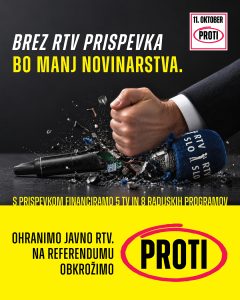
RTV Slovenija fulfills a public service remit that includes radio, television and digital news services, educational and cultural programmes, programmes for minorities, content for people with disabilities, children’s programming and other content serving the public interest.
The future of RTV Slovenija therefore cannot be reduced to the question of a single monthly contribution. The key question is how Slovenia will ensure a strong and independent public service media organisation that is accountable to citizens rather than dependent on the political will of the government of the day.
The EFJ stresses that stable funding and editorial independence are inseparably linked. When a public service media organisation must negotiate year after year for the resources it needs to survive, it becomes more vulnerable to political pressure, regardless of which political force is in power.
The EFJ calls on the Slovenian authorities to ensure that any future changes to RTV Slovenija’s funding or governance model are fully compliant with Article 5 of the European Media Freedom Act. Strong public service media are essential for media pluralism, citizens’ right to reliable information and the functioning of a democratic society. Protecting their independence is not a privilege for journalists or media organisations; it is about protecting the public they serve.
That is why we call on citizens to take part in the referendum and vote PROTI (AGAINST).