European Federation of Journalists

openMedia, investigating press freedom

Title of the project : openMedia, investigating press freedom
Lead Applicant
: openDemocracy

Partner organisations : EFJ, Index on censorship, King’s College London

The recently launched openMedia project aims to investigate and expose commercial interference in editorial decisions. The project is run by openDemocracy with the European Federation of Journalists (EFJ) as a partner alongside the Index on Censorship and King’s College London.

The project believes that there has not been enough of a concerted, ongoing spotlight on the extent and effects of commercial influence over the media, despite the dangerous consequences it poses for press freedom. For now, the project focuses on 47 countries across Europe but also has ambitions to expand.

Despite the recent launch, the project is adamant that it is not a response to the “fake news” hype of the past year or so. Rather, the project responds to scandals of commercial sponsors influencing media content; for example the Daily Telegraph’s suppression of investigations into its advertiser HSBC; and allegations that Buzzfeed deleted articles which advertisers found unfavourable.

According to the project, this power dynamic can suppress investigations of banks, pharmaceuticals, agriculture, fossil fuel giants, energy companies and other big businesses.

In addition, the project recognizes how for many readers, “sponsored content” is difficult to distinguish from genuine news content. The project therefore aims to clarify the commercial interests apparent in media to readers, and as part of the project, King’s College London will develop digital tools to help readers be better informed about news sources.

The findings of the project will be used to campaign for greater transparency and press freedom in news organisations and to empower journalists to advocate for transparency.

In order to do this, openMedia is currently conducting a confidential and anonymous survey of journalists across Europe, asking about their own working practices and experiences of commercial pressure inside newsrooms. The survey is available in English here and in many other languages here.
Actions

Major questions about journalists in Portugal: Precarity, low wages, gender gap and early retirement

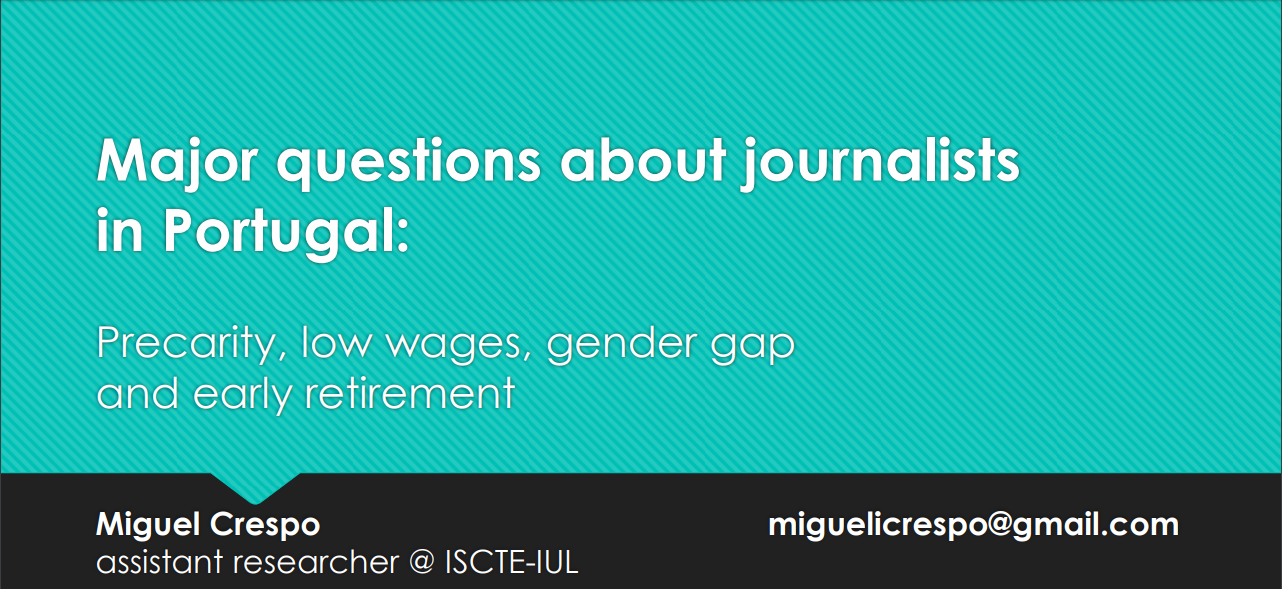
A survey in Portugal, performed by University Institute of Lisbon (ISCTE-IUL), aimed at analyzing the working conditions of Portuguese journalists, exploring the diversity of journalists, and identifying the main constraints and challenges. Almost 1 500 journalists were surveyed between 1st of May and 13th of June, 2016, with 78 questions on the current situation and their future, for the data to be comparable to international data. There are 6 161 journalists holding a professional licence or its equivalent in Portugal, according to The Comissão da Carteira Profissional de Jornalista (CCPJ), 16th March 2018, with 51.8% male and 48.2% female journalists. The survey…

“Words That Matter” – glossary by Cypriot journalists to address local issues

On 10th of July in Nicosia, the Office of the OSCE Representative on Freedom of the Media (RFOM) in cooperation with the Ethical Journalism Network (EJN), and several local journalists, including members of EFJ affiliates Basin-Sen and Union of Cyprus Journalists,  has published “Words That Matter“, a trilingual glossary in English, Greek, and Turkish, to list phrases and words, used by the journalists in communities, which may be taken sensitively. The glossary resulted from a common effort between the organisations to minimise hate speech in journalism, as well as trying to overcome the long-lasting tensions between Greek Cypriot and Turkish…

Turkey : Three newspapers and one TV station closed by decree-law

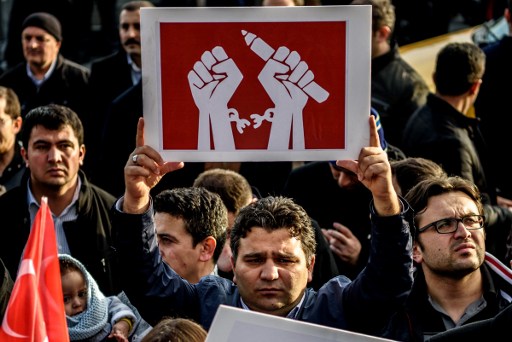
On July 9, 2019, the Turkish government issued a decree-law firing 18,632 civil servants due to their alleged ties to “terrorist groups” and closing 12 associations, three newspapers and one TV station. The decree also dismissed 199 academics, some of whom were among the signers of the Academics for Peace initiative, which called on the Turkish government to halt military operations in the country’s Southeast, which resulted in hundreds of deaths and some hundred thousand displaced people. Among the closed newspapers, Özgürlükçü Demokrasi had been seized by the government in March when trustees were appointed to the board. Özgürlükçü Demokrasi,…

Turkey: Zaman journalists and columnists heavily sentenced to prison

On July 06, 2018, six journalists and columnists have been heavily sentenced to prison by a court in Istanbul for alleged membership to an armed illegal terrorist organisation. The suspects were all working for the late Zaman daily newspaper banned by the Turkish authorities following the failed coup attempt of July 15, 2016. “Our colleagues from Zaman newspaper did not take part to the coup attempt and have condemned it afterwards. Prosecuting workers solely on the basis of their work employment is not ruling based on facts but a politically motivated decision. The Turkish authorities must drop all the charges…

Ukraine: Draft bill to allow blocking of Internet sites without a court order

On 4 July 2018, the Ukrainian Parliament’s Committee on security and defence approved a draft bill that would enable prosecution and the National Security and Defence Council to block Internet sites they deem threatening to national security without a court ruling. According to the bill, Internet sites, can be blocked temporarily if they “threaten national security” or “have an impact on decision-making, or the action or inaction, of national or local government bodies, officials of these bodies, associations of citizens, or legal entities”. Internet providers would have to purchase equipment that would allow the security services to monitor traffic and…

European Authors call on MEPs to maintain their strong support to authors’ rights

The European organisations representing authors have acknowledged the decision of the European Parliament to postpone the adoption of its position on the Copyright Directive. The Authors’ Group now calls on MEPs to maintain their strong and cross-party support to reinforce the contractual position of authors in Europe so that the Copyright Directive can soon bring concrete benefits to authors’ rights in the European Union. The Authors’ Group represents more than half a million writers, composers, journalists, film directors, screenwriters and songwriters in Europe. Today, the European Parliament decided to postpone the adoption of its position on a Proposal for a Directive…