European Federation of Journalists

openMedia, investigating press freedom

Title of the project : openMedia, investigating press freedom
Lead Applicant
: openDemocracy

Partner organisations : EFJ, Index on censorship, King’s College London

The recently launched openMedia project aims to investigate and expose commercial interference in editorial decisions. The project is run by openDemocracy with the European Federation of Journalists (EFJ) as a partner alongside the Index on Censorship and King’s College London.

The project believes that there has not been enough of a concerted, ongoing spotlight on the extent and effects of commercial influence over the media, despite the dangerous consequences it poses for press freedom. For now, the project focuses on 47 countries across Europe but also has ambitions to expand.

Despite the recent launch, the project is adamant that it is not a response to the “fake news” hype of the past year or so. Rather, the project responds to scandals of commercial sponsors influencing media content; for example the Daily Telegraph’s suppression of investigations into its advertiser HSBC; and allegations that Buzzfeed deleted articles which advertisers found unfavourable.

According to the project, this power dynamic can suppress investigations of banks, pharmaceuticals, agriculture, fossil fuel giants, energy companies and other big businesses.

In addition, the project recognizes how for many readers, “sponsored content” is difficult to distinguish from genuine news content. The project therefore aims to clarify the commercial interests apparent in media to readers, and as part of the project, King’s College London will develop digital tools to help readers be better informed about news sources.

The findings of the project will be used to campaign for greater transparency and press freedom in news organisations and to empower journalists to advocate for transparency.

In order to do this, openMedia is currently conducting a confidential and anonymous survey of journalists across Europe, asking about their own working practices and experiences of commercial pressure inside newsrooms. The survey is available in English here and in many other languages here.
Actions

Meeting the challenge of atypical working – new handbook launched

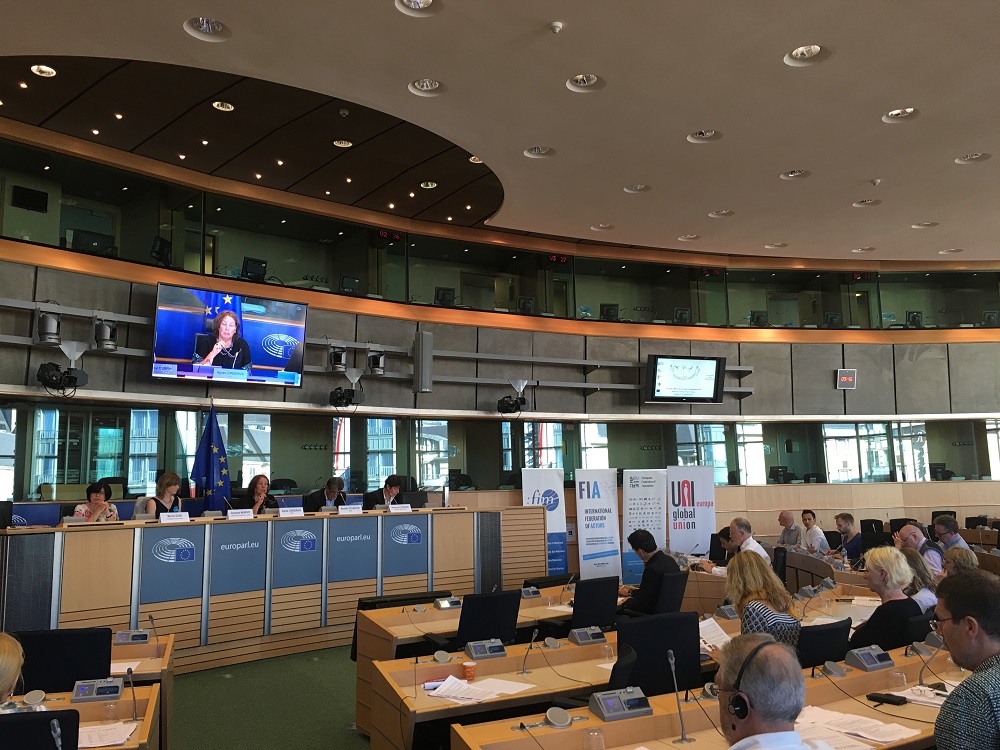
The Media, Arts and Entertainment sector has seen significant changes in the structure of the labour market and in the organisation of work both within and outside the framework of the traditional employment relationships – with an established trend towards various forms of atypical working arrangements. The European Federation of Journalists (EFJ), the International Federation of Actors (FIA), UNI MEI and the International Federation of Musicians (FIM) have today launched a handbook on ”The Future of Work in the Arts, Media & Entertainment Sector”, outlining conclusions and recommendations addressing atypical work in the Media, Arts and Entertainment sector. The launch…

Emergency fund for women journalists in crisis

The International Women’s Media Foundation (IWMF) Emergency Fund is established since 2013 to provide women journalists with a lifeline of support in times of crisis. Now more than ever, journalists around the world face real dangers as a result of their reporting. The Emergency Fund is sustained with the support of individual donors to address the growing need to provide direct assistance to women journalists who are suffering. The IWMF Emergency Fund provides women journalists with: Small grants for psychological and medical care for incidents directly related to threats and crises caused by one’s work as a journalist; Three months of…

Turkey’s failed coup: implications for journalists, unionists and human rights activists

The European and International Federations of Journalists (EFJ-IFJ) invite you for a press briefing on “Turkey’s failed coup: implications for journalists, unionists and human rights activists”, with Sanar Yurdatapan, Initiative for Freedom of Expression-Turkey and moderated by Mehmet Koksal (EFJ-IFJ). It will take place on Monday 12 September from 10:00 to 12:00 at the Press Club Brussels, 95 rue Froissard, in Brussels. Şanar Yurdatapan is a composer and human rights activist. Born in Susurluk (Turkey) in 1941, he became well-known as a composer and song-writer during the 1970s.  In 1979, he established DEMAR (Democratic Artists Community).  Following the military coup of 1980, he left…

South East Europe and Turkey journalists join European Labour Rights Experts group

Journalists and media workers from South East Europe and Turkey are able to share best practices, illuminate present challenges in labour rights and benefit from legal expertise after joining European Labour Rights Experts Group. “If journalists’ working conditions are poor, how can media be the driver for sustainable and peaceful development in the region? By promoting these exchanges, UNESCO and the European Federation of Journalists (EFJ) aim for a collective upgrade of media professionals’ rights, for the benefit of publics and democracy,” commented Mehmet Koksal, project officer from EFJ. Under the EU-funded project “Building Trust in media in South East…

Croatia: EFJ alarmed by extended term for acting general manager of public service media HRT

The Croatian technical Government decided to extend the term to Siniša Kovačić as acting HRT general manager from 6 months to 1 year besides internal and external opposition. With early elections scheduled for September 11, the technical government in July opened a ten-day-consulting process on a decree to amend the law on the Croatian Radio-Television, HRT in order to allow the acting head of HRT to stay on for a year, instead of six months, which is the timeframe stipulated under the existing law. While the regulation says that the present acting HRT general manager term shall be expanded until…

International civil society organisations condemn crackdown on freedom of expression in Turkey

From 31 August to 2 September, an international delegation of civil society organisations visited Istanbul to demonstrate solidarity with writers, journalists and media outlets in Turkey. The failed coup of 15 July, in which at least 265 people were killed, has traumatised the Turkish population and the government must bring those responsible for the violence to account. However, this must be done on the basis of specific, individual evidence of involvement in a crime and with full respect for international standards on the right to freedom of expression, the right to liberty and security and the right to a fair…