European Federation of Journalists

IFJ-EFJ Regional Development Fund

Czech Republic


The European Federation of Journalists (EFJ) signed an agreement on 18 December 2014 with the Union of Journalists and Media Workers of Czech Republic (OSNPM) in order to investigate the working conditions of Czech journalists and media workers. The project is implemented with the cooperation of Judith Reitstatter, from the Austrian union GPA-djp.

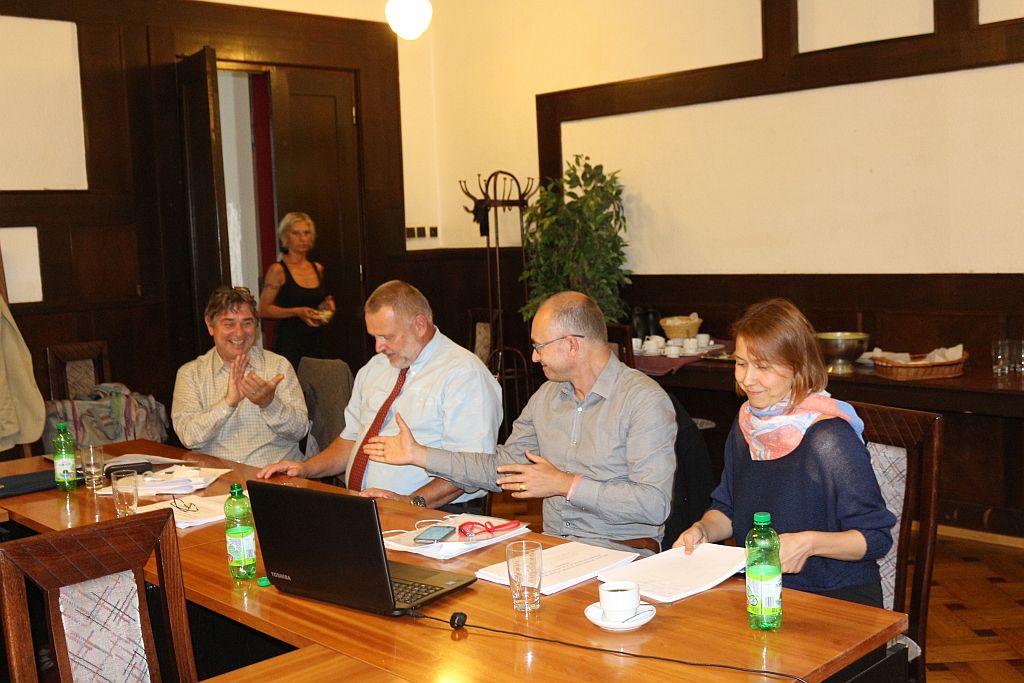
The online survey was launched on 19 May 2015. Around 2,500 journalists and media workers were invited to participate to the survey. The EFJ, OSNPM and GPA-djp analysed together the main outcomes of the survey during a round table conference, on 19 August 2015, in Prague.

The questionnaire focus mainly on labour rights. “This area is underestimated by the Czech media, journalists themselves and their employers as well,” explains Zdeněk Kučera, chairman of OSNPM.

“Over the past 25 years, journalists’ attention was focused primarily toward freedom of speech, access to information, relations with media ownership and the development of media houses. These are very serious topics. However, journalists’ status remained grossly underrated. A specific problem is the status of freelance journalists, which are increasingly numerous, particularly in regional media.”

The main findings of the survey are available on the EFJ website, here.
FOCUS EFJ

Side event of our project: a high school magazines national competition (Nejinspirativnější středoškolský časopis 2015). Here are the winners (picture credit: F. Cakl):

Czech

Contact details: OSNPM, e-mail: odborovy-svaz-novinaru@seznam.cz, website: http://www.odborovysvaznovinaru.cz


Slovakia

The European Federation of Journalists (EFJ), its Austrian union GPA-djp and the Slovak Union of Journalists (Slovenský syndikát novinárov) organized a meeting in Vienna, on 30 October 2014. Trade unionists and media students from both countries met in GPA-djp offices, in Vienna. The discussion on media convergence was launched by Dr. Roman Hummel, from the university of Salzburg.

Contact details: Judith Reitstaetter, judith.reitstaetter (at) gpa-djp.at


Estonia

The European Federation of Journalists (EFJ), the Estonian Union of Journalists (Eesti Ajakirjanike Liit, EAL) and the Union of Journalists in Finland (Suomen Journalistiliitto, UJF) agreed on 6 February 2015 to jointly implement the project “Workshops to Strengthen Journalists’ organisation in Estonia”.

The main objective of the project is to strengthen journalists’ organisation in Estonia, through three activities:

  • a freelance workshop in Helsinki,
  • a radio & TV negotiators workshop in Helsinki,
  • an authors’ rights seminar in Tallinn.

An action plan will be proposed for the next period.

Contact details: Juha Rekola, Juha.Rekola (at) journalistiliitto.fi, and Helle Tiikmaa, helle (at) eal.ee
 

Actions

Statement regarding the situation of media freedom in Turkey

Following the specific request of the delegates at the Annual Meeting held in Bucharest on 18-19 May 2017 asking for a strong position of the European Federation of Journalists (EFJ), the Steering Committee issued the following statement regarding the situation of media freedom in Turkey : The EFJ, fighting in cooperation with the IFJ and all its affiliates, welcomes the “send a postcard to jailed journalists in Turkey campaign” in the framework of its #JournalismisNOTacrime / #Gazeteciliksuçdegildir project inviting everyone to send written moral support to journalists and media workers in jail. 165 journalists are still in jail according to…

Slovenia to reform labour laws enforcing contractual obligations

The Slovenian government has recently introduced two draft labour laws on employment and labour inspection. The main changes concern giving the labour inspectors more authority to act, especially when the employer fails to pay the salary of employees, accelerate the process whereby the unemployed take up employment again and make employment contract termination more flexible. “Precarious conditions are becoming more and more common, not just in Slovenia, but also in Europe,” said Anja Kopač Mrak, the Slovenian minister of Labour, Family, Social Affairs and Equal Opportunities at the voting session of the draft labour laws at the beginning of this…

EFJ responds to EU consultation on access to social protection

The European Federation of Journalists (EFJ) has responded to a consultation launched by the European Commission calling for equal access and treatment of freelance and atypical workers in journalism. The consultation on ”a possible action addressing the challenges of access to social protection for people in all forms of employment” has identified a number of issues facing the so-called ”atypical workers”. In journalism, these atypcial workers are characterised by the work of freelance journalists who mostly are precarious due to the existing gap in social protection and wage. The EFJ welcomed the consultation and the challenges identified by the Commission.…

26/06: Debate on the precarious state of journalism at the Press Club Brussels

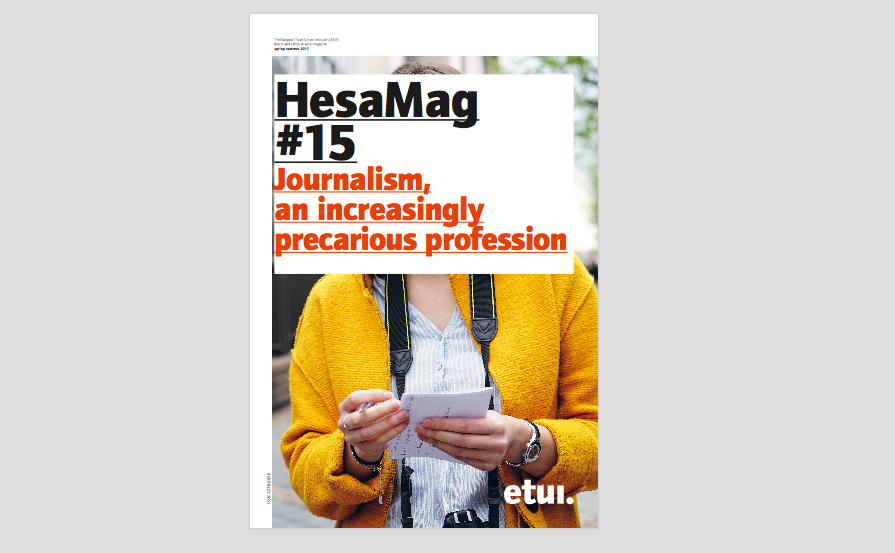
The EFJ and ETUI invite you to a debate on 26 June at the Press Club Brussels Europe at 10.30 am to 12 noon, rue Froissart 95, 1040 Brussels. There appears to be no end in view to the crisis gripping the mainstream media, the profit statements of the various media groups are far from the only pitiful sight, and information professionals are also feeling the pressure – these are just some of the conclusions to emerge from the analysis of the state of journalism in Europe which appears in the latest issue of HesaMag – the journal published by the European Trade…

EFJ responds to EU consultation on Written Statement Directive

The European Federation of Journalists (EFJ) has responded to the consultation on the Written Statement Directive that obliges employers to inform employees their rights and conditions applicable to the contract or employment relationship. The consultation was launched by the European Commission within the framework of the European Pillar of Social Rights. The EFJ welcomes the consultation looking into improved protection for workers especially the so-called atypical workers who are in precarious working conditions. Here is the EFJ’s response.

A study on the impact of the Panama Papers recommends the EU to protect whistleblowers

A recent study carried out by Blomeyer & Sanz in early 2017 – assessing the impact of the Panama Papers revelations on the economy and finances of eight European Member States – recommends the European Union to introduce measures to guarantee the protection of whistleblowers. “This will improve the availability of the data and act as a driver against the use of tax haven schemes”, the report says. More transparency is also suggested in order to better monitor and prevent the use of such schemes. Study on impact of #PanamaPapers on 8 MS economy recommends more transparency & measures to protect…