European Federation of Journalists

openMedia, investigating press freedom

Title of the project : openMedia, investigating press freedom
Lead Applicant
: openDemocracy

Partner organisations : EFJ, Index on censorship, King’s College London

The recently launched openMedia project aims to investigate and expose commercial interference in editorial decisions. The project is run by openDemocracy with the European Federation of Journalists (EFJ) as a partner alongside the Index on Censorship and King’s College London.

The project believes that there has not been enough of a concerted, ongoing spotlight on the extent and effects of commercial influence over the media, despite the dangerous consequences it poses for press freedom. For now, the project focuses on 47 countries across Europe but also has ambitions to expand.

Despite the recent launch, the project is adamant that it is not a response to the “fake news” hype of the past year or so. Rather, the project responds to scandals of commercial sponsors influencing media content; for example the Daily Telegraph’s suppression of investigations into its advertiser HSBC; and allegations that Buzzfeed deleted articles which advertisers found unfavourable.

According to the project, this power dynamic can suppress investigations of banks, pharmaceuticals, agriculture, fossil fuel giants, energy companies and other big businesses.

In addition, the project recognizes how for many readers, “sponsored content” is difficult to distinguish from genuine news content. The project therefore aims to clarify the commercial interests apparent in media to readers, and as part of the project, King’s College London will develop digital tools to help readers be better informed about news sources.

The findings of the project will be used to campaign for greater transparency and press freedom in news organisations and to empower journalists to advocate for transparency.

In order to do this, openMedia is currently conducting a confidential and anonymous survey of journalists across Europe, asking about their own working practices and experiences of commercial pressure inside newsrooms. The survey is available in English here and in many other languages here.

Actions

Study recommends EU action to protect atypical workers

A recent study explored ‘Temporary contracts, precarious employment, employees’ fundamental rights and EU employment law‘, commissioned by the European Parliament’s Policy Department for Citizens’ Rights and Constitutional Affairs at the request of the Committee on Petitions. The findings have implications for journalists, as atypical and precarious employment has been tied to media industries and digitisation. The study emphasises that precarious employment is a fundamental rights issue of enormous weight and significance within the EU’s normative order. Some groups, such as women and younger workers, are more affected by precarious employment. Self-employment, which affects many freelancers and journalists, is discussed in…

Ukrainian journalist arrested in Belarus on spy charges

Pavlo Sharoyko, a Ukrainian Radio correspondent (Public Broadcasting Company of Ukraine), was arrested in Minsk, Belarus, on 25 October 2017 by the Belarusian KGB. Sharoyko is only being allowed representation provided by Belarusian authorities, says Sergiy Tomilenko, head of Ukraine’s National Union of Journalists (NUJU). Sharoyko’s colleagues have said that the journalist was working on stories related to the search for Pavlo Hryb, a Ukrainian citizen who disappeared in Belarus after being arrested and was later found to have been sent to Russia. Sharoyko also investigated cases involving Russia’s Ukrainian political prisoners, and reported on military exercises taking place in…

Journalists in Turkey facing more and more imprisonment

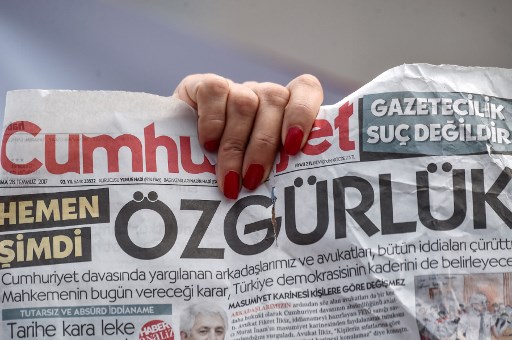
November was a difficult month again for imprisoned and prosecuted journalists in Turkey. More and more professional journalists and media workers are facing imprisonment or threats for reporting information or simply for being affiliated to specific media outlets, wrongly considered by Turkish authorities as criminal acts. On 21 November 2017, journalist Oğuz Güven, editor-in-chief of the online version of Cumhuriyet daily newspaper, was sentenced to 3 years and 1 month of imprisonment due to a temporary tweet which Mr Güven had sent and quickly deleted regarding the accidental death of a public prosecutor. Mustafa Alper, the Chief Public Prosecutor of Denizli, died…

EU’s Colloquium on Fundamental Rights addresses women and the media

The EU’s annual Colloquium on Fundamental Rights was held this year on 20-21 November 2017, with the theme of “Women’s Rights in Turbulent Times”. Discussions over the two days raised many issues around journalists and the media. Discussing the empowerment of women’s voices, Wim Slabbinck, a journalist for Charlie magazine, argued that media pushes girls into corners. “Only 7 % of sports media coverage is about women”, said Katrien Meire, owner of Charlton Athletic. In terms of coverage of female politicians, Pamela Morinière from the International Federation of Journalists (IFJ) noted that women in politics are not covered in the…

#TackleFakenews: European Commission convenes expert meeting

Brussels, 13-14 November 2017.  Yannis Kotsifos, member of the European Federation of Journalists (EFJ) Steering Committee and Renate Schroeder, EFJ director participated in the European Commission’s Directorate-General for a communications networks, content and technology multi-stakeholder conference on fake news. The European Commission engages on a broad-based consultation about how to deal with disinformation online. The objective is to help the Commission in close cooperation with consultation partners, define the scope of the fake news issue and reach consensus on how to proceed. There is no common understanding on what fake news is. Guy Berger, director of the Freedom of Expression…

European Parliament calls for respect for media freedom in Poland

In the European Parliament plenary sitting in Strasbourg, 15 November 2017, the European Parliament called on Poland to respect the rule of law concerning media freedom, independence of the judiciary, freedom of assembly, sexual and reproductive rights, and asylum-seekers’ access. The Socialists & Democrats (S&D) group president, Gianni Pitella, called on Poland to improve its situation of media freedoms and criticised the government’s interference on media organisation. State limitations of media freedom in Poland have been recognised by the European Federation of Journalists (EFJ). Last December, mass demonstrations took place in Warsaw against government plans to restrict journalists’ access to parliament. In July…