European Federation of Journalists

IFJ-EFJ Regional Development Fund

Czech Republic


The European Federation of Journalists (EFJ) signed an agreement on 18 December 2014 with the Union of Journalists and Media Workers of Czech Republic (OSNPM) in order to investigate the working conditions of Czech journalists and media workers. The project is implemented with the cooperation of Judith Reitstatter, from the Austrian union GPA-djp.

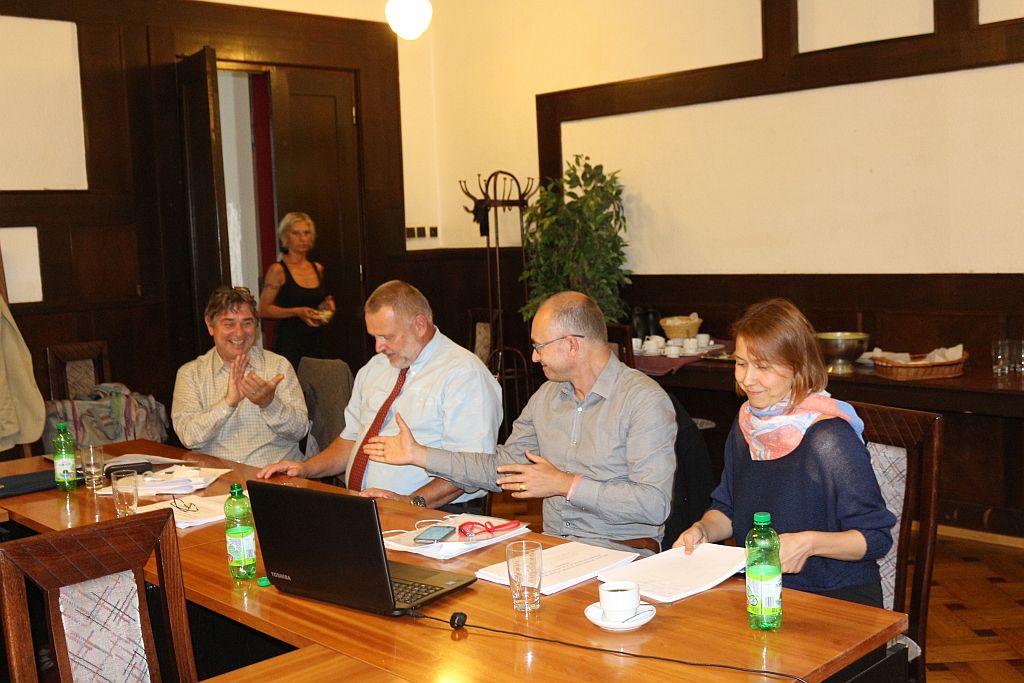
The online survey was launched on 19 May 2015. Around 2,500 journalists and media workers were invited to participate to the survey. The EFJ, OSNPM and GPA-djp analysed together the main outcomes of the survey during a round table conference, on 19 August 2015, in Prague.

The questionnaire focus mainly on labour rights. “This area is underestimated by the Czech media, journalists themselves and their employers as well,” explains Zdeněk Kučera, chairman of OSNPM.

“Over the past 25 years, journalists’ attention was focused primarily toward freedom of speech, access to information, relations with media ownership and the development of media houses. These are very serious topics. However, journalists’ status remained grossly underrated. A specific problem is the status of freelance journalists, which are increasingly numerous, particularly in regional media.”

The main findings of the survey are available on the EFJ website, here.
FOCUS EFJ

Side event of our project: a high school magazines national competition (Nejinspirativnější středoškolský časopis 2015). Here are the winners (picture credit: F. Cakl):

Czech

Contact details: OSNPM, e-mail: odborovy-svaz-novinaru@seznam.cz, website: http://www.odborovysvaznovinaru.cz


Slovakia

The European Federation of Journalists (EFJ), its Austrian union GPA-djp and the Slovak Union of Journalists (Slovenský syndikát novinárov) organized a meeting in Vienna, on 30 October 2014. Trade unionists and media students from both countries met in GPA-djp offices, in Vienna. The discussion on media convergence was launched by Dr. Roman Hummel, from the university of Salzburg.

Contact details: Judith Reitstaetter, judith.reitstaetter (at) gpa-djp.at


Estonia

The European Federation of Journalists (EFJ), the Estonian Union of Journalists (Eesti Ajakirjanike Liit, EAL) and the Union of Journalists in Finland (Suomen Journalistiliitto, UJF) agreed on 6 February 2015 to jointly implement the project “Workshops to Strengthen Journalists’ organisation in Estonia”.

The main objective of the project is to strengthen journalists’ organisation in Estonia, through three activities:

  • a freelance workshop in Helsinki,
  • a radio & TV negotiators workshop in Helsinki,
  • an authors’ rights seminar in Tallinn.

An action plan will be proposed for the next period.

Contact details: Juha Rekola, Juha.Rekola (at) journalistiliitto.fi, and Helle Tiikmaa, helle (at) eal.ee


Actions

Croatian journalists stage protest against abusive lawsuits

Several hundred journalists rallied in Zagreb on Saturday to protest against a wave of lawsuits targeting the media. According to the Croatian Journalists’ Association (HND), an EFJ affiliate, which organized the march, politicians, public figures and corporations had filed over 1,100 lawsuits against journalists and news outlets. HND says these court cases are part of an attempt to censor the media and put pressure on journalists. The protest was called after Croatian public broadcaster HRT itself filed 36 lawsuits against its own journalists and others, including HND head Hrvoje Zovko and HND branch in Public Service Media, who complained of…

EU Whistleblowing Directive: protection for companies or for whistleblowers?

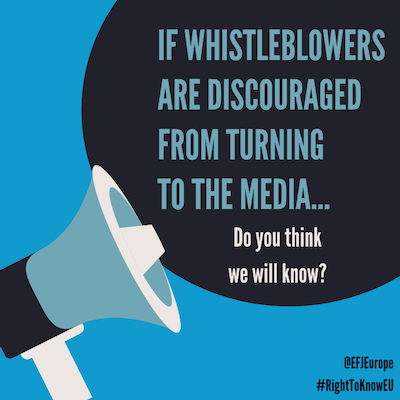
As the EU’s flagship whistleblowing Directive reaches the final stage of negotiations between national Governments and the European Parliament, the European Federation of Journalists (EFJ) joins the European Trade Union Confederation (ETUC) to warn that the EU risks ending up with a Directive that protects companies more than it protects whistleblowers! “Some member states are insisting that whistleblowers must first go through an internal reporting procedure,” said Esther Lynch, Confederal Secretary of the ETUC. “This is not in the interests of those exposing wrong-doing or the public. It would give companies every opportunity to cover up their wrong-doing and to…

New online platform to change “pale and male” media content

Building bridges among journalists, students and media educators to improve gender equality in newsrooms and media content. This is what the Advancing Gender and Equality in Media Industries (AGEMI) project stands for. On 26th February, the EU-funded project launched its online platform on gender and media at the Press Club in Brussels. The web platform provides a resource bank of over 100 best practices on gender equity in media as well as free learning resources to support journalism trainers and educators in their curricula. The project itself also included a summer school and internships for 30 students across the EU.…

European whistleblowers call for a better directive

In an open letter to the European Council, Commission and Parliament, five well-known European whistleblowers speak out for changing the directive and removing barriers for safe reporting. This letter is published as the negotiations between the European institutions are entering the final stretch. The European Council, Commission and Parliament have started the trilogue phase since the end of January and one main point of discord remains: what procedure whistleblowers should follow to be granted protection against retaliation? The draft directive indicates three reporting channels: internal within the company, external to an authority, and public including through the press. In the…

AGEMI is launching new platform on gender and media

The Advancing Gender Equality in the Media Industries (AGEMI), an EU funded project, is launching its web platform to build bridges between educators, media and media students to improve gender equality in media content and in the newsrooms. The launch is taking place during a seminar organised by AGEMI at the Brussels’ Press Club in Belgium today. The AGEMI consortium is composed of the Universities of Newcastle, Padova and Gothenbörg, as well as the European Federation of Journalists (EFJ) and the Permanent Conference of the Mediterranean Audiovisual Operators (COPEAM). The AGEMI platform provides a resource bank of over 100 best…

EFJ study on new business models to promote journalism

The European Federation of Journalists (EFJ) report “Digital Journalism & New Business Models” underpins the trends in new business models for the digital newsroom: from the British Guardian to the pioneering French Mediapart, from Sweden to Spain, we witness the increase in new funding models, in so-called entrepreneurial journalists who take care of both fundraising and the newsroom and still achieve trusted journalism with the highest editorial standards, values that ground the fourth estate in a democratic society in order to hold the powerful to account. The EFJ Digital Expert Group presents its report on “Digital Journalism & New Business…