European Federation of Journalists

openMedia, investigating press freedom

Title of the project : openMedia, investigating press freedom
Lead Applicant
: openDemocracy

Partner organisations : EFJ, Index on censorship, King’s College London

The recently launched openMedia project aims to investigate and expose commercial interference in editorial decisions. The project is run by openDemocracy with the European Federation of Journalists (EFJ) as a partner alongside the Index on Censorship and King’s College London.

The project believes that there has not been enough of a concerted, ongoing spotlight on the extent and effects of commercial influence over the media, despite the dangerous consequences it poses for press freedom. For now, the project focuses on 47 countries across Europe but also has ambitions to expand.

Despite the recent launch, the project is adamant that it is not a response to the “fake news” hype of the past year or so. Rather, the project responds to scandals of commercial sponsors influencing media content; for example the Daily Telegraph’s suppression of investigations into its advertiser HSBC; and allegations that Buzzfeed deleted articles which advertisers found unfavourable.

According to the project, this power dynamic can suppress investigations of banks, pharmaceuticals, agriculture, fossil fuel giants, energy companies and other big businesses.

In addition, the project recognizes how for many readers, “sponsored content” is difficult to distinguish from genuine news content. The project therefore aims to clarify the commercial interests apparent in media to readers, and as part of the project, King’s College London will develop digital tools to help readers be better informed about news sources.

The findings of the project will be used to campaign for greater transparency and press freedom in news organisations and to empower journalists to advocate for transparency.

In order to do this, openMedia is currently conducting a confidential and anonymous survey of journalists across Europe, asking about their own working practices and experiences of commercial pressure inside newsrooms. The survey is available in English here and in many other languages here.
Actions

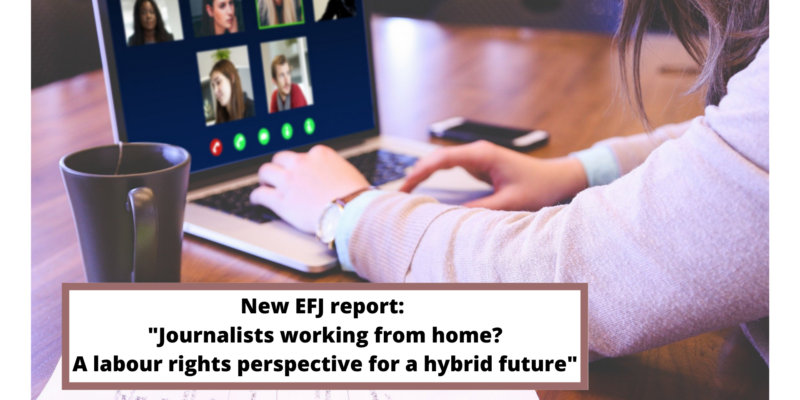
World Decent Work Day: Better conditions for journalists working from home

On the occasion of the World Decent Work Day on 7 October, the European Federation of Journalists (EFJ) has launched a report “Journalists working from home? a labour rights perspective for a hybrid future“ authored by Marc Gruber, showing the impact of the pandemic on the working conditions of journalists and the trend of the hybrid working model is becoming the norm. The report shows that while the working from home policies implemented by media companies are far from perfect, most journalists would still want to work from home but in a hybrid working model which allows them to work…

Belarus: Government must restore access to Deutsche Welle website

The Belarusian government has blocked access to Deutsche Welle’s website as well as other foreign news portals. The European Federation of Journalists (EFJ) joins its German affiliates, the German Journalists Association (DJV) and the German Journalists Union (dju in ver.di), in condemning this censorship and calling for the website to be immediately re-enabled. Since 28 October, Deutsche Welle’s website is blocked in Belarus, the German public state-owned international broadcaster informed. The online offers in all 32 broadcast languages are no longer available. #Belarus sperrt Internetseite der Deutschen Welle – völlig inakzeptabel! https://t.co/V4QRqpuK03 #journalismus #deutschewelle — dju in ver.di (@djuverdi) October 29, 2021 The Ministry…

Takeaways of Day 2: “Trust in media webinar: Photojournalism in the digital age”

On 25 and 26 October, the European Federation of Journalists (EFJ) hosted a two-day webinar session called “Trust in the Media: Photojournalism in the Digital Age”, the last in the series of five as part of the “Trust and Quality in Journalism” project, in partnership with the European Commission. For the day 1 takeaways, click here. Day 2 of the webinar was hosted by Yuklan Wong and Oddrun Midtbø. The four panelists were Markus Pentikäinen, photojournalist from Helsinki, Finland, Sitara Thalia Ambrosio, photographer and visual storyteller based in Germany, Boris Pejovic, photojournalist and board member of TUMM, Montenegro, and Michael Trammer, (photo-)journalist based in Berlin,…

Finland: three journalists face jail term for allegedly “disclosing state secrets”

Three journalists from Finland’s largest national daily Helsingin Sanomat were charged on 29 October 2021 with “attempted disclosure of a security secret” and face jail term. The European Federation of Journalists (EFJ) joined its affiliates in Finland, the Finnish Journalists’ Union (UJF), in expressing solidarity with the journalists and condemning Finland’s deputy prosecutor general’s decision to prosecute them. Laura Halminen, Tuomo Pietiläinen and Kalle Silfverberg face four months to four years in prison for publishing in December 2017 an article about the Finnish Defence Intelligence Agency (VKoeL), at a time when a constitutional change gave the Finnish security services increased surveillance…

Takeaways of Day 1: “Trust in media webinar: Photojournalism in the digital age”

On 25 and 26 October, the European Federation of Journalists (EFJ) hosted a two-day webinar session on “Trust in the Media: Photojournalism in the Digital Age”, the last in a series of five as part of the “Trust and Quality in Journalism” project, in partnership with the European Commission. Day 1 of the webinar was moderated by Yuk Lan Wong with two experts, Lars Boering, director of the European Journalism Center (EJC) and Anna Gordon, freelance photographer in the UK. The session was kicked off by the national partner, Radomir Kračković, Vice-President of the Trade Union of Media of Montenegro (TUMM).…

CREDITS: CANVA

European Parliament adopts ambitious much needed Action Plan for media

On Wednesday 6 October the European Parliament published a report for the European Commission titled Media in the Digital Decade: An Action Plan to Support Recovery and Transformation drafted by rapporteur Dace Melbārde. The report was adopted on Tuesday 19 October by the Parliament. It was voted in the Plenary with no changes as to the version voted in the Committee on Culture and Education (CULT.) The European Federation of Journalists (EFJ) welcomes this report and the recommendations it put forward. The EFJ insists on the need for the European Commission to ensure that  all Member States quickly put in…