European Federation of Journalists

openMedia, investigating press freedom

Title of the project : openMedia, investigating press freedom
Lead Applicant
: openDemocracy

Partner organisations : EFJ, Index on censorship, King’s College London

The recently launched openMedia project aims to investigate and expose commercial interference in editorial decisions. The project is run by openDemocracy with the European Federation of Journalists (EFJ) as a partner alongside the Index on Censorship and King’s College London.

The project believes that there has not been enough of a concerted, ongoing spotlight on the extent and effects of commercial influence over the media, despite the dangerous consequences it poses for press freedom. For now, the project focuses on 47 countries across Europe but also has ambitions to expand.

Despite the recent launch, the project is adamant that it is not a response to the “fake news” hype of the past year or so. Rather, the project responds to scandals of commercial sponsors influencing media content; for example the Daily Telegraph’s suppression of investigations into its advertiser HSBC; and allegations that Buzzfeed deleted articles which advertisers found unfavourable.

According to the project, this power dynamic can suppress investigations of banks, pharmaceuticals, agriculture, fossil fuel giants, energy companies and other big businesses.

In addition, the project recognizes how for many readers, “sponsored content” is difficult to distinguish from genuine news content. The project therefore aims to clarify the commercial interests apparent in media to readers, and as part of the project, King’s College London will develop digital tools to help readers be better informed about news sources.

The findings of the project will be used to campaign for greater transparency and press freedom in news organisations and to empower journalists to advocate for transparency.

In order to do this, openMedia is currently conducting a confidential and anonymous survey of journalists across Europe, asking about their own working practices and experiences of commercial pressure inside newsrooms. The survey is available in English here and in many other languages here.

Actions

Russia: authorities target investigative journalists with raids amid increasing pressure on media

Tuesday morning, Russian authorities raided the apartments of several investigative journalists and their family members in Moscow. Amid a growing pressure exerted by Russian authorities on independent news media and journalists in recent months, the European Federation of Journalists together with the Journalists’ and Media Workers’ Union (JMWU) in Russia strongly condemn the raid and the unlawful actions of Russian authorities. The police raided the journalists of the investigative online outlet Proekt: editor-in-chief Roman Badanin, correspondent Maria Zholobova, and the home of the parents of deputy-in-chief Mikhail Rubin. Rubin was detained near Zholobova’s residential building and brought to his parents’…

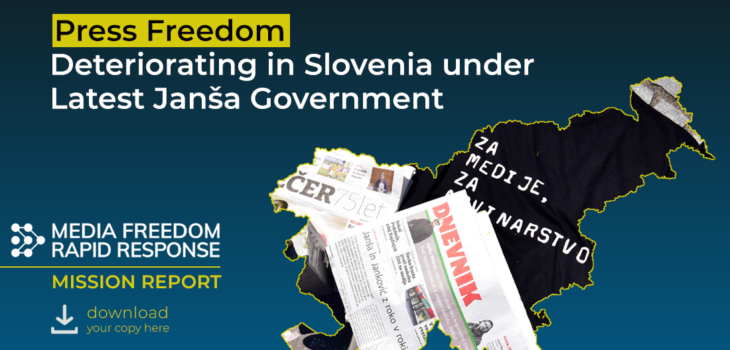
Slovenian government eroding media freedom as it takes over EU Presidency

The Slovenian government of Prime Minister Janez Janša is overseeing an increasingly systematic effort to undermine critical media, a coalition of press freedom organisations and journalism groups warn today in a new report. The report concludes that Slovenia, which assumes the rotating presidency of the EU on July 1, has seen press freedom deteriorate ever since Janša returned to power in March 2020. Since then, the ruling SDS party has embarked on a multipronged campaign to reshape the media landscape in favour of a pro-government narrative, renewing tactics successful during previous administrations and forging ahead with new forms of pressure.…

Takeaways of webinar “Trust in media: Trends, skills and training in journalism”

On 23 and 24 June, the European Federation of Journalists (EFJ) organised a two-day webinar on trends, skills and training in journalism as part of the Trust and quality in journalism project. Invited speakers addressed what journalistic skills are needed to thrive in the digital world and how media companies and journalists’ organisations can provide support to journalists. Day 1 The first day’s speakers were media professionals from various fields who shared their insights on the latest trends in journalism and skills required. Monique Hofmann, General Secretary of the German journalists’ union, dju in ver.di, opened the webinar by emphasising…

WPFD: Safety4Journalists Survey – Have your say!

The European Federation of Journalists (EFJ) has launched a European survey on 3 May, World Press Freedom Day, as part of a wider campaign to push for a safer and healthier working environment for journalists. “The safety of journalists has been in the spotlight in recent years as a record attacks on journalists are being made, sometimes even resulting in deaths,” says Ricardo Gutiérrez, EFJ General Secretary. “The well-being and safety of journalists has long been neglected in the pursue of 24-hour speedy news. It is time to fulfil our duty of care for journalists’ both physical and mental health.”…

Reuters DNR 2021 – trust increased, now we need to keep audiences engaged

On 23 June 2021, the Reuters Digital News Report 2021 was published by the Reuters Institute for Journalism in cooperation with Oxford University. Apanel of experts discussed the findings for its launch. The most encouraging result of this extensive study is that the public’s trust levels have sharply risen during the Covid-19 pandemic. Now, major challenges are how to build on the trust gained and to further engage high audiences. In the panel discussion, it appeared that major questions defining the future of news consumption concern how media can hold and engage subscribers, especially regarding young audiences: “It’s important to…

Ukraine: Prosecutors and police deliver public update on investigation into murder of journalist Vadym Komarov

The European and International Federations of Journalists (EFJ/IFJ) has called on the Ukrainian authorities to continue to pursue the killers of Cherkasy journalist Vadym Komarov, two years after his death following a brutal attack. The call came as the head of the Cherkasy Regional Prosecutor’s Office Oleksandr Voronin and deputy head of the Cherkasy police Yevhen Rohachov updated reporters at a press conference about the progress of the investigation. During these 2 years, more than 1,700 interrogations and more than 200 investigative leads have been followed. Data from hundreds of cameras and more than 1000 phone calls have been analysed. The…