European Federation of Journalists

IFJ-EFJ Regional Development Fund

Czech Republic


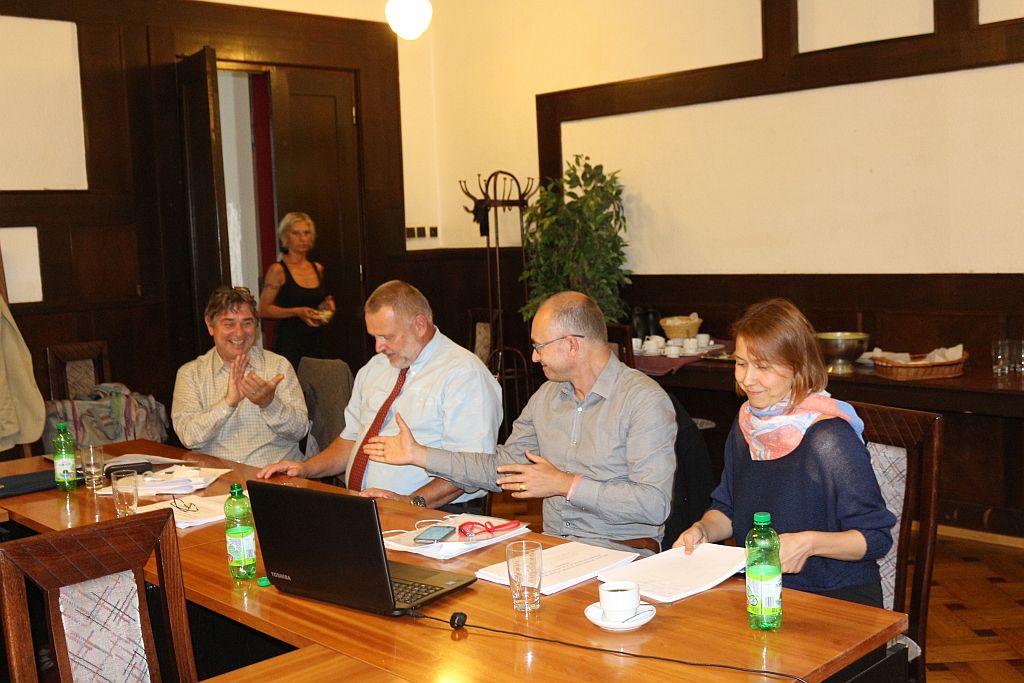
The European Federation of Journalists (EFJ) signed an agreement on 18 December 2014 with the Union of Journalists and Media Workers of Czech Republic (OSNPM) in order to investigate the working conditions of Czech journalists and media workers. The project is implemented with the cooperation of Judith Reitstatter, from the Austrian union GPA-djp.

The online survey was launched on 19 May 2015. Around 2,500 journalists and media workers were invited to participate to the survey. The EFJ, OSNPM and GPA-djp analysed together the main outcomes of the survey during a round table conference, on 19 August 2015, in Prague.

The questionnaire focus mainly on labour rights. “This area is underestimated by the Czech media, journalists themselves and their employers as well,” explains Zdeněk Kučera, chairman of OSNPM.

“Over the past 25 years, journalists’ attention was focused primarily toward freedom of speech, access to information, relations with media ownership and the development of media houses. These are very serious topics. However, journalists’ status remained grossly underrated. A specific problem is the status of freelance journalists, which are increasingly numerous, particularly in regional media.”

The main findings of the survey are available on the EFJ website, here.
FOCUS EFJ

Side event of our project: a high school magazines national competition (Nejinspirativnější středoškolský časopis 2015). Here are the winners (picture credit: F. Cakl):

Czech

Contact details: OSNPM, e-mail: odborovy-svaz-novinaru@seznam.cz, website: http://www.odborovysvaznovinaru.cz


Slovakia

The European Federation of Journalists (EFJ), its Austrian union GPA-djp and the Slovak Union of Journalists (Slovenský syndikát novinárov) organized a meeting in Vienna, on 30 October 2014. Trade unionists and media students from both countries met in GPA-djp offices, in Vienna. The discussion on media convergence was launched by Dr. Roman Hummel, from the university of Salzburg.

Contact details: Judith Reitstaetter, judith.reitstaetter (at) gpa-djp.at


Estonia

The European Federation of Journalists (EFJ), the Estonian Union of Journalists (Eesti Ajakirjanike Liit, EAL) and the Union of Journalists in Finland (Suomen Journalistiliitto, UJF) agreed on 6 February 2015 to jointly implement the project “Workshops to Strengthen Journalists’ organisation in Estonia”.

The main objective of the project is to strengthen journalists’ organisation in Estonia, through three activities:

  • a freelance workshop in Helsinki,
  • a radio & TV negotiators workshop in Helsinki,
  • an authors’ rights seminar in Tallinn.

An action plan will be proposed for the next period.

Contact details: Juha Rekola, Juha.Rekola (at) journalistiliitto.fi, and Helle Tiikmaa, helle (at) eal.ee

 

Actions

EFJ condemns the harassment campaign targeting journalist Arzu Geybulla

The European Federation of Journalists (EFJ) condemns the online harassment campaign targeting Azerbaijani journalist Arzu Geybulla, unjustly accused of betraying her country for taking a measured and journalistic stance in the face of the recent armed conflict between Azerbaijan and Armenia. Azerbaijani journalist Arzu Geybulla has been the target of an online harassment campaign following the publication of an opinion article about her on the online portal AzLogos, a platform managed by Azerbaijanis living abroad. The article alleges that the journalist disrespected the martyrs of the conflict between Azerbaijan and Armenia, accusing her of deliberately mocking the minute of silence…

Journalists and press publishers are concerned by the latest e-evidence proposal

The European Federation of Journalists together with EMMA, the European Magazine Media Association and ENPA, the European Newspaper Publishers’ Association, acknowledge yesterday’s vote in the European Parliament’s Committee on Civil Liberties, Justice and Home Affairs (LIBE) on the Report for a Regulation on European Production and Preservation Orders for electronic information in criminal proceedings (E-Evidence Regulation). Despite the efforts by the European Parliament to address several issues contained in the European Commission’s proposal, we regret that some key amendments have been rejected. As a result, the adopted report falls short of the necessary procedural safeguards to protect press and media freedom. This is…

EFJ welcomes EU Media Action Plan and urges to include support for freelancers

On 3 December, the European Commission adopted the communication Europe’s Media in the Digital Decade: An Action Plan to Support Recovery and Transformation. The Action Plan focuses on three areas of activity in the media and audiovisual sector and 10 concrete actions, to help the media sector recover from the crisis by facilitating and broadening access to financial support, by encouraging investments for the  digital transformation all on the basis that the media and news sector are not only economical but public goods central for Europe’s democracies “We are committed to help the media sector weather the current storm and challenges brought…

Media councils must anticipate news automation, says new report

The Council for Mass Media in Finland published today a new report on self-regulation in the emerging era of news automation. While news automation and personalisation have become more common in recent years, it has received little attention from Press and Media Councils which have not faced major ethical problems so far. However, the report suggests that in the future self-regulatory guidance on news automation is likely to be needed.  The report introduces the present state of affairs in news automation and discusses what ethical considerations it raises. Based on a European-wide research project, the key takeaways are as follows:…

Danish government increased support for the media sector

The Danish government agreed on 6 December with the majority of the parliament to stop financial cuts of 122 million euros in support of public service media over the next four years. In addition, the government proposed to increase support for the media sector by providing an additional annual budget of 20 millions euros. The minister of Culture stressed: media are important for our democracy. “This is a great day for journalism and the media in Denmark. Cuts in public service media would have caused dramatic changes in DR (the Danish Broadcasting Corporation) also resulting in many new unemployed journalists.…

Slovenia: news agency funding cut puts press freedom at risk

The European Federation of Journalists (EFJ) has joined calls to repeal the decision to cut funding for the Slovenia Press Agency (STA) in a row over its alleged failure to respond to what media freedom campaigners describe as reckless and unlawful information requests. The Slovenian government confirmed on 30 November a decision by its communication office (UKOM) to cut STA monthly funds for October for allegedly failing to answer information requests related to its editorial content. The EFJ joined the International Federation of Journalists (IFJ) and its affiliates, the Slovenian Journalists’ Association (DNS) and the Slovenian Union of Journalists (SUJ)…