European Federation of Journalists

IFJ-EFJ Regional Development Fund

Czech Republic


The European Federation of Journalists (EFJ) signed an agreement on 18 December 2014 with the Union of Journalists and Media Workers of Czech Republic (OSNPM) in order to investigate the working conditions of Czech journalists and media workers. The project is implemented with the cooperation of Judith Reitstatter, from the Austrian union GPA-djp.

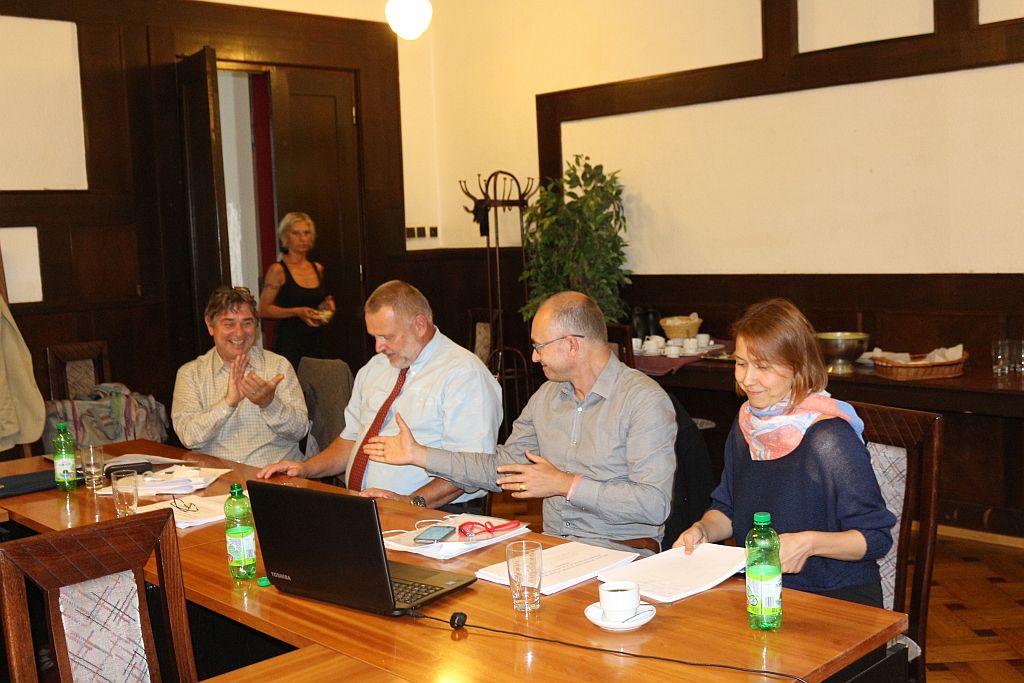
The online survey was launched on 19 May 2015. Around 2,500 journalists and media workers were invited to participate to the survey. The EFJ, OSNPM and GPA-djp analysed together the main outcomes of the survey during a round table conference, on 19 August 2015, in Prague.

The questionnaire focus mainly on labour rights. “This area is underestimated by the Czech media, journalists themselves and their employers as well,” explains Zdeněk Kučera, chairman of OSNPM.

“Over the past 25 years, journalists’ attention was focused primarily toward freedom of speech, access to information, relations with media ownership and the development of media houses. These are very serious topics. However, journalists’ status remained grossly underrated. A specific problem is the status of freelance journalists, which are increasingly numerous, particularly in regional media.”

The main findings of the survey are available on the EFJ website, here.
FOCUS EFJ

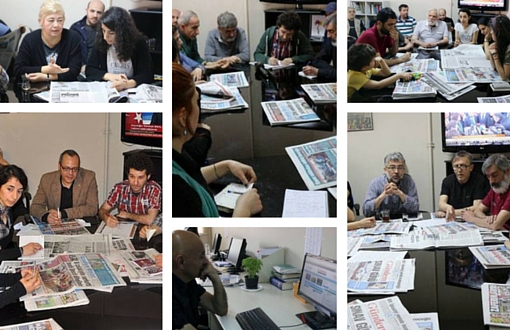
Side event of our project: a high school magazines national competition (Nejinspirativnější středoškolský časopis 2015). Here are the winners (picture credit: F. Cakl):

Czech

Contact details: OSNPM, e-mail: odborovy-svaz-novinaru@seznam.cz, website: http://www.odborovysvaznovinaru.cz


Slovakia

The European Federation of Journalists (EFJ), its Austrian union GPA-djp and the Slovak Union of Journalists (Slovenský syndikát novinárov) organized a meeting in Vienna, on 30 October 2014. Trade unionists and media students from both countries met in GPA-djp offices, in Vienna. The discussion on media convergence was launched by Dr. Roman Hummel, from the university of Salzburg.

Contact details: Judith Reitstaetter, judith.reitstaetter (at) gpa-djp.at


Estonia

The European Federation of Journalists (EFJ), the Estonian Union of Journalists (Eesti Ajakirjanike Liit, EAL) and the Union of Journalists in Finland (Suomen Journalistiliitto, UJF) agreed on 6 February 2015 to jointly implement the project “Workshops to Strengthen Journalists’ organisation in Estonia”.

The main objective of the project is to strengthen journalists’ organisation in Estonia, through three activities:

  • a freelance workshop in Helsinki,
  • a radio & TV negotiators workshop in Helsinki,
  • an authors’ rights seminar in Tallinn.

An action plan will be proposed for the next period.

Contact details: Juha Rekola, Juha.Rekola (at) journalistiliitto.fi, and Helle Tiikmaa, helle (at) eal.ee
 

Actions

40 % of Serbian journalists wants to leave the profession

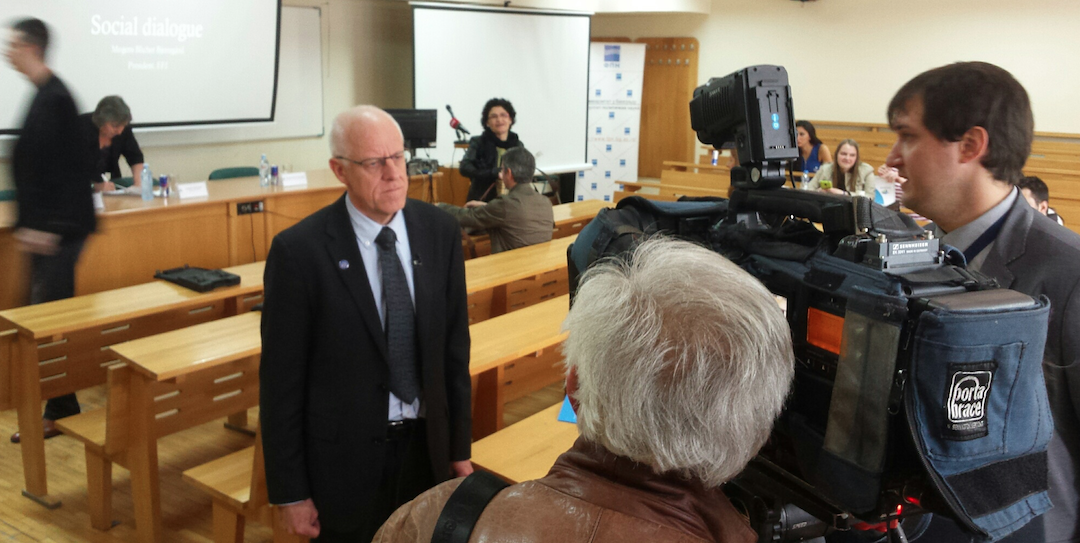
Journalists Union of Serbia (SINOS – EFJ affiliate) in partnership with the Friedrich Ebert Foundation held a seminar in Prolom Banja (Serbia) from 19 to 21 May. The theme of the was organising unions for media workers in Serbia and the Balkans countries. The participants talked about precarious work, legal and social status of journalists and the sustainability of trade unions in the media with multinational ownership problems. The President of the European Federation of Journalists (EFJ), Mogens Blicher Bjerregard spoke about the experience of organizing unions for journalists in different European Union member states. He stressed that progress is possible when…

Europe follows worrying developments at the Radio Television of Vojvodina

UPDATE (01/06/2016) : Nada Kalkan, the new editor of RTV, is sending the EFJ the following statement : “That’s not true that journalists in RTV were layoffs. Previous program director was replaced and new director elected because the executive board was not satisfied. The general director and the editor-in-chief have resigned. Now, we have new a group of managers, nobody at RTV was dismissed or degraded and most of them have same salary and rested on editorial places.” Serbian media report that program director of RTV, Slobodan Arežina, was replaced, general director Srđan Mihajlović resigned under political pressure; 7 editors of news program…

Turkey must stop feeding its environment of fear for journalists and trade unionists

Update (25th May): Our Turkish colleague Erol Önderoglu is also under criminal investigation for “terrorist propaganda” for participating in a solidarity campaign with the Kurdish daily newspaper Özgür Gündem. The EFJ and IFJ demand that all criminal charges be dropped against journalists involved in this campaign. The European and International Federations of Journalists (EFJ and IFJ) is calling upon the presumptive upcoming Turkish Prime minister, Binali Yildirim, to end the climate of permanent judicial intimidation, threats, harassment, detention and physical assaults against journalists and media workers in Turkey. The EFJ is particularly underlining the fact that Turkish judicial authorities have recently opened an…

Legalislative framework for investigative journalism need improvements

The Institute of European Media Law (EMR), consortium partner of the European Centre for Press and Media Freedom (ECPMF), has recently conducted a study on the state of media freedom and investigative journalism in Europe. The results published on 17 May 2016 show that restrictive rules for the development of press freedom remain a major obstacle in all countries. 1. Decriminalisation of journalism = Hungarian model Journalists might infringe the law while trying to obtain information. According to the report, all legal frameworks know limits to the freedom of obtaining information. Even though in many states courts take into consideration the importance of press freedom…

Three-day conference to discuss the impacts of the digital revolution on work, 27-29 June, Brussels

A three-day conference will be held on 27-29 June 2016 in Brussels on the theme: “Shaping the new world of work – The impacts of digitalisation and robotisation”. Organised by the European Trade Union Confederation and the European Trade Union Institute, the conference will bring together over 400 representatives of trade unions, research bodies, academia, civil society, EU institutions and international organisations to discuss how the world and nature of work and employment is being changed radically by the digital revolution. Contrary to similar conferences, this event will not only focus on the quantity of work (‘will robots destroy our jobs?’) but also…

Three RBC editors resign under political pressure from Kremlin

Three top editors from the Russian RBC media group announced their departure on 13 May as the political pressure against the independent media outlet grows in Russia. The International and European Federations of journalists (IFJ/EFJ) back their affiliate the Russian Union of Journalists (RUJ) in expressing concerns over the growing intimidation against the media in Russia. In a statement published on 13 May RBC said that the resignations of editor-in-chief Yelizaveta Osetinskaya, chief editor of the RBC newspaper Maxim Solyus, and chief editor of the RBC news agency Roman Badanin were due to “differences regarding the media company’s future and…