European Federation of Journalists

openMedia, investigating press freedom

Title of the project : openMedia, investigating press freedom
Lead Applicant
: openDemocracy

Partner organisations : EFJ, Index on censorship, King’s College London

The recently launched openMedia project aims to investigate and expose commercial interference in editorial decisions. The project is run by openDemocracy with the European Federation of Journalists (EFJ) as a partner alongside the Index on Censorship and King’s College London.

The project believes that there has not been enough of a concerted, ongoing spotlight on the extent and effects of commercial influence over the media, despite the dangerous consequences it poses for press freedom. For now, the project focuses on 47 countries across Europe but also has ambitions to expand.

Despite the recent launch, the project is adamant that it is not a response to the “fake news” hype of the past year or so. Rather, the project responds to scandals of commercial sponsors influencing media content; for example the Daily Telegraph’s suppression of investigations into its advertiser HSBC; and allegations that Buzzfeed deleted articles which advertisers found unfavourable.

According to the project, this power dynamic can suppress investigations of banks, pharmaceuticals, agriculture, fossil fuel giants, energy companies and other big businesses.

In addition, the project recognizes how for many readers, “sponsored content” is difficult to distinguish from genuine news content. The project therefore aims to clarify the commercial interests apparent in media to readers, and as part of the project, King’s College London will develop digital tools to help readers be better informed about news sources.

The findings of the project will be used to campaign for greater transparency and press freedom in news organisations and to empower journalists to advocate for transparency.

In order to do this, openMedia is currently conducting a confidential and anonymous survey of journalists across Europe, asking about their own working practices and experiences of commercial pressure inside newsrooms. The survey is available in English here and in many other languages here.
Actions

WPFC: EFJ calls for real commitment from European countries signing up to protection for journalists

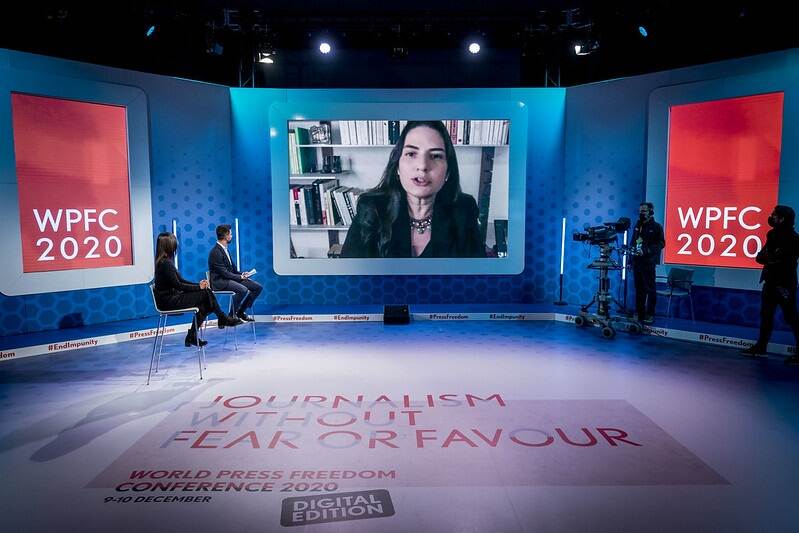
On Wednesday 9 and Thursday 10 December, ministers from close to 60 countries, including 33 European countries (1), are taking part in the Unesco World Press Freedom Conference (WPFC), at the invitation of the Dutch Foreign Minister Stef Blok. This is the first time in the history of the WPFC that a session gathers 56 foreign affairs ministers from around the world. On Wednesday they discussed topics like how to tackle violence against journalists, photographers and media workers more effectively. All participating countries will confirm the agreements they reach in a final declaration, The Hague Commitment to increase the Safety…

Croatia: Smear campaign against journalist Anja Kožul, protection needed

As part of the Media Freedom Rapid Response (MFRR), the European Federation of Journalists (EFJ), the International Press Institute (IPI) and the European Centre for Press and Media Freedom (ECPMF) condemn the smear campaign against Croatian journalist Anja Kožul and call for her protection. Kožul works for Novosti, a Croatian and Serbian-language weekly magazine published by the Serb National Council (SNV) in Croatia, which covers issues related to the Serb community in the country.  She has been exposed to numerous threats, insults and attacks coming from Serbia since 1 December. The hate campaign started after she published an article entitled…

EFJ condemns the harassment campaign targeting journalist Arzu Geybulla

The European Federation of Journalists (EFJ) condemns the online harassment campaign targeting Azerbaijani journalist Arzu Geybulla, unjustly accused of betraying her country for taking a measured and journalistic stance in the face of the recent armed conflict between Azerbaijan and Armenia. Azerbaijani journalist Arzu Geybulla has been the target of an online harassment campaign following the publication of an opinion article about her on the online portal AzLogos, a platform managed by Azerbaijanis living abroad. The article alleges that the journalist disrespected the martyrs of the conflict between Azerbaijan and Armenia, accusing her of deliberately mocking the minute of silence…

Journalists and press publishers are concerned by the latest e-evidence proposal

The European Federation of Journalists together with EMMA, the European Magazine Media Association and ENPA, the European Newspaper Publishers’ Association, acknowledge yesterday’s vote in the European Parliament’s Committee on Civil Liberties, Justice and Home Affairs (LIBE) on the Report for a Regulation on European Production and Preservation Orders for electronic information in criminal proceedings (E-Evidence Regulation). Despite the efforts by the European Parliament to address several issues contained in the European Commission’s proposal, we regret that some key amendments have been rejected. As a result, the adopted report falls short of the necessary procedural safeguards to protect press and media freedom. This is…

EFJ welcomes EU Media Action Plan and urges to include support for freelancers

On 3 December, the European Commission adopted the communication Europe’s Media in the Digital Decade: An Action Plan to Support Recovery and Transformation. The Action Plan focuses on three areas of activity in the media and audiovisual sector and 10 concrete actions, to help the media sector recover from the crisis by facilitating and broadening access to financial support, by encouraging investments for the  digital transformation all on the basis that the media and news sector are not only economical but public goods central for Europe’s democracies “We are committed to help the media sector weather the current storm and challenges brought…

Media councils must anticipate news automation, says new report

The Council for Mass Media in Finland published today a new report on self-regulation in the emerging era of news automation. While news automation and personalisation have become more common in recent years, it has received little attention from Press and Media Councils which have not faced major ethical problems so far. However, the report suggests that in the future self-regulatory guidance on news automation is likely to be needed.  The report introduces the present state of affairs in news automation and discusses what ethical considerations it raises. Based on a European-wide research project, the key takeaways are as follows:…