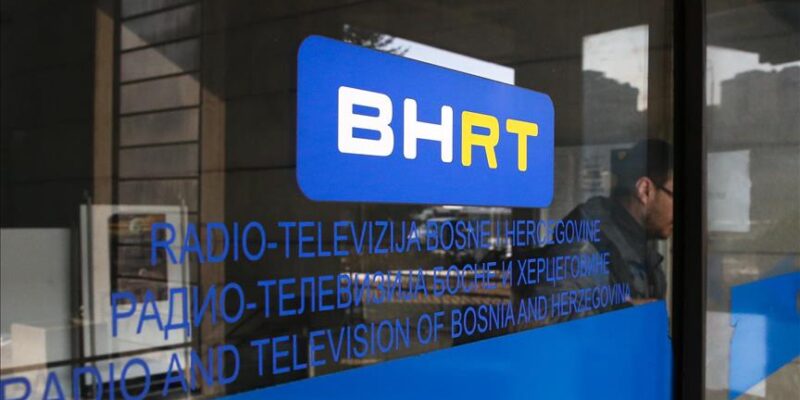
Bosnia and Herzegovina: Prevent the shutdown of BHRT, urgent European action needed

The European Federation of Journalists (EFJ) joins its affiliate, Bosnia-Herzgovina Journalists’ Association (BHN), in warning that BHRT, Bosnia and Herzegovina’s public service broadcaster, is on the verge of shutting down, and in calling for urgent action from Bosnian and European institutions to prevent its possible collapse. BHRT has been in a long-standing financial and institutional crisis, but the situation has now reached a point where the broadcaster’s very survival is at risk. Last week, BHRT was forced to start reducing its programming due to a lack of funding, while its bank accounts have been blocked for over a month. There…

France: Three journalists summoned by security agency over suspected violation of national defence secrecy

The European Federation of Journalists (EFJ) joined the partner organisations of the Media Freedom Rapid Response (MFRR) today in expressing concern over the latest summons issued by France’s top security agency to journalists from investigative platform Disclose and public broadcaster Radio France over the suspected violation of national secrecy in connection with their reporting on the armed forces. Our organisations raise the alarm that the three journalists summoned for voluntary questioning could facepotential prison sentences of up to five years and a fine of €75,000 if charged and ultimately found guilty. We therefore urge the General Directorate of Internal Security…

13 journalists killed so far in Europe in 2022

The International Federation of Journalists (IFJ) today renewed its call on the international community for concrete action to protect the safety and freedoms of journalists as it recorded a spike in the numbers of journalists killed or imprisoned during 2022. The vote on the IFJ Convention on the Safety and Independence of Journalists by the UN General Assembly has become urgent. The IFJ released the latest figures ahead of International Human Rights Day, recording 67 killings of journalists and media staff in the line of duty in 2022 (including 13 in Europe) compared to 47 last year – a reversal…

Belarus: former journalist Larysa Shchyrakova in pre-trial detention

Belarusian former journalist Larysa Shchyrakova was detained in the city of Homel, RFE/RL Belarus reported on 7 December 2022. The European Federation of Journalists (EFJ) calls for her immediate release. “The reasons and circumstances of her detention are still unknown. She is in pre-trial detention, and her son Sviataslau is in a shelter for children. Larysa has not been engaged in any public or journalistic activities in recent years,” said the RLE/RF Belarus source. Larysa Shchyrakova is a well-known journalist who stopped her journalistic activities in 2021 due to threats of arrest. The schoolteacher-turned-journalist worked for a number of independent…

Latvia: Media regulator urged not to revoke TV Dozhd license pending court review

Update (10.01.2023): The Dutch media regulator has granted a licence to Russian independent channel Dozhd, after Latvia revoked the broadcaster’s permit. Dozhd said it would move its editorial offices to Amsterdam and will contest Latvian authorities’ decision to strip it of the license.   The European Federation of Journalists (EFJ) joined the undersigned partners of the Media Freedom Rapid Response (MFRR) today in expressing serious concern over the decision by Latvia’s National Electronic Mass Media Council (NEPLP) to revoke the broadcast license of exiled independent Russian TV station Dozhd, which is based in Riga. Given the clear implications for media freedom,…

Lithuania: Threats to self-regulation worries journalists organisations

The European Federation of Journalists (EFJ) supports the work of the Lithuanian Journalists’ Union (LŽS) and media organisations active in the country to maintain the media self-regulation system in place, against the will of the Culture Committee of Parliament of Republic of Lithuania and to reshuffle it in favour of more space for public broadcaster. In an attempt to restrict self-regulation mechanisms, the Cultural Committee, in unison with the public broadcaster LRT (the largest media group in Lithuania), had put forward the Public Information Amendments, a proposal to reorganise the internal structure of the self-regulation systems in place in the…

Multiple journalists threatened and harassed in Serbia, authorities must take urgent action

In the past month in Serbia, several journalists have been targeted by serious threats raising fears for their physical safety. The European Federation of Journalists (EFJ) joins the Media Freedom Rapid Response partners and the Safe Journalists Network in condemning in the strongest terms the intimidation and often orchestrated campaigns by pro-government media outlets and members of the public to silence journalists. The undersigned organisations urge the authorities to take the necessary measures to ensure their protection and prevent further threats. The latest shocking threat reported on 1 December 2022 targeted Nova S TV’s journalist Jelena Obucina. Obucina received messages…

Tove Carlén: “The Swedish new law on public espionage provides little protection for journalists’ sources”

The Riksdag, Sweden’s highest decision-making body, recently voted through a new law on public espionage. As of 1 January 2023, “foreign espionage”, “aggravated foreign espionage” and “disclosure of secret information in the framework of international cooperation” will be considered as part of the penal code in Swedish legislation following the amendments to two of the four countries’ Constitutional Laws – the Freedom of the Press Act and the Fundamental Law on Freedom of Expression. We spoke to the Legal Advisor of the Swedish Union of Journalists (SJF) Tove Carlén about the impact on journalists and their sources. How does the new…

Belarus: send a letter to journalists in prison

On this Day of Solidarity with Political Prisoners in Belarus, the European Federation of Journalists (EFJ) joins its affiliate the Belarusian Association of Journalists (BAJ) in encouraging you to send a letter to the 32 journalists and media workers currently in prison in Belarus. 27 November marks the Global Day of Solidarity with Belarusian Political Prisoners. The number of political prisoners in Belarus is growing with now near 1,450; up from 1,000 in February. The war in Ukraine and solidarity of Belarusians and civil society with Ukraine grant new reasons for the Lukashenka’s regime to target ordinary civilians and journalists.…

EU Court of Justice decision to “invalidate” transparency in beneficial ownership is a blow to the right to know

In a landmark decision on 22 November 2022, the Court of Justice of the European Union ruled that the EU anti-money laundering directive’s provisions on access to beneficial ownership registers are “invalid”. The court found that the directive (AMLD5, 2018) interferes with the privacy and personal data protection rights of beneficial owners and should therefore not be made available to a wide public. The European Federation of Journalists (EFJ) denounced a decision restricting the freedom of information in favour of business interests. The European legislation was adopted in 2015 with the objective to combat money laundering and terrorist financing by…

Italy: Prime Minister sues Domani newspaper for defamation

Italian defamation laws are once again being misused by Prime Minister Giorgia Meloni to silence and threaten independent journalism in Italy. The undersigned organisations call for the lawsuit against the newspaper Domani to be dropped and for the Italian Parliament to adopt a comprehensive reform of defamation laws in Italy.  In October 2021, the current Prime Minister, at the time member of the Italian Parliament and leader of the far-right party Fratelli d’Italia,  initiated legal action for aggravated criminal defamation against Emiliano Fittipaldi and Stefano Feltri, respectively correspondent and editor of the daily national newspaper Domani. The lawsuit originated from an article that raised…

Journalists and union representatives in the Balkans undertook safety training with a gender focus

Twenty-six trade union representatives and journalists from the Balkans region received a 1.5-day training on safety in Zagreb, Croatia, on 22 and 23 November 2022. The practical guidance focused on how to be safer at work and the responsibilities of employers, with a particular focus on the different threats facing journalists. The training was organised prior to the International Day for the Elimination of Violence against Women on 25 November to draw attention to the increasing violence facing female journalists. Neus Vidal from the European Centre for Press and Media Freedom (ECPMF) gave a regional overview of the situation. She…

The statue outside the headquarters of Slovenian public broadcaster Radiotelevizija Slovenija (RTV SLO) in the capital Ljubljana

Slovenia: Media freedom groups back legislative efforts to depoliticise public media

The European Federation of Journalists (EFJ), together with other international media freedom and journalists’ organisations, today outlined their tentative support for reform of the law on Radiotelevizija Slovenija (RTV SLO) and the urgent need to depoliticise the public service media and their oversight bodies amidst continued threats to their independence. The undersigned organisations welcome the initiative of the new coalition government to reduce the influence of politics on the broadcaster’s operations and foster an enabling climate for its public service mission. Events of the last few years at RTV SLO have provided a clear illustration of why such changes are…

Věra Jourová talking at the European Anti-SLAPP Conference On 20 October 2022

What is a SLAPP? – Factsheet

SLAPP: Strategic Lawsuit Against Public Participation. SLAPPs are a form of legal harassment used to intimidate and silence those speaking out in the public interest. They are often used as a tool to suppress information that the plaintiffs don’t want to be brought to light. The plaintiffs are attempting to keep information secret – information that the public has a right to know. Download the PDF:

“E-evidence” open letter: What’s left of fundamental rights safeguards?

Blog Post by EDRi (European Digital Rights Association) Shortly before the end of their mandate, the French Presidency of the Council nearly reached a political compromise with the European Parliament on the so-called “e-evidence” proposal. This draft compromise lays down general guidelines to establish a future legal framework enabling national law enforcement to request personal data from private companies located in other Member States of the European Union (EU). However, a few points remain to be agreed upon before the final text can be adopted by the co-legislators. Unfortunately, the direction of the negotiations does not favour the protection of…

Albania: media pluralism and transparency concerns fuel deterioration in media freedom

In Albania, capture of media by vested business and political interests suffocates journalism. Following a two-day fact-finding mission to Tirana on 17-18 November 2022, the partners of the Council of Europe’s Platform on Safety of Journalists today publish their findings on press freedom, media pluralism and the safety of journalists in Albania. During the visit the organisations met with the journalists association, editors and journalists, government officials, members of parliament, the prime minister, judicial authorities, police, the privacy and information agency, the media regulator, the press council, NGOs and the public broadcaster. Our assessment is that overall Albania continues to…

Qatar: IFJ publishes safety advice for World Cup coverage

A Danish TV2 team was prevented from filming in a public space in Doha, Qatar’s capital, on 15 November. Security officials tried to cover the camera and interrupted the live broadcast, in what constitutes one of the first infringements on media freedom against international journalists accredited to report on the World Cup. On the occasion of the start of the football World Cup, the International Federation of Journalists (IFJ) published a 7-point safety advisory to support journalists’ and media workers’ reporting on the ground.   1. Restrictions on topics and places: While Qatari authorities claim reports on strict conditions placed on media…