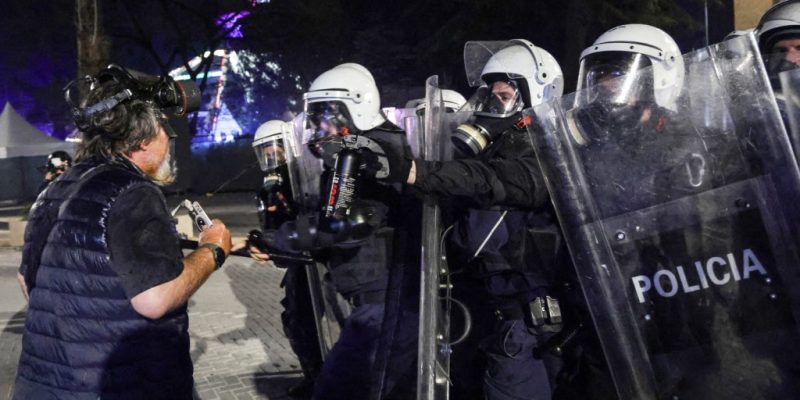
World Press Freedom Day: Six years of monitoring reveals emerging threats against media freedom in Europe

To mark World Press Freedom Day, the European Federation of Journalists (EFJ) and its partners from the Media Freedom Rapid Response (MFRR) are publishing today an analysis of six years of monitoring data that reveals, in granular detail, the most serious challenges and trends threatening freedom of the press in Europe. The MFRR consortium first began comprehensive monitoring in 2020 and has become the largest public database of media freedom violations in Europe. Our Mapping Media Freedom (MapMF) platform has now recorded 6092 media freedom violations in Europe affecting more than 10,200 different journalists and media-related entities in EU Member States…
Germany: Repeal NetzDG bill, deletion is not the answer

The German journalists’ association and affiliate of the European Federation of Journalists (EFJ), Deutscher Journalisten-Verband (DJV), has called on the members of the German Bundestag to abolish the Network Enforcement Act (NetzDG) as soon as possible. DJV federal chairman, Frank Uberall, said that “the censorship of the satirical magazine Titanic, by Twitter, has confirmed our fears that we have already put forward in the legislative process. The NetzDG pushes the power over the fundamental right of freedom of the press and freedom of private companies such as Twitter and Facebook. There is no sound legal consideration of the deletion of…

HesaMag #16: working conditions and fake news in the digital era

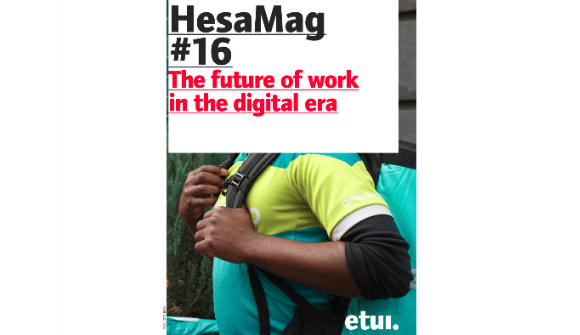
After an issue on the precarious working conditions of journalists, HesaMag, a magazine produced by the European Trade Union Institute (ETUI) about health and safety at work, just released its 16th edition entitled “The future of work in the digital era“. The magazine’s special report investigates the impact of technologies on working conditions and environments in the industry sector, as well as in the intellectual professions. A story on the fake news industry in Macedonia shows how young people, with no prospects of finding a decently paid job, manage to earn a few hundred euros by working around the clock. Working conditions…

Global survey on media ethics highlights fake news, low pay and spin

The Centre for International Media Ethics (CIME) has published the results of its survey on ‘Media Ethics in the Post-Truth Era’. The survey, with responses from Africa, the Americas, Central and South Asia, Europe and Oceania, aimed to learn from media professionals about the state of media ethics in their countries. According to participants, the top issues faced at work for journalists around the world were fake news, low pay, the pressure to attract the largest audience and political or corporate spin. Despite these issues, over half of respondents said that their government’s responses to protecting media ethics rate between…

Google to finance development of Union project in Finland

This news was originally published on heikkijokinen.info. Cooperative Mediakunta received 50,000 euro from the Google fund to develop its business model for the billing work for freelance journalists and media professionals. The Union of Journalists in Finland set up the cooperative Mediakunta in January 2017 to help its members who are working on a gig-basis. The cooperative takes care of billing, pays taxes and other statutory contributions. The idea was to allow Union members to fully focus on what they do best, journalism and media work. So far some 150 Union members have joined the cooperative. Among them are both…

Let independent journalism thrive

European institutions continuously emphasize that independent journalism and free media are fundamental pillars for our European democracy. Thanks for that, but it is not only words that are needed but also more political will, not only from institutions such as the Council of Europe and the EU, but also firmly and unconditionally from national leaders. We want to hear from the highest authorities that independent journalism must thrive. Strong support from all parties is a prerequisite for the safety of journalists and for fighting impunity, fighting “fake news”, developing mechanisms to defend journalists’ rights, including authors’ rights, and for improving…

5 media professionals killed in Europe in 2017

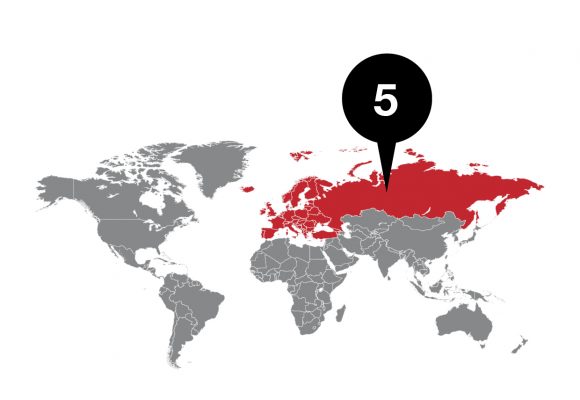
80 journalists have been killed worldwide this year, including 5 in Europe, according to the International Federation of Journalists’ (IFJ) Killed List, published today. The list details the journalists and media staff killed in targeted killings, car bomb attacks and cross fire incidents around the world during 2017. Denmark: Kim Wall The Swedish freelance journalist Kim Wall was killed in Denmark in August this year. The journalist had boarded a civilian submarine with its inventor, Peter Madsen, and was researching for a feature about him and the vessel which he had built from crowdfunding. Kim Wall’s body parts were later found…

Turkey: Four Cumhuriyet journalists ordered to remain in prison

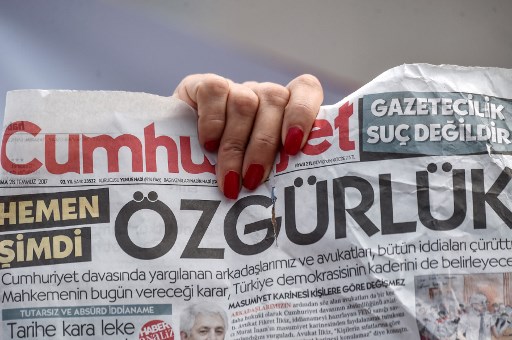
At a hearing on 25 December 2017, a Turkish judge ordered four journalists and senior staff from the newspaper Cumhuriyet to remain in prison for at least two more months during their trial. The newspaper’s editor-in-chief Murat Sabuncu, attorney Akin Atalay, correspondent Ahmet Şık and accountant Emre Iper, are charged with supporting through their coverage three outlawed groups: The Kurdistan Workers’ Party (PKK), the Revolutionary People’s Liberation Party-Front (DHKP-C), and the Gülen network. They face up to 43 years in prison if convicted. The newspaper and staff have denied the charges, and argue that they are being targeted to silence…

“Information Disorders”: Council of Europe committee discusses recommendations to tackle fake news

At the meeting of the Council of Europe Steering Committee on Media and Information Society (CDMSI), from 5 to 8 December 2017, participants discussed a series of documents and recommendations currently relevant for journalists and media workers. A study by Claire Wardle and Hossein Derakhshan, commissioned by the Council of Europe, highlighted the various aspects of what the authors call “Information Disorders” (not “fake news”). These information disorders come in three forms: misinformation, disinformation and malinformation. Information disorders can be organised or unorganised, and are emotional, visual and repetitive. To counter information disorders, the authors recommend action by content providers…

Republic of Macedonia: High time to protect Media Freedom

Report on the April 2017 Joint International Mission In a joint mission, the European Centre for Press and Media Freedom (ECPMF), the European Federation of Journalists (EFJ), the South East Europe Media Organisation (SEEMO), and the Osservatorio Balcani e Caucaso Transeuropa (OBCT) observed the situation of journalists and media workers in the Republic of Macedonia. The on-site research in Macedonia in April 2017 was motivated by the deterioration of the safety of journalists through the increasing number in verbal and physical attacks. This report indicates that through complex set of mechanism the previous government, as well as authorities, gave their…

Greece: journalists’ union ESIEMTH and two municipal media attacked in Thessaloniki

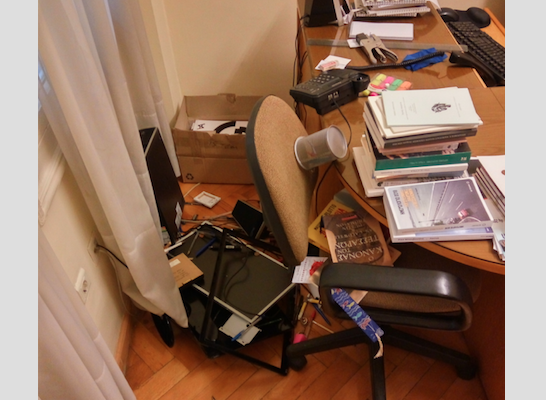
The European and International Federation of Journalists (EFJ/IFJ) condemn the attacks that took place in Thessaloniki (Greece) on 20 and 21 December 2017, against the Journalists’ Union of Macedonia and Thrace Daily Newspapers (ESIEMTH) and two municipal media. Today at noon, the ESIEMTH headquarters were attacked by around ten hooded assailants. The staff were threatened and asked not to move as the intruders said that “an intervention (was) about to take place”. They destroyed two PCs, a TV set and other material such as chairs and a printer before leaving the office. ESIEMTH told the EFJ that the police has launched an investigation. Yesterday, what…

EU directive on transparent and predictable working conditions

Responding today to the European Commission’s proposal for a Directive on Transparent and Predictable Working Conditions, Esther Lynch, ETUC Confederal Secretary, welcomed some important improvements, although this reform is not the game-changer unions needed or expected. “Many of the provisions in this new measure, replacing the Written Statement Directive, represent a significant improvement. For example, all workers will be entitled to a written statement from the first day of employment. This means seasonal agriculture, domestic, on-demand, intermittent, voucher-based and platform workers will be effectively covered. And the Directive goes further in proposing very helpful provisions to ensure that online platforms…

Eurobarometer survey shows whistleblowing is seen as difficult and dangerous

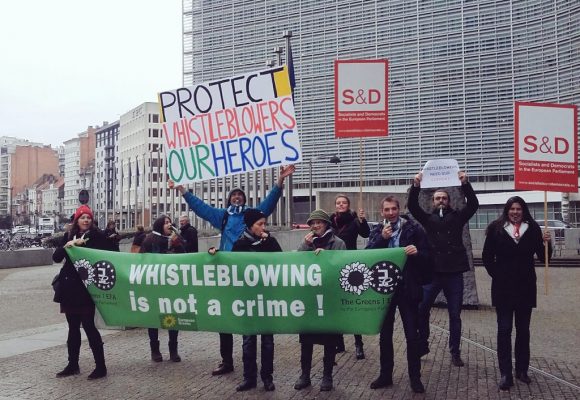
The latest Special Eurobarometer on Corruption, published on 19 December 2017, shows a widespread perception that whistleblowers across Europe face a difficult and dangerous situation. This collection of surveys across 28 European Union member states, conducted by the European Commission, focuses on corruption, giving a clear overview of the state of corruption in Europe. According to the results, more than two thirds (68%) of Europeans think that corruption is widespread in their country. This number has fallen by 8% since 2013, however the majority of Europeans (73%) still believe that there is corruption in national public institutions, and that the…

Council of Europe Culture Committee asks governments to strenghten the status of journalists

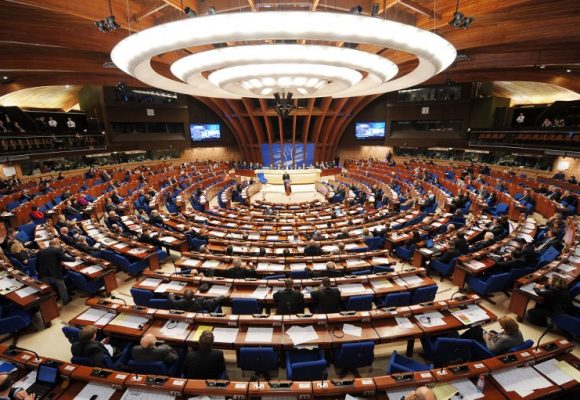
The Culture Committee of the Parliamentary Assembly of the Council of Europe (PACE) has adopted a draft resolution asking European governments to do more to protect media professionals, revising laws if necessary, as they state that media freedom is a “key prerequisite for the existence and development of a democratic society”. At a meeting in Bucharest on 4 December 2017, PACE Committee recognised the precarious nature of the current journalism profession, and the threats to journalistic values and freedoms. In response, PACE Committee unanimously adopted the draft resolution, asking governments of member states to assume their obligation to protect media professionals, to…

BBC and The Guardian taken to court over Paradise Papers

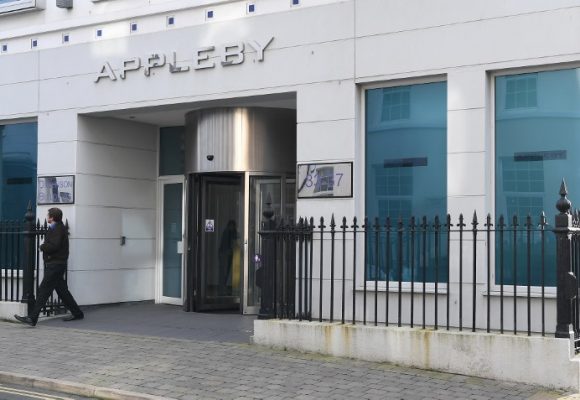
Following the release of Paradise Papers, offshore company Appleby has taken legal action against two British news organisations, the BBC and The Guardian. The BBC and The Guardian are two out of 94 news organisations that reported on the controversial Paradise Papers, a leak of financial documents that showed how hundreds of politicians, multinationals, celebrities and individuals with a high net worth use complex structures to avoid paying higher taxes. Appleby has since initiated breach of confidentiality proceedings against the two British news organisations. The law firm is seeking damages for the disclosure of what it says are confidential legal…

Temporary refuge for European journalists at risk

The ECPMF’s Journalists-in-Residence programme is designed to host journalists from across geographical Europe who face harrassment and intimidation in their home country. It provides a temporary refuge, a safe place to rest and to continue ones work and — if so desired by those being hosted — a platform to highlight threats to media freedom back home. The ECPMF has just released a new call for applications for journalists based in the EU28 and candidate countries. Key info at a glance: Eligible to apply are journalists living in an EU28 or candidate country Two timeslots to choose from: February to…

Omar Aourtilane Prize in solidarity with journalists in Turkey

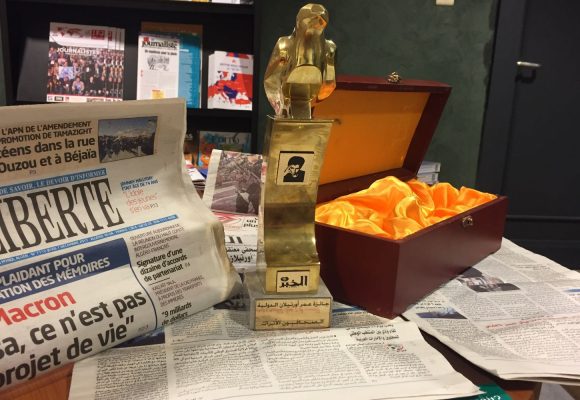
The Algerian Arabic-language daily El Khabar has decided to award this year its prestigious Omar Aourtilane International Prize for Press Freedom to the Journalists Union of Turkey (TGS, an EFJ-IFJ affiliate) in solidarity with imprisoned and prosecuted journalists in Turkey for their journalistic activities. The eighteenth edition of the ceremony was held in Algiers on December 7, 2017 at the headquarters of the KBC television channel, owned by the Algerian private group El Khabar, in the presence of journalist Zoubir Souissi who chaired the jury assisted by journalist Kaddour Hamlaoui (France 3) and Zakia Aourtilane , Secretary General of this prize. “The…