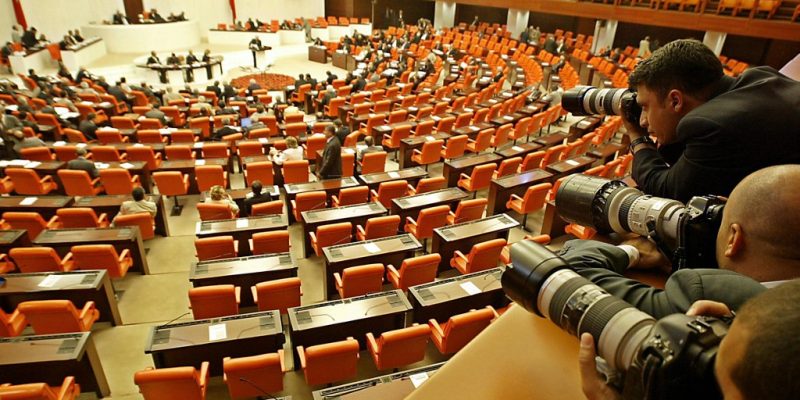
Turkey: EFJ and partner organisations condemn escalating use of “disinformation law” against journalists and call for its repeal

The European Federation of Journalists (EFJ) joins the undersigned organisations in strongly condemning the intensifying use of Article 217/A of the Turkish Penal Code — widely known as the “disinformation law” — to arrest, detain, and prosecute journalists, and calling on the government to repeal the provision immediately and release all journalists imprisoned under it. Since the law entered into force in October 2022, at least 83 journalists have been charged 114 times over disinformation according to news reports. The scale of Article 217/A’s use against journalists has been starkly illustrated in a recent article. The two journalists most frequently…
Report about fact-finding mission to Estonia and Lithuania

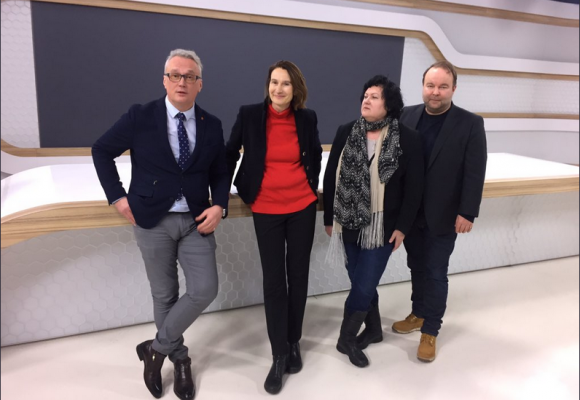
A new report about the fact-finding mission conducted by the European Federation of Journalists (EFJ) and the European Centre for Press and Media Freedom (ECPMF) which investigated the media situation in Estonia and Lithuania from 22 to 24 January can be found here. Members of the mission interviewed almost 30 experts: representatives of the government, academia, press councils, public service media, journalists‘ organisations, investigative journalists, editors-in-chief and CEOs of major media companies. The two Baltic states were chosen in the wake of a wave of disinformation spread by Russian specialists during the US election campaign. The question, whether the comparatively small societies of Estonia and…

European Parliament resolution on the current human rights situation in Turkey

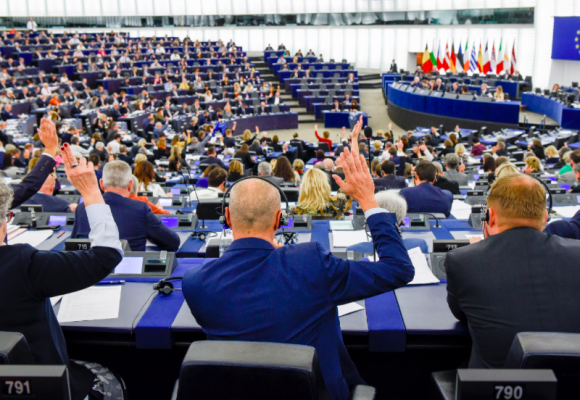
During the European Parliament plenary session (5-8 February 2018) in Strasbourg, MEPs voted a resolution on the current human rights situation in Turkey. The European Federation of Journalists welcomes the references to the fate of imprisoned journalists, to the specific cases of Deniz Yücel, Ayla Albayrak, Mehmet Altan, Sahin Alpay and Ahmet Sik, to the indictments of signatories of Academics for Peace, to the misuse of the state of emergency to silence dissent, to the chilling effect of the pressure on social media users expressing criticism against the military operation in Afrin. The full text of the resolution as adopted…

The EFJ launches the book “Free European Media”

The European Federation of Journalists (EFJ) launches the book “Free European Media” in connection with the conference, barring the same name Free European Media 2018, to take place in Gdansk, Poland. Hate speech and fake news are rife, citizens are getting more and more confused as propaganda undermines the credibility of our news media, and our fundamental values are under attack. Impartial and accurate journalism is under attack. It is high time to address the importance of uncensored, pluralistic media for the development of our free democracies in Europe. The conference Free European Media 2018 adresses that challenge and  Nordic Journalist Center is…

Serbia: EFJ denounced the intimidation campaign against its affiliate NUNS

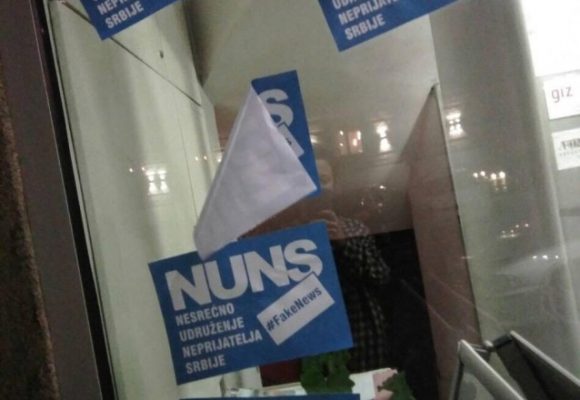
On 7 February 2018, the European Federation of Journalists (EFJ) denounced on the platform of the Council of Europe for the safety of journalists and protection of journalism the following case: On two separate occasions (04/02/2018 and 05/02/2018), the Belgrade office of the Independent Journalists Association of Serbia (NUNS or IJAS) has been the target of insults and intimidation with a printed flyer describing IJAS as an “Unhappy Association of Enemies of Serbia”. The flyers were glued into the glass entrance of the House of Journalists where the head office of the Independent Journalists Association of Serbia is located. It…

In France and Italy, the so-called “fake news” have a limited reach, new study reveals

The Reuters Institute just published the first evidence-based study “Measuring the reach of ‘fake news’ and online disinformation in Europe” focusing on the most popular false news sites in France and Italy. The results show that the so-called “fake news” have a limited reach and that the time spent on false news websites is far lower than the time spent on news websites. It is often assumed that false news have a huge impact on the people who read them. Yet the research reveals that most of the false news websites analysed had a reach of less than 1% of…

Programme Director of Serbian Radio TV Vojvodina dismissed for the second time

The European Federation of Journalists (EFJ) joined its affiliates in Serbia, the Journalists’ Association of Serbia (UNS), the Independent Journalists’ Association (NUNS) and the Journalists’ Union of Serbia (SINOS) in expressing concerns about the new dismissal on 29 January 2018 of Slobodan Arežina, programme director of regional public broadcaster Radio Television Vojvodina (RTV). Arežina was first dismissed in May 2016, due to an alleged decline in ratings, and the lack of a Program Production and Broadcasting Plan for 2016. The Court of Appeal stated that Arežina was unlawfully dismissed and ruled for his readmission. He was reinstated in December 2017 but not allowed…

EFJ co-organises the “Free European Media” Conference in Gdansk

Over 150 journalists, representatives of media organisations, media regulators and press councils, as well as academics, politicians and human rights activists are expected to attend the “Free European Media” Conference to take place in Gdansk (Poland) on 15 – 16 February 2018. The conference is organised by the European Federation of Journalists (EFJ), in cooperation with the Council of Europe, the Nordic Journalism Centre, the European Centre for Press and Media Freedom and the International Press Institute, with the support of Polish journalists associations, local authorities and European Trade Union Federations, to address the importance of uncensored pluralistic media, a crucial element of liberal democracy. Participants…

“No to NoBillag”: BREG sent a solidarity letter to Swiss affiliates

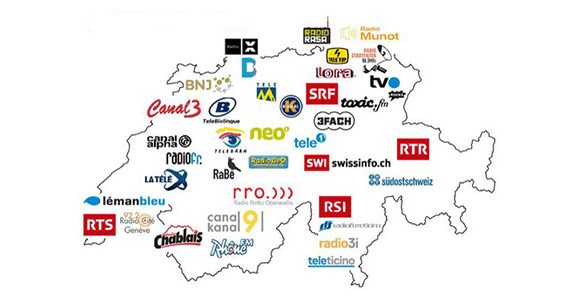
The Broadcasting Expert Group (BREG) of the European Federation of Journalists sent the following letter to Swiss affiliates, impressum and syndicom, ahead of the “No Billag” vote to take place on the 4th of March 2018. Dear colleagues, The Broadcasting Expert Group (BREG), one of the expert groups working for the European Federation of Journalists (EFJ), is deeply concerned by the news from Switzerland, regarding the plans to scrap the licence fee in public service broadcasting, and the proposed prohibition of any kind of subsidies for the Swiss public service broadcasting sector. If the law passes, we are informed it would lead to the…

Journalists at Swiss news agency strike against job cuts

The European Federation of Journalist’s (EFJ) Swiss affiliates, Impressum and Syndicom, have called for support for the workers from Swiss news agency SDA-ATS, who have been on strike since 29 January 2018. The EFJ expresses its solidarity with workers affected by the SDA-ATS job cuts. The news agency began their strike at 2pm on Tuesday afternoon, which has continued past its scheduled time of 2-5pm on 29 January and is still ongoing. The workers are striking after the agency announced on 9 January 2018 that up to 40 out of their 180 total employees are at risk of losing their jobs,…

Germany: EFJ supports constitutional complaint against new surveillance law

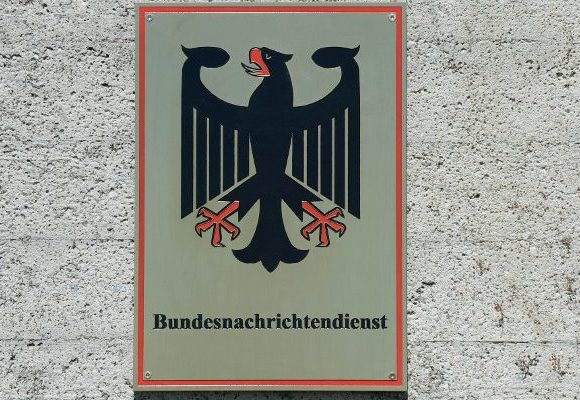
The European Federation of Journalists’ (EFJ) supports its German affiliates, the Deutscher Journalisten-Verband (DJV) and the dju in ver.di, in their statement of support for the constitutional complaint of foreign journalists against the Federal Intelligence Service (BND-G) law on “overseas surveillance” of telecommunications operations. The complaint by foreign journalists was filed in December, and presented publicly on 30 January 2018 in Berlin. It criticises the insufficient protection of fundamental rights of foreign journalists from surveillance measures. Among the plaintiffs are renowned investigative journalists, including the winner of this year’s Alternative Nobel Prize Khadija Ismayilova (Azerbaijan), Blaž Zgaga (Slovenia) and Richard…

Czech reporters physically harassed by Presidential supporters

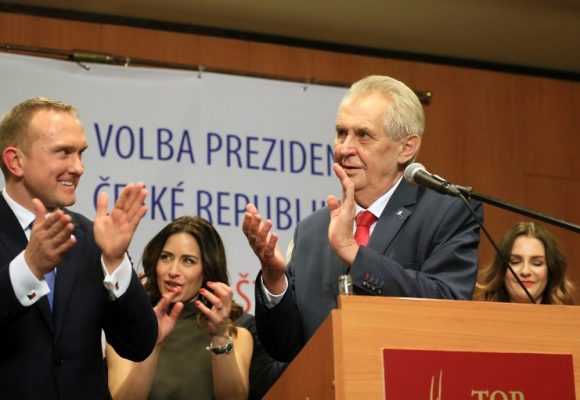
The European Federation of Journalists joined its affiliate in Czech Republic, the Syndikat novinaru Ceske republiky, in condemning the violence against journalists that occurred on 27 January 2018 in Prague, during the re-election of the President Milos Zeman. Last Saturday, supporters of Milos Zeman physically harassed journalists at the president’s election headquarters, where journalists were reporting on the President’s re-election. As captured in this video footage, reporters were pushed, punched and one camera’s reporter was threw to the ground in order to prevent him filming. The OSCE Representative on Freedom of the Media, Harlem Désir, condemned the violence against reporters and urged a…

Fact-finding mission to the Baltics: no “fake news” but blurring lines between journalism and advertising

Journalism is under tremendous economic pressure in the Baltics. This opens the door to political influence and PR. The governments of Estonia and Lithuania answer this with very different approaches. The European Federation of Journalists (EFJ) and the European Centre for Press and Media Freedom (ECPMF) investigated the media situation in Estonia and Lithuania from 22-24 January 2018. They interviewed almost 30 experts, among them representatives from the government, academia, press councils, public service media, journalists’ organisations, investigative journalists, editors-in-chief and CEOs. First, the good news: concerning media freedom and pluralism, Estonia and Lithuania are doing comparatively well. Considering the…

Danish court acquits photojournalist charged with refusing to obey police order

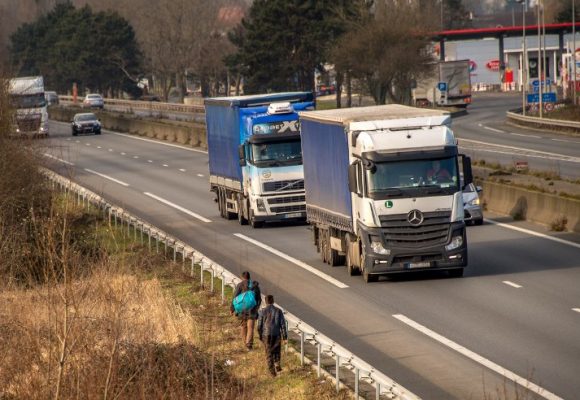
By Joshua Hollingdale, Dansk Journalistforbund The photojournalist from Danish daily Politiken, Martin Lehmann, was acquitted on the 22 January 2018 in a case concerning the legality of refusing a command by the police to remove himself from a Danish motorway, where a large group of refugees were travelling by foot. The acquittal was viewed as a matter of principle, largely based on a regard to public interest and freedom of the press. Lehmann was arrested by Danish police on 9 September 2015 for refusing a command by officers to leave the motorway where the group of refugees were walking, and…

Fact-finding mission to Estonia highlights negative impact of a deregulated media

The European Federation of Journalists (EFJ) and the European Centre for Press and Media Freedom (ECPMF) concluded their Fact-Finding Mission to Estonia, 22-23rd January 2018, by noting that in comparison with many other Eastern European countries,  media freedom in Estonia is rather high. However, the complete deregulation of the media has led to  high media concentration and a negative impact on quality of the media. Many journalists are, as in other countries, replaced by  ”media content providers” who are only valued for their speed and quantity to churn out content in order to reach profit goals. Managing director of ECPMF,…

Gender inequalities in media content and production persist, new study says

The European Parliament has just published its latest study on ‘Gender Equality in the Media Sector’. The study, requested by the Committee on Women’s Rights and Gender Equality and undertaken by the Department of Citizens’ Rights and Constitutional affairs, examines representation and conditions in the media and key elements of European policy towards gender equality in the sector. It also presents case studies in Austria, Malta, Sweden, and the UK. Many women who were interviewed reported widespread discrimination and inequality of opportunities in pay, recruitment, allocation of work, and promotion. Working structures, norms and practices were also seen as advantaging…

Joint mission to Serbia: our recommendations

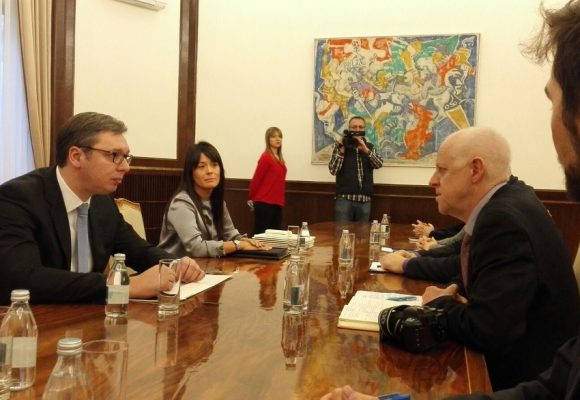
Following concerns about the state of media freedom in Serbia expressed by both Serbian journalists and media organisations as well as international organisations and institutions, an international joint fact-finding mission comprised of representatives from the European Federation of Journalists (EFJ), the International Press Institute (IPI) and the South East Europe Media Organisation (SEEMO) visited Serbia from 18th-19th January 2018. “It was encouraging to follow the big interest in Serbia on our fact finding mission. Without any doubt our mission shows that there are a huge need of creating an environment where all journalist by decent working conditions can do their…