Ukraine: NUJU launches international advisory council to strengthen support for journalists in wartime

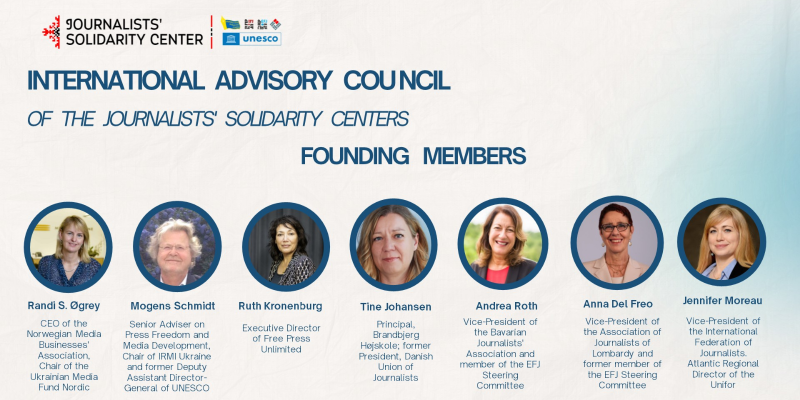
Today, on Ukraine independence day, our Ukrainian affiliate, the National Union of Journalists of Ukraine (NUJU) launched the International Advisory Council of the Journalists’ Solidarity Centers, a pro bono, non-governing advisory board. The new group of international experts will advise NUJU on journalists’ safety, media resilience and the strategic development of its nationwide Solidarity Centers network. The group will also help connect the needs of Ukrainian journalists and independent media with international expertise, professional solidarity and appropriate forms of support. “Ukrainian journalists and media are working in conditions that change almost every week, from missile and drone attacks to displacement,…

‘Media (literacy) and Refugees’ events to discuss media role in representing migrants

The European Association of Viewers’ Interests (EAVI) and MyStory project have announced their ‘Media (Literacy) and Refugees’ event, taking place on 5 December 2017 at L42 Rue de la Loi. EAVI is a non-profit international organisation, working across Europe to promote media literacy. In the morning, a series of roundtable discussions will look at the way media shapes citizens’ perceptions of migrants and refugees. The discussions will highlight the success of grassroots organisations and their media initiatives, and touch on media literacy, journalism, civil society and fake news. The project Media Against Hate will be presented at this occasion. Registration here.…

Russian ‘foreign agents’ media law threatens media freedom

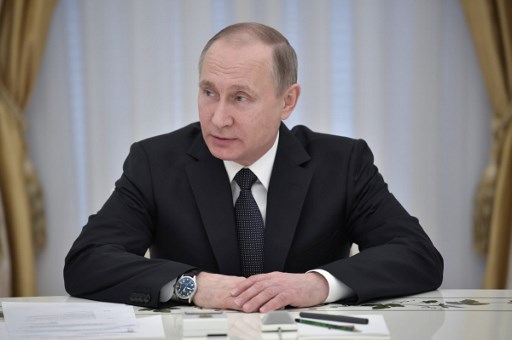
The European Federation of Journalists (EFJ) has expressed grave concern over the recent adoption of a new law that would allow the state to have more control and scrutiny over foreign media and journalists in Russia. On 25 November 2017, Russian president Vladimir Putin signed a new law which will allow authorities to classify foreign journalists and media outlets as “foreign agents”. In practice, the law means that Russia now has the power to force foreign journalists and media to register themselves as “foreign agents”, to submit their content to scrutiny and to reveal their funding sources. Failure to comply…

Belarus: harrassment against freelance journalists on the rise

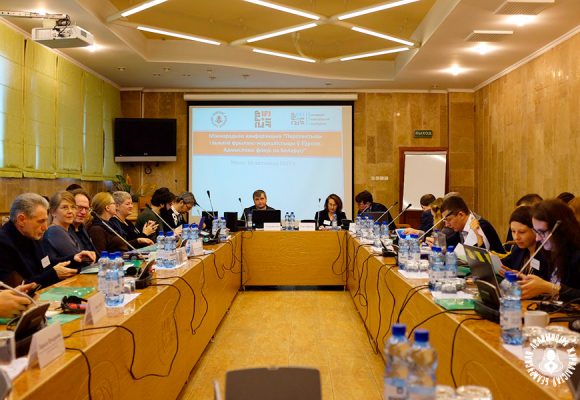
On 16 November 2017, the Belarus Association of Journalists (BAJ) in cooperation with the International Federation of Journalists (IFJ) and European Federation of Journalists (EFJ), organised a one-day meeting in Minsk focusing on “The Perspectives and challenges for freelance journalism in Belarus and Europe”.  Around 40 journalists, including media lawyers, EFJ/IFJ affiliates and the EU Delegation to Belarus, discussed how to best put the desperate issue of freelance journalism at the heart of local and national authorities in Belarus and the European Union. Renate Schroeder from the EFJ, Michael Hirschler from the German Journalists’ Association (DJV), and other colleagues from the EFJ’s Freelance Expert Group (FREG)…

Manifesto of Venice against gender-based violence

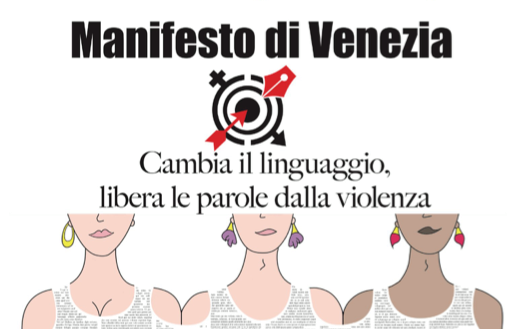
The “Manifesto of Venice”, a manifesto for gender equality and correct information, will be launched on the World Day for the Elimination of Violence against Women and Girls, on 25 November 2017. Signed by 800 journalists, including directors of national newspapers in Italy, the manifesto will be launched by the EFJ affiliate in Italy, the Federazione Nazionale Stampa Italiana (FNSI) Equal Opportunities Committee (CPO). It is a result of their collaboration with the CPO of Unione Sindacale Giornalisti Rai and Giornaliste Unite Libere Autonome (GiULiA), following a proposal by the Veneto Journalists’ Union. “We, journalist signatories of the Manifesto of Venice, are…

News Impact Summit returns with focus on media and politics

The News Impact Summit returns to Brussels on 4 December 2017, with the theme of “A Year is a Long Time in Politics”. Organised by the European Journalism Centre with help from the Google News Lab, the day of speakers, workshops and discussion will look back on the relationship between media and politics this year. The event will focus on how the global political upheaval shaped the way journalists covered the news, as well as how evolving journalism practices changed the face of politics. Editors, reporters, technologists and researchers from International Consortium of Investigative Journalists (ICIJ), Euronews, First Draft, Berliner…

EFJ Focus November 2017

The latest EFJ newsletter, EFJ Focus, is available here EDITORIAL: Lack of leaders standing up for media freedom in Western Balkans The EU- Western Balkans Media Days that recently took place in Tirana, Albania, proved the importance of having a very firm focus on press freedom in the region where journalists are often caught in cross-fire. Firstly, journalists in the region are often attacked, harassed and even imprisoned. In particular, female journalists are exposed to harassments and threats. Impunity for crimes against journalists remains as a common practice. Governments have the duty to support media and journalists. Swift actions should be taken whenever there is a…

Study recommends EU action to protect atypical workers

A recent study explored ‘Temporary contracts, precarious employment, employees’ fundamental rights and EU employment law‘, commissioned by the European Parliament’s Policy Department for Citizens’ Rights and Constitutional Affairs at the request of the Committee on Petitions. The findings have implications for journalists, as atypical and precarious employment has been tied to media industries and digitisation. The study emphasises that precarious employment is a fundamental rights issue of enormous weight and significance within the EU’s normative order. Some groups, such as women and younger workers, are more affected by precarious employment. Self-employment, which affects many freelancers and journalists, is discussed in…

Ukrainian journalist arrested in Belarus on spy charges

Pavlo Sharoyko, a Ukrainian Radio correspondent (Public Broadcasting Company of Ukraine), was arrested in Minsk, Belarus, on 25 October 2017 by the Belarusian KGB. Sharoyko is only being allowed representation provided by Belarusian authorities, says Sergiy Tomilenko, head of Ukraine’s National Union of Journalists (NUJU). Sharoyko’s colleagues have said that the journalist was working on stories related to the search for Pavlo Hryb, a Ukrainian citizen who disappeared in Belarus after being arrested and was later found to have been sent to Russia. Sharoyko also investigated cases involving Russia’s Ukrainian political prisoners, and reported on military exercises taking place in…

Journalists in Turkey facing more and more imprisonment

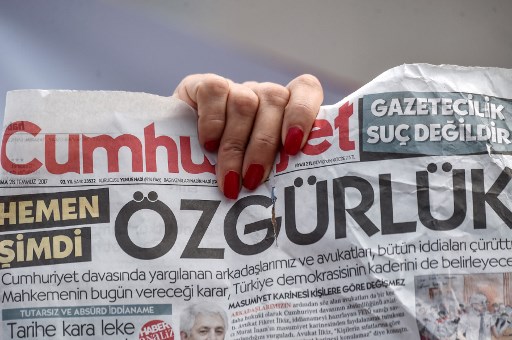
November was a difficult month again for imprisoned and prosecuted journalists in Turkey. More and more professional journalists and media workers are facing imprisonment or threats for reporting information or simply for being affiliated to specific media outlets, wrongly considered by Turkish authorities as criminal acts. On 21 November 2017, journalist Oğuz Güven, editor-in-chief of the online version of Cumhuriyet daily newspaper, was sentenced to 3 years and 1 month of imprisonment due to a temporary tweet which Mr Güven had sent and quickly deleted regarding the accidental death of a public prosecutor. Mustafa Alper, the Chief Public Prosecutor of Denizli, died…

EU’s Colloquium on Fundamental Rights addresses women and the media

The EU’s annual Colloquium on Fundamental Rights was held this year on 20-21 November 2017, with the theme of “Women’s Rights in Turbulent Times”. Discussions over the two days raised many issues around journalists and the media. Discussing the empowerment of women’s voices, Wim Slabbinck, a journalist for Charlie magazine, argued that media pushes girls into corners. “Only 7 % of sports media coverage is about women”, said Katrien Meire, owner of Charlton Athletic. In terms of coverage of female politicians, Pamela Morinière from the International Federation of Journalists (IFJ) noted that women in politics are not covered in the…

#TackleFakenews: European Commission convenes expert meeting

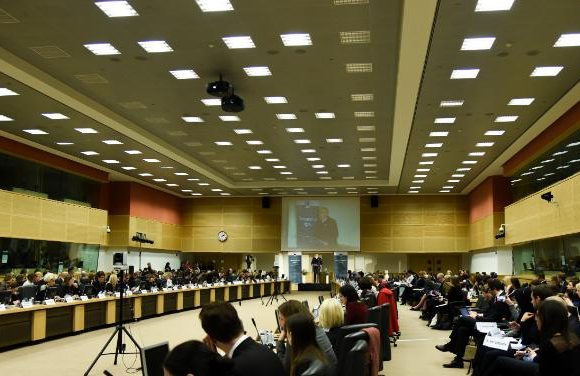
Brussels, 13-14 November 2017.  Yannis Kotsifos, member of the European Federation of Journalists (EFJ) Steering Committee and Renate Schroeder, EFJ director participated in the European Commission’s Directorate-General for a communications networks, content and technology multi-stakeholder conference on fake news. The European Commission engages on a broad-based consultation about how to deal with disinformation online. The objective is to help the Commission in close cooperation with consultation partners, define the scope of the fake news issue and reach consensus on how to proceed. There is no common understanding on what fake news is. Guy Berger, director of the Freedom of Expression…

European Parliament calls for respect for media freedom in Poland

In the European Parliament plenary sitting in Strasbourg, 15 November 2017, the European Parliament called on Poland to respect the rule of law concerning media freedom, independence of the judiciary, freedom of assembly, sexual and reproductive rights, and asylum-seekers’ access. The Socialists & Democrats (S&D) group president, Gianni Pitella, called on Poland to improve its situation of media freedoms and criticised the government’s interference on media organisation. State limitations of media freedom in Poland have been recognised by the European Federation of Journalists (EFJ). Last December, mass demonstrations took place in Warsaw against government plans to restrict journalists’ access to parliament. In July…

Italian journalists protest against mafia attack on journalists

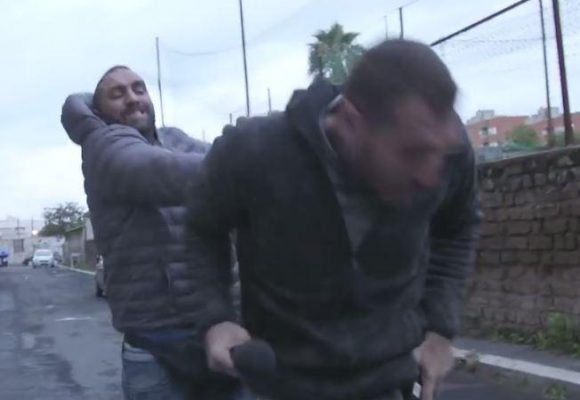
Today, 15 November 2017, the Italian Secretary of State for the Interior, Marco Minniti, has met with leaders of the National Federation of Italian Press (FNSI), a member of the European Federation of Journalists (EFJ) to discuss journalists’ concerns for press freedom. Daniele Piervincenzi, a journalist for Italian TV RAI, was assaulted by Roberto Spada, the brother of a mafia boss, when he approached him for an interview about the local elections in Ostia, on 7 November 2017. Following the report from FNSI, the EFJ condemn the assault and filed a complaint to the Council of Europe Platform to protect the safety of…

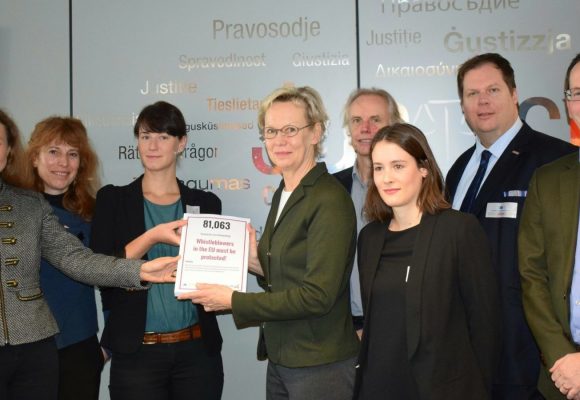
More than 81,000 citizens call on the European Commission to protect whistleblowers

On 14 November 2017, representatives from the European Federation of Journalists, Eurocadres, the European Public Service Union (EPSU), Transparency International and WeMove.eu met with Tiina Astola, the Director General of DG Justice. They handed over the 81,000 signatures and the list of 80 organisations participating in the WhistleblowerProtection.eu platform. The platform and the petition were initiated by Eurocadres in October 2016 with the aim to push the European institutions to protect whistleblowers at the European level with a directive. During the meeting, the group highlighted the recent good news in the work for EU-wide whistleblower protection: The Parliament adopted, with a large majority, a…

Incentivising media rights and plurality by supporting good practices in Western Balkans and Turkey

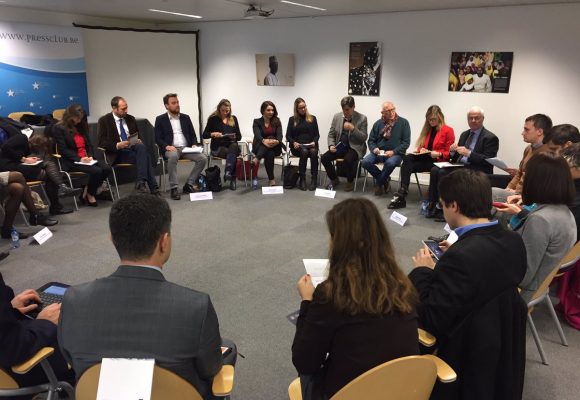
“How to improve the precarious state of journalism in South East Europe and Turkey” was the topic of a press conference held by the European Federation of Journalists (EFJ) on 14th November 2017 at the Press Club Brussels. The press conference took place in the framework of the EFJ project, Building Trust in Media in South East Europe and Turkey – a project supported financially by UNESCO and the European Union. Andris Kesteris, principal advisor at DG for Neighbourhood and Enlargement Negotiations (NEAR) at the European Commission and Tarja Turtia, UNESCO Programme Specialist, attended the event to hear representatives of…

Media Days urges political leaders to ensure press freedom in Western Balkans

The European Federation of Journalists (EFJ) welcomed the focus, that European Union has provided, when over 250 representatives of media, stakeholders and policymakers from the Western Balkans and the European Union met at the EU Western Balkans Media Days in Tirana, Albania, on 9 and 10 November 2017, dedicated to the important role of media in the accession process. Two panels and six workshops gave the opportunity for participants to exchange their views and work on forward-looking initiatives for independent, sustainable and professional media, in a region where the media freedom situation is not only slow to improve, but also in some…