Georgia: An escalating media freedom crisis

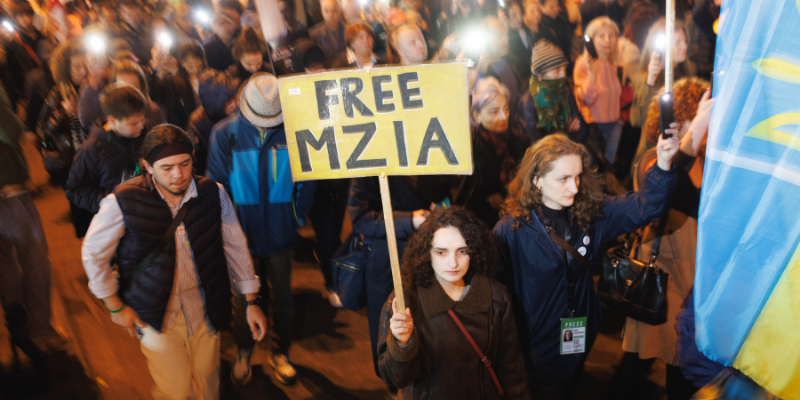
Since the contested parliamentary elections in October 2024, Georgia has experienced one of the most rapid and serious deteriorations of press freedom ever seen in an EU member state or candidate country, Media Freedom Rapid Response (MFRR) partners warn today. As we mark World Press Freedom Day 2026, the European Federation of Journalists (EFJ) and its partners once again draws attention to the plight of independent media and journalists in Georgia, where the Russia-friendly ruling party has continued its intensifying clampdown over the past year. Our thoughts today are particularly with jailed journalist Mzia Amaglobeli, who has now been behind…
A silent problem: 4 stories on the threat of (self-)censorship

Hungary It all started with a simple question. Janos Karpati, then Brussels correspondent for the Hungarian national newswire, didn’t think it would terminate his longtime career when he addressed the Hungarian Prime Minister Victor Orban at a press conference at the fringes of the European Parliament’s plenary meeting in Strasbourg. Orban had come to Strasbourg to speak about migration – and his widely-criticized comment on reinstating the death penalty. Karpati, an experienced correspondent who has worked in Prague and Washington, DC, asked Orban about Fidesz’ position within the European People’s Party, a question he hadn’t cleared with anyone beforehand. He…

Azerbaijan: Journalist Khadija Ismayilova released on probation

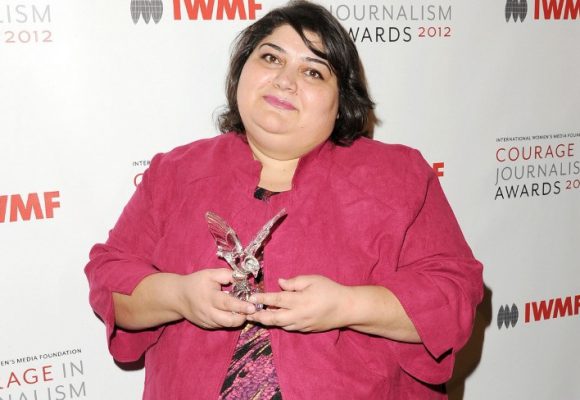
The International and European Federations of Journalists welcome the Azerbaijani Supreme Court’s decision today to release investigative reporter Khadija Ismayilova, who had been imprisoned on trumped-up charges since December 2014. The court converted Ismayilova’s jail term into a three-and-a half-year suspended term. Khadija Ismayilova has already served 1.5 years in prison, held on politically motivated charges for her work exposing corruption. She now faces 3.5 years on probation, and a two-year ban on professional activities. In September 2015, the Baku Court of Serious Crimes sentenced Ismayilova to seven-and-a-half years in prison on tax evasion and large-scale embezzlement charges. The IFJ…

European Creators’ conference

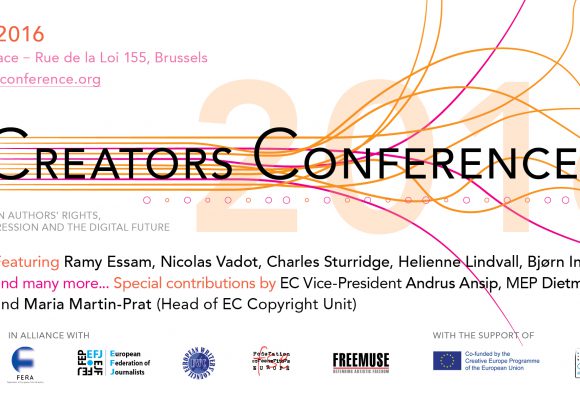
How do we bring authors’ rights back to the core of the copyright debate? Where are authors in the EU copyright priorities? How can EU lawmakers ensure that authors get a fair share of their works and do not get ripped of by unfair contracts? To address these questions, the European Federation of Journalists (EFJ), is partnering with European organisations representing music composers (ECSA), writers (EWC), film directors (FERA) and Screenwriters (FSE) in a key conference on 31 May in Brussels addressing authors’ rights, freedom of expression and digital future. More about the conference: http://creatorsconference.org/home

40 % of Serbian journalists wants to leave the profession

Journalists Union of Serbia (SINOS – EFJ affiliate) in partnership with the Friedrich Ebert Foundation held a seminar in Prolom Banja (Serbia) from 19 to 21 May. The theme of the was organising unions for media workers in Serbia and the Balkans countries. The participants talked about precarious work, legal and social status of journalists and the sustainability of trade unions in the media with multinational ownership problems. The President of the European Federation of Journalists (EFJ), Mogens Blicher Bjerregard spoke about the experience of organizing unions for journalists in different European Union member states. He stressed that progress is possible when…

Europe follows worrying developments at the Radio Television of Vojvodina

UPDATE (01/06/2016) : Nada Kalkan, the new editor of RTV, is sending the EFJ the following statement : “That’s not true that journalists in RTV were layoffs. Previous program director was replaced and new director elected because the executive board was not satisfied. The general director and the editor-in-chief have resigned. Now, we have new a group of managers, nobody at RTV was dismissed or degraded and most of them have same salary and rested on editorial places.” Serbian media report that program director of RTV, Slobodan Arežina, was replaced, general director Srđan Mihajlović resigned under political pressure; 7 editors of news program…

Turkey must stop feeding its environment of fear for journalists and trade unionists

Update (25th May): Our Turkish colleague Erol Önderoglu is also under criminal investigation for “terrorist propaganda” for participating in a solidarity campaign with the Kurdish daily newspaper Özgür Gündem. The EFJ and IFJ demand that all criminal charges be dropped against journalists involved in this campaign. The European and International Federations of Journalists (EFJ and IFJ) is calling upon the presumptive upcoming Turkish Prime minister, Binali Yildirim, to end the climate of permanent judicial intimidation, threats, harassment, detention and physical assaults against journalists and media workers in Turkey. The EFJ is particularly underlining the fact that Turkish judicial authorities have recently opened an…

Legalislative framework for investigative journalism need improvements

The Institute of European Media Law (EMR), consortium partner of the European Centre for Press and Media Freedom (ECPMF), has recently conducted a study on the state of media freedom and investigative journalism in Europe. The results published on 17 May 2016 show that restrictive rules for the development of press freedom remain a major obstacle in all countries. 1. Decriminalisation of journalism = Hungarian model Journalists might infringe the law while trying to obtain information. According to the report, all legal frameworks know limits to the freedom of obtaining information. Even though in many states courts take into consideration the importance of press freedom…

Three-day conference to discuss the impacts of the digital revolution on work, 27-29 June, Brussels

A three-day conference will be held on 27-29 June 2016 in Brussels on the theme: “Shaping the new world of work – The impacts of digitalisation and robotisation”. Organised by the European Trade Union Confederation and the European Trade Union Institute, the conference will bring together over 400 representatives of trade unions, research bodies, academia, civil society, EU institutions and international organisations to discuss how the world and nature of work and employment is being changed radically by the digital revolution. Contrary to similar conferences, this event will not only focus on the quantity of work (‘will robots destroy our jobs?’) but also…

Three RBC editors resign under political pressure from Kremlin

Three top editors from the Russian RBC media group announced their departure on 13 May as the political pressure against the independent media outlet grows in Russia. The International and European Federations of journalists (IFJ/EFJ) back their affiliate the Russian Union of Journalists (RUJ) in expressing concerns over the growing intimidation against the media in Russia. In a statement published on 13 May RBC said that the resignations of editor-in-chief Yelizaveta Osetinskaya, chief editor of the RBC newspaper Maxim Solyus, and chief editor of the RBC news agency Roman Badanin were due to “differences regarding the media company’s future and…

Ukraine: Journalists’ security threatened by publication of personal details

A Ukrainian organisation working on national security published thousands of personal details of journalists on its website on 7 May claiming the journalists had accreditation with pro-Russian separatists in the eastern Ukraine. It further accused them of ‘co-operating with terrorist organisations’ and violating Ukraine law. The European and International Federation of Journalists (EFJ/IFJ) support their Ukrainian affiliates the National Union of Journalists of Ukraine (NUJU) and the Independent Media Trade Union of Ukraine (IMTUU) in denouncing this leak which endangers journalists’ safety and urge the Ukrainian government to bring those responsible to justice. The private contact details published by Myrotvorets (“The Peacemaker”…

Parliament committees plan to address better work-life balance and gender equality

On May 24, the Committee on Employment and Social Affairs as well as the Committee on Women’s Rights and Gender Equality will discuss with the Commission a draft report on “Creating labour market conditions favourable for work-life balance”. The co-rapporteurs are Vilija Blinkevičiūtė (S&D) and Tatjana Ždanoka (Greens/EFA). This own initiative report is a reaction to the roadmap and public consultation published in 2015 titled “A new start to address the challenges of work-life balance faced by working families”. The objective is to increase the participation of women in the labour market by modernising and adapting the current EU policy framework to today’s labour…

Greek journalists draft ethical code to fight racism on refugees coverage

The European Federation of Journalists (EFJ) is strongly supporting the initiative of its affiliate in Greece the Journalists’ Union of Macedonia and Thrace Daily Newspapers (ESIEMTH) – who drafted a proposal for the adoption of the Anti-racism Ethics Code of the Greek journalists called The Charter of Idomeni, in the name of the border control village where thousands of refugees are passing through to reach Northern European countries. The aim of the charter is to preserve the social role of journalists in the conditions created by the presence of refugees, migrants, minorities and socially vulnerable groups in Greece, discourage and denounce climates of intolerance, guarantee…

Ismayilova: Humanity suffers when journalists are silenced

Khadija Ismayilova‘s acceptance speech on the occasion of receiving the UNESCO/ Guillermo Cano World Press Fredom Prize 2016 The mother of imprisoned Azerbaijani journalist Khadija Ismayilova has accepted the 2016 UNESCO/Guillermo Cano World Press Freedom Prize on her daughter’s behalf. Dear ladies and gentleman, distinguished colleagues. You have graciously and generously gathered tonight on the occasion of the award of the annual Guillermo Cano award for press freedom. If you don’t mind, I will take a minute to pay tribute to Mr. Cano, since the award is very much about him, a person, as much as it is about press…

Press freedom must be a part of any agreement with Turkey

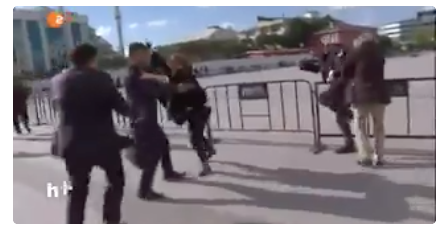
The European Federation of Journalist (EFJ) has strongly condemned the assassination attempt on 6 May in Istanbul against journalist Can Dündar (editor-in-chief of Cumhuriyet daily newspaper) and the jail sentences of 5 years and 10 months for Can Dündar and 5 years for Erdem Gül for procuring, revealing and publishing state secrets. Cumhuriyet published in May 2015 footage that show Turkey’s state intelligence agency ferrying weapons into Syria in 2014, the journalists have since been accused of revealing state secrets. “This new verdict is clearly unacceptable, in contradiction with Turkey’s Constitutional Court ruling and nobody can claim of a fair trial since the court decided to hold the trial behind closed…

Coalition of journalists and press organisations highlight importance of defending press freedom on World Press Freedom Day

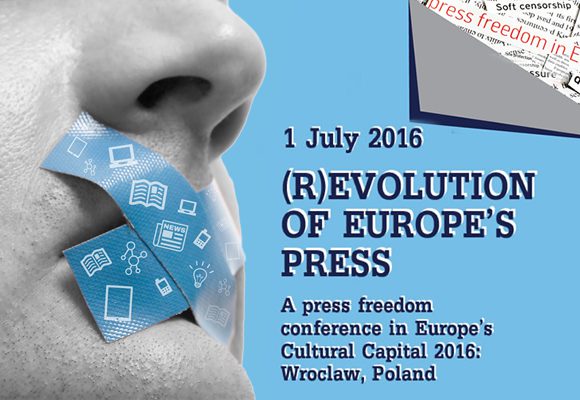
On May 3, World Press Freedom Day, offers an opportunity to highlight the importance of defending press freedom worldwide, as it is an essential component of any democracy. The European Magazine Media Association, in cooperation with an alliance of national, European and international media and journalist organisations, is organizing a conference, “(R)EVOLUTION OF EUROPE’S PRESS”, on 1 July 2016 in this year’s European Capital of Culture, Wroclaw, Poland. The event will bring together press publishers, politicians, journalists, academics, start-ups and technology experts to discuss a holistic view of real and potential threats for press freedom in Europe. World Press Freedom Day…

Self-censorship is affecting more and more European media

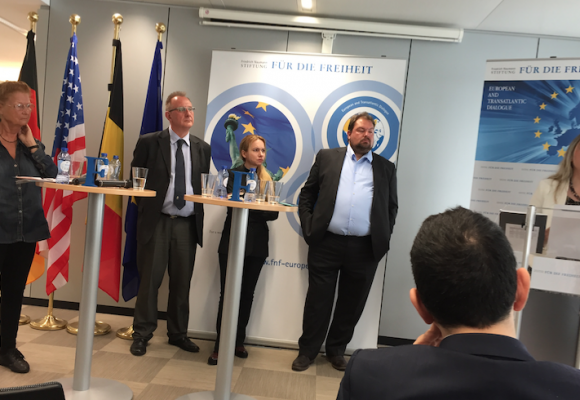
I can’t write that, it seems that more and more European journalists are saying this sentence to themselves when working for a media outlet. The refugee crisis, the Cologne attacks, the Panama papers or the new French surveillance law are some recent examples of sensitive topics that raised the question of self-censorship among journalists. The Friedrich Naumann Stiftung für die Freiheit in co-operation with the EFJ organised an event (02/05/2016) in Brussels to discuss how self-censorship affects journalists’ reporting in the European media industry.  The debate was moderated by EFJ Director Renate Schroeder, who at the outset drew the meeting’s attention to a comprehensive quantitative…