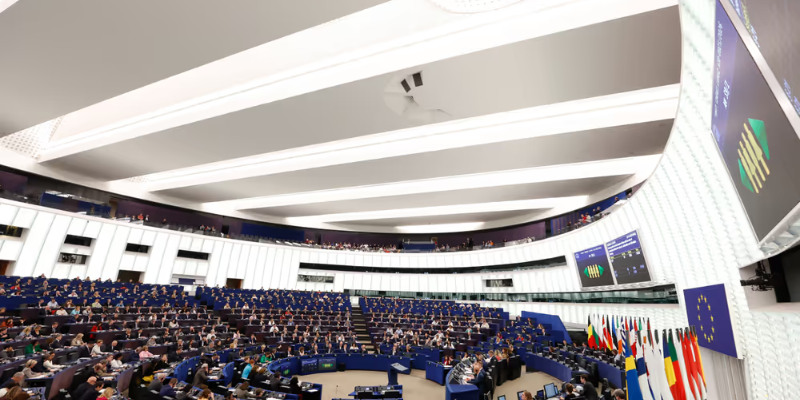
EFJ welcomes European Parliament’s call for an EU regulatory framework that protects copyright in the age of AI

Today the European Parliament adopted the report on “copyright and generative artificial intelligence” drafted by MEP Axel Voss (by 460 votes to 71, 88 abstentions). The European Federation of Journalists (EFJ) welcomes this first step as a sign of political will to strengthen and make fairer the copyright framework protecting journalists from the unauthorised use of their work in AI training and content generation. Until now, AI companies have been relying on journalistic content without seeking consent, providing remuneration, or ensuring transparency about how such material is used. This practice not only undermines journalists’ intellectual property rights but also threatens…

Ensuring a fair digital single market: Independence of media regulators

A debate on the revision of the Audio-Visual Media Services Directive (AVMSD) and the independence of media regulatory authorities will be hosted by the European Parliament by MEP Sabine Verheyen on 7 December. The aim of the meeting is to provide MEPs and other stakeholders with an overview of the key challenges to be addressed in the revision. The European Commission recently conducted a public consultation (closed 30 September 2015) and is currently preparing revisions to the Directive which will then be submitted to the European Parliament and the Council of the European Union. The meeting will include contributions from Lorena Boix Alonso, Head of Unit,…

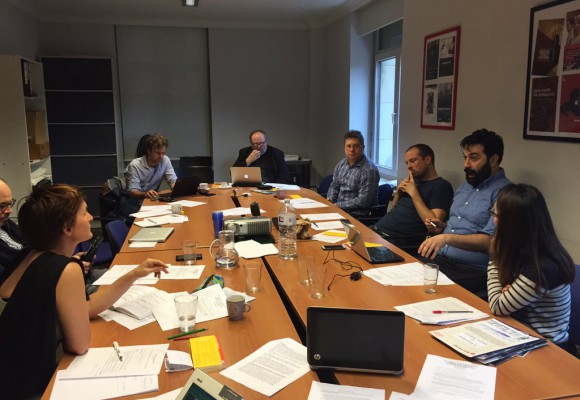
Highlights of EFJ Freelance Expert Group (FREG) meeting

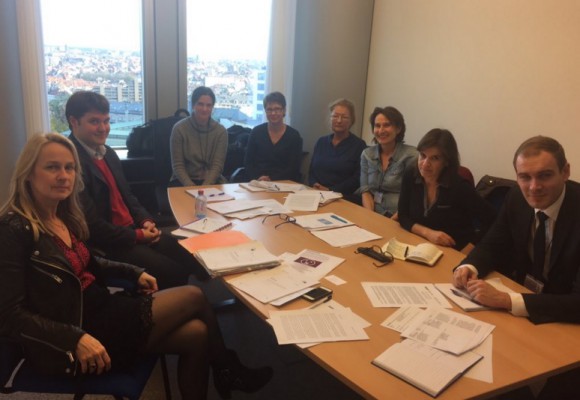
On 19 November, the EFJ organised its biannual Freelance Experts’ Group (FREG) meeting, in which participants from 8 European countries discussed EFJ activities, national developments regarding freelance activities and ideas for the  future working programme to be adopted by next year’s EFJ General Meeting. Below is a snap shot of the main topics debated by the participants. EFJ issues & activities Results of the survey “Mapping Freelance Journalists” : Please click HERE for more information. The Rights and Jobs in Journalism EFJ project debriefing : The Dublin Freelance conference on atypical workers, which was organised in September 2015 by the National union of…

What’s your recruitment strategy? Share with us!

The EFJ has created a short survey aiming to collect latest information among EFJ affiliates to provide an overview of the current recruitment strategy, development of services and youth in journalists’ unions. This will help the EFJ map out the situation in our membership better its services for members in this area in the future. 19 members have already responded. Some of them have also shared their best practices in a workshop on recruitment in Copenhagen in May. You can find out the top 10 tips on recruitment and organising in the EFJ membership.  If you have not responded yet,…

EFJ survey reveals disparities of freelancers’ social rights in Europe

A new survey launched by the European Federation of Journalists reveals the diversity of the freelancers’ professional situations and disparities of their labour rights’ protection in Europe. On 19th November, the EFJ had its biannual meeting with the Freelance Experts’ Group (FREG). Together, they discussed the results of the survey “Mapping Freelance Journalists” conducted since May by the EFJ to collect updated database regarding the social status of the freelance journalists and their representation in professional associations and unions in Europe. Thirty-three organisations from 28 countries have responded to the online questionnaire. The results reveal disturbing disparities between levels of freelancers…

Global media competition: Reporting fairly on labour migration

Update (18/12/2015): The ILO received a total of 258 entries from contestants in 68 countries. Follow this link to discover the winners. ———————- Recent debates on the migrants and refugees crisis have put media under spotlight raising the question of fair and ethical reporting. The International Labour Organisation (ILO) has launched its first-ever global competition for the media, entitled ‘Reporting Fairly on Labour Migration’ to recognise exemplary media coverage on the topic. The winner will be announced on the International Migrants Day on 18 December and he/she will receive $1,000. The work of the winner will be promoted widely as an example of good practices worldwide. The competition is organised…

Free Dawit Isaak

Imagine you are being locked away in a prison for 14 years without trial for crimes you have not committed? On Sunday 15 November, you can experience the injustice facing the Swedish-Eritrean journalist, Dawit Isaak, who has been detailed Eritrea for 14 years now. To share the solidarity with Dawit, you will be put in a  four square metres of pitch dark and stifled surroundings symbolize Dawit Isaak’s prison cell for 15 minutes. The European Federation of Journalists (EFJ) will join a campaign launched by the Belgian branch of the world association of writers, PEN, to highlight the struggle of…

Trade Secrets: Legitimate use for journalists or not is still the question

In view of the ongoing trilogue negotiations, informal tripartite meetings attended by representatives of the European Parliament, the Council and the Commission on reaching the proposal for an EU directive (also know as trade secrets directive) “on the protection of undisclosed know-how and business information against their unlawful acquisition, use and disclosure”, journalists’ and media organisations expressed their concern regarding a potential damaging impact on press freedom. A letter has been sent to the rapporteur, shadow-rapporteurs, members of the European Parliament of the Legal Committee, the Permanent representatives of the EU member states (COREPER) and relevant  contacts in the European…

Greek media on 24-hour strike

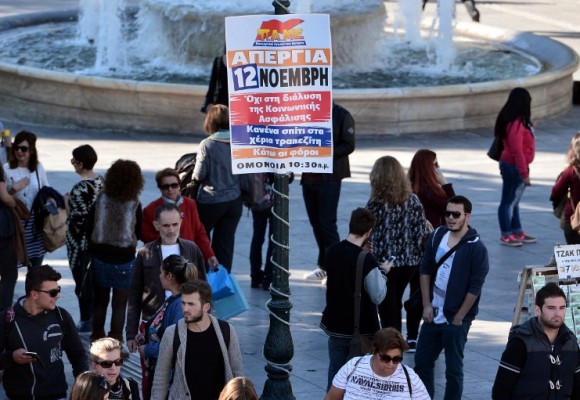
Greek media will strike will hold a 24-hour strike starting from 6:00 am on Thursday until 6:00 am on Friday, following the general strike that has been scheduled by the country’s public and private sector unions, including the Panhellenic Federation of Journalists’ Unions (an EFJ affiliate), for Thursday 12 November. The strike for journalists covers all print media (newspapers and magazines), public broadcaster ERT and all private TV, radio and internet media, Athens-Macedonian News Agency, Secretariat General of Information and Communication and all Press Offices. The Journalists’ Union of the Athens Daily Newspapers (JUADN-ESIEA), also member of the EFJ, has called on its…

EFJ-IFJ-TGS address journalists and trade unionists’ perspective for the upcoming EU-Turkey’s relations

The European and International Federations of Journalists (EFJ-IFJ) and their affiliate the Journalists Union of Turkey (TGS) reviewed the implications for journalists and trade union rights following the victory of the Justice and Development Party (AKP) in the re-run of Turkey’s national elections this weekend, during a Press briefing at the Brussels Press Club, 5 November 2015. Anthony Bellanger IFJ General Secretary said that : “Before Sunday’s elections, to be a journalist in Turkey wasn’t easy but now it will be even more difficult. Turkey was the biggest prison for journalists in Europe with around 20 journalists still held in prisons…

Journalists speak out against media violations in Western Balkans and Turkey

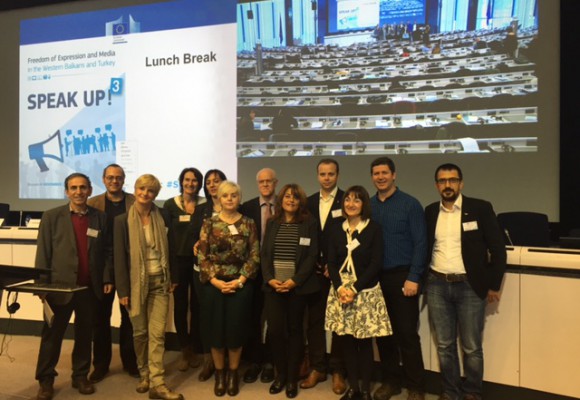
The European Federations of Journalists (EFJ) and its members from Bosnia-Herzegovina, Macedonia, Montenegro, Serbia and Turkey (in picture) spoke out against media violations in their countries and call for more actions in a conference held on 4 November in Brussels by the European Commission (DG NEAR) to highlight the media freedom situation and progress made in Western Balkans and Turkey. A high-level meeting, the “Speak Up conference on Freedom of Expression and Media in the Western Balkans and Turkey” was kicked off by the European Commissioner in charge of European Neighbourhood Policy & Enlargement Negotiations, Mr Johannes Hahn. Unfortunately, hardly any progress is echoed by…

Speak up! 3 conference: Freedom of expression in the Western Balkans and Turkey

The European Federation of Journalists, represented by its President Mogens Blicher Bjerregård and Director Renate Schroeder will participate in an international conference on freedom of expression in the Western Balkans and Turkey held today at the European Commission. The Speak Up! 3 conference will bring together journalists, media analysts, decision-makers from the enlargement countries, experts from international, regional and national organizations to discuss achievements and challenges to media freedom. The EFJ affiliates from Western Balkans and Turkey will also participate in the conference. The conference will be broadcast live. To follow the debate, you can also follow the Twitter hashtag #SpeakUp3. Here is the…

CoE Commissioner for Human Rights raises concerns over surveillance laws

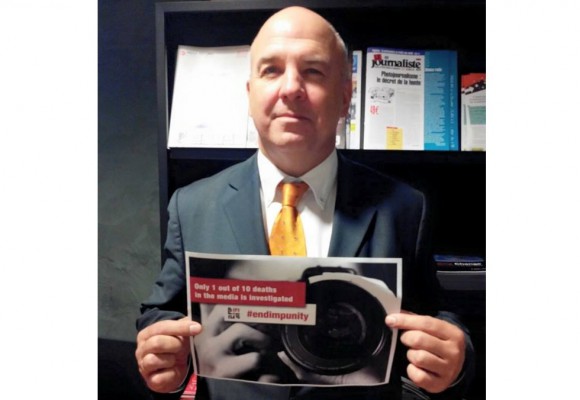
The Council of Europe (CoE) Commissioner for Human rights Nils Muižnieks visited the International and European Federations of Journalists (IFJ and EFJ) on 3 November in Brussels to exchange on the threat of surveillance laws to press freedom in Europe. Commissioner Muižnieks , accompanied by Deputy Director Giancarlo Cardinale and Stefano Montanari , met with the EFJ Secretary General Ricardo Gutiérrez , IFJ press officer Pamela Morinière together with human rights and safety head Ernest Sagaga. The Commissioner said he has been assessing the impact of surveillance laws on journalism in Europe and wanted to consult the two journalists’ organisations…

EFJ survey reveals precarious working conditions of journalists working for digital media in Europe

What kind of conditions, such as contracts or salaries are online journalists working under? Are they satisfied with their jobs? What needs to be improved and what role can the union play to enhance the working conditions of journalists in digital media? The European Federation of Journalists (EFJ) has launched a survey aiming to get a better overview of their working conditions and ways to protect their interests through unions/associations.The survey reveals a dangerous trend where many online journalists face precarious working conditions. Among the 231 respondents, 62% said they worked overtime and over 50% of them do not have a full-time employment…

Tirana: Who is protecting journalists? Conference on Journalists Labour Conditions in SEE

Within the framework of  the #seemediapartnership, the Center for Independent Journalism, Romania in cooperation with the Albanian Media Institute organised a regional conference on journalists’ employment conditions in South Eastern Europe in Tirana last week. Together with EFJ affiliates from Bosnia, Bulgaria, Montenegro and future members from Albania and Kosovo, participants discussed an action plan on how to improve the situation of journalists in the Balkan including capacity building of journalists’ organisations, Social dialogue, improved legal and labour protection for all journalists independent of their employment relation. Independent judiciary, rules on media concentration but also media education/media literacy and funding…

Italian journalists protest against gag law #nobavaglio

The European Federation of Journalists (EFJ) has joined its affiliate, the Journalists’ Union of Italy (FNSI) and a coalition of civil society organisations in Italy protesting against the new gag law that will hamper the rights of citizens to freedom of information. A press conference will be organised at the FNSI office tomorrow at 11 am, 3 November to launch the online petition ”No Bavaglio 3” (”No to Gag Law” in English). #nobavaglio The new law containing provisions that will impose sanctions and penalities on journalists and media organisations who published wiretapping materials for investigative journalism. Raffaele Lorusso, the General…

Webinar: Deeper perspectives on migration and asylum

It is always easy to report on migration and asylum issues as it requires journalists to be unbiased while still reflecting the human side of the story. If you are a journalist looking for inspiration for passionate journalism on the issue of migration, this online course will be useful for you to further your reporting on the issue. This online course is organised by the Germany based institution, torial academy. It aims to connect migration experts, researchers and journalists from Europe and Africa providing them information and pathways to quality resources. The course will consist of five live web-video-conference discussions. These will…